






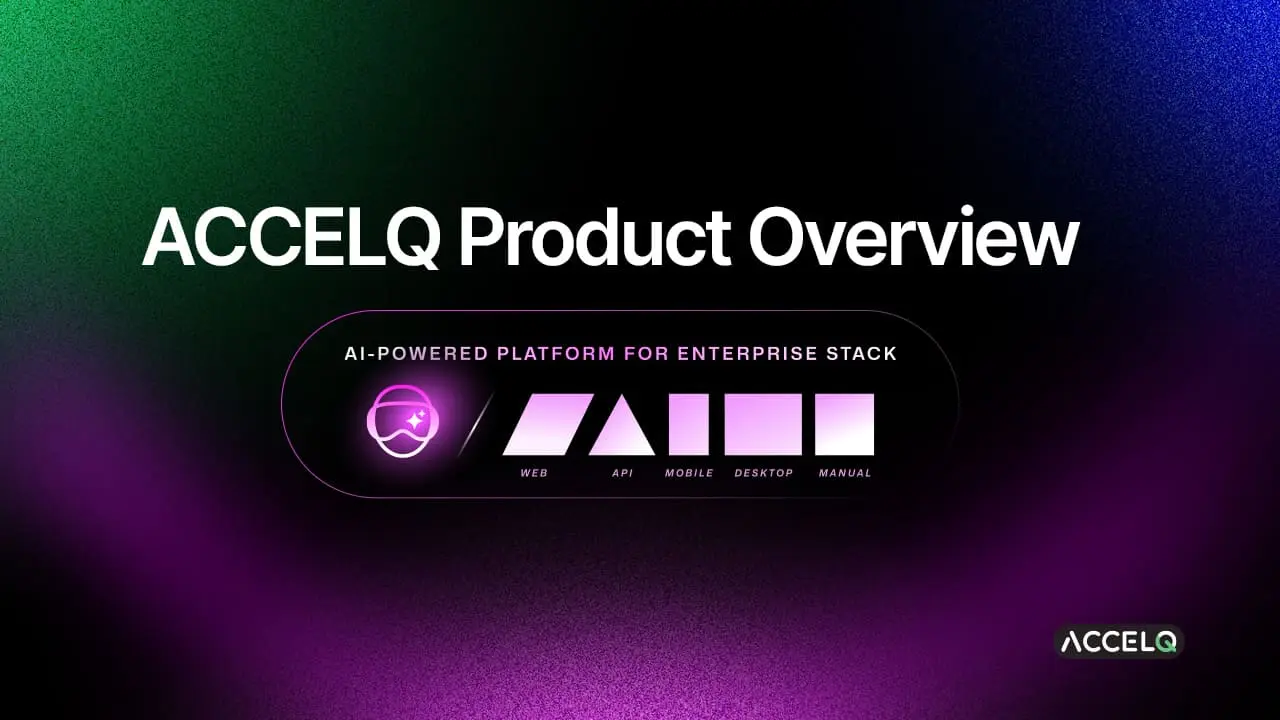
ACCELQ Product Overview: From Automation to Autonomous Quality Engineering

- Why Test Automation Needs a Rethink?
- What Is ACCELQ?
- ACCELQ Application Universe
- How Tests Are Created Without Scripts?
- Autonomous Test Generation with ACCELQ Autopilot
- Agentic Automation: How ACCELQ Uses AI Agents?
- Why the Agentic Model Matters?
- Change Intelligence and Self-Healing Automation
- CI/CD, DevOps, and Enterprise Integrations
- Sprint Visibility, Traceability, and Quality Insights
- Why ACCELQ Delivers Higher ROI?
- Conclusion
Why Test Automation Needs a Rethink?
Script-based test automation solved a real problem once. It doesn’t anymore.
Most teams today are stuck maintaining brittle scripts across multiple tools. Every application change triggers a wave of test failures. Maintenance effort keeps rising, while trust in automation keeps dropping.
At the same time, applications themselves have changed. UI, APIs, backend services, events, and data layers all move together. Testing them in isolation no longer reflects how systems actually behave.
What this really means is simple: automation needs to understand applications, not just interact with them. That shift has pushed the industry toward autonomous and AI-native quality engineering, where testing systems learn, adapt, and evolve alongside the application, an approach increasingly shaped by AI-native testing platforms.
This is the space where ACCELQ operates.
What Is ACCELQ? A Unified Autonomous Quality Engineering Platform
ACCELQ is an AI-native, cloud-based platform designed to automate the entire quality lifecycle without scripts or custom frameworks, supporting a broader shift toward autonomous quality engineering.
It supports testing across:
- Web and mobile applications
- APIs and services
- Databases and backend systems
- Packaged enterprise platforms such as Salesforce, SAP, and Oracle
This is the space where ACCELQ operates, driven by principles aligned with agentic automation in software testing. ACCELQ is built for Agile and DevOps teams working at enterprise scale. Instead of stitching together tools for design, execution, change handling, and reporting, teams work from a single system.
The unifying idea is straightforward: model the application once, then let automation scale from that foundation.
ACCELQ Application Universe: The Foundation of Business-Centric Automation
The Application Universe sits at the core of ACCELQ.
It is a structured blueprint of the application that captures:
- Pages and components
- Navigation paths and transitions
- API calls and backend interactions
- End-to-end business processes
Instead of treating automation as a collection of scripts, ACCELQ models how the application behaves from a business perspective, an approach rooted in business-centric test automation for Saas Application.
This matters because once the Universe exists:
- Every scenario becomes reusable
- Every page and step is modular
- Automation stays stable even as the application changes
Change resilience is not added later. It is built into the design.
From Universe to Automation: How Tests Are Created Without Scripts?
Automation in ACCELQ is scenario-driven, not script-driven, aligning closely with modern scriptless test automation practices.
Teams define end-to-end business scenarios using:
- Natural language intent
- Visual interaction modeling
- API, database, and backend validations
A single scenario can include UI actions, service calls, data checks, and conditional logic without switching tools or writing code.
Everything created inside the Application Universe is reusable by default. There is no need to build frameworks to manage modularity or maintenance. The platform handles it automatically.
The result is automation that mirrors real business flows instead of isolated test steps.
From Discovery to Execution in a Single Click!
Step into Future-Ready Testing Today
Autonomous Test Generation with ACCELQ Autopilot
ACCELQ Autopilot extends automation beyond manual design.
From a single business scenario, Autopilot can automatically generate:
- Multiple test variations
- Data-driven permutations and combinations
- Coverage aligned to business rules and conditions
This removes the overhead of manually creating and maintaining large test case libraries, a benefit increasingly enabled by generative AI in software testing.
What this really means is that test coverage grows without increasing manual effort. Teams focus on defining intent and validating outcomes, not assembling test cases by hand.
Agentic Automation: How ACCELQ Uses AI Agents?
ACCELQ Autopilot is built on an agentic architecture, where multiple AI agents work together, each with a clearly defined responsibility, reflecting the rise of AI in software testing. This separation keeps automation explainable, predictable, and scalable.
Discovery Agent: Building Application Intelligence
The Discovery Agent establishes context. It learns how the application works by analyzing screens, flows, APIs, and supporting artifacts such as requirements or ALM metadata.
Its role is not to generate tests, but to answer a more fundamental question:
What does this application do, and how do its parts relate to each other?
This shared understanding becomes the foundation for all automation decisions.
Automation Agent: Producing Executable Logic
The Automation Agent translates structured intent into executable automation logic aligned with the application model.
It works at the level of actions, decisions, and outcomes rather than scripts or locators. UI, API, and backend steps are composed into coherent flows that reflect actual system behavior.
The focus here is correctness and alignment, not just speed.
Analyzer Agent: Learning and Optimization
The Analyzer Agent evaluates execution outcomes and patterns over time.
It identifies trends in failures, highlights areas where coverage may be thin, and surfaces signals that help teams refine their automation strategy. This agent doesn’t replace human judgment. It supports better decisions by making patterns visible.
Why the Agentic Model Matters?
By separating understanding, generation, and analysis into distinct agents, ACCELQ avoids opaque, one-size-fits-all automation.
The system remains adaptable without becoming unpredictable. Automation evolves alongside the application instead of collapsing under maintenance pressure.
Do more with Test Automation
Discover more ways to add ‘low-code no-code‘ test automation in your workflows
Built-In Change Intelligence and Self-Healing Automation
Applications change constantly. ACCELQ is designed around that reality.
Because automation is tied to the Application Universe, ACCELQ understands dependencies between:
- Pages and scenarios
- Tests and validations
- UI elements and backend logic
When changes occur, the platform performs automated impact analysis to identify what is affected.
At runtime, autonomous element healing allows tests to recover from unexpected UI changes without manual intervention.
The outcome is straightforward: less rework, fewer false failures, and stable automation across releases.
CI/CD, DevOps, and Enterprise Integrations
ACCELQ integrates natively with:
- CI/CD pipelines
- Jira and Azure DevOps
- Git-based source control
- Cloud execution environments
Tests can be triggered as part of build, release, or deployment workflows and executed at scale.
Automation is aligned to release cycles from the start, not forced into pipelines later, an essential requirement for a scalable CI/CD pipeline.
Sprint Visibility, Traceability, and Quality Insights
ACCELQ provides visibility into:
- Test coverage across sprints
- Execution health and trends
- Change impact between releases
- Business risk associated with test outcomes
This allows teams to move beyond pass-or-fail metrics and understand how quality evolves sprint by sprint.
Testing becomes a measurable contributor to delivery decisions, not just a checkpoint.
Why ACCELQ Delivers Higher ROI Than Traditional Automation?
The ROI from ACCELQ comes from removing waste, not just running tests faster.
Teams typically see:
- Lower maintenance effort
- Faster test creation and updates
- Reduced dependency on specialized scripting skills
At the same time, they gain broader coverage and higher confidence in releases.
Scalability comes from platform design, not from maintaining larger frameworks.
📈 Accelerate Your Testing ROI
Leverage AI-powered automation to reduce testing time by 70%.
Conclusion: Moving from Automation to Autonomous Quality Engineering
Test automation is no longer about how fast scripts can be written or how many tools can be connected. That model breaks down as applications grow more complex and change more often.
What teams need is a testing system that understands how an application works, adapts as it evolves, and scales without adding maintenance overhead. That is the shift from automation to autonomous quality engineering.
ACCELQ is built around this idea. By modeling applications as business systems, generating automation from intent, and handling change intelligently, it replaces fragile scripts with something more durable.
The result is not just better test execution, but a quality foundation that supports continuous delivery, reduces time, and keeps pace with modern software development.



Guljeet Nagpaul
Chief Product Officer at ACCELQ
Guljeet, an experienced leader, served as North America's head for ALM at Mercury Interactive, leading to its acquisition by HP. He played a key role in expanding the ALM portfolio with significant acquisitions. Now at ACCELQ, he sees it as a game-changer in Continuous Testing. As Carnegie Mellon graduate, he oversees ACCELQ's Product Strategy and Marketing.


You Might Also Like:
 Top 7 Pega Testing Tools in 2026
Top 7 Pega Testing Tools in 2026
 Reimagine ServiceNow Testing with AI-Powered Codeless Automation
Reimagine ServiceNow Testing with AI-Powered Codeless Automation
 SAP Testing: Best Practices, Types, and Automation Guide for 2026