








How AI-Based Agentic Automation Differs from Traditional Automation Testing

A QA lead at a mid-size SaaS company ships a release on Friday. By Monday, a vendor pushed a UI update, three test suites are red, and the team spends the first two days of the sprint fixing scripts instead of testing the new feature. This is the exact failure mode agentic automation was built to remove, not by writing better scripts, but by removing the need to maintain scripts at all.
Traditional automation executes what you tell it to. Agentic automation decides what to do next. That distinction, small as it sounds, is the difference between a tool that breaks every time your application changes and a system that adapts to the change on its own.
- What Is Agentic Automation?
- How Is Agentic AI Different from Traditional Automation?
- Agentic AI and Architecture
- Key Capabilities of Agentic Test Automation
- What Are Some Real-World Examples of Agentic AI?
- What Are the Top Tools and Platforms for Agentic AI?
- How Does ACCELQ Autopilot Approach Agentic Automation?
- How Can I Build or Develop an Agentic AI System?
- How Do You Test Agentic AI Systems?
- Why Do Businesses Need to Adopt Agentic Automation Now?
- Conclusion: Why Agentic Automation Is the Future
Agentic automation is changing how enterprises approach software testing. Traditional automation depends on fixed scripts that break when applications change, forcing teams to spend time maintaining tests instead of improving coverage. AI-driven agentic systems understand business intent, adapt to application behavior, and continuously optimize testing workflows across complex enterprise environments.
- Understand Agentic Automation’s Three Core Shifts: Intent-based test creation replaces step-by-step scripting, autonomous healing reduces maintenance effort when applications change, and predictive intelligence helps teams identify risks before failures reach production.
- Evaluate Platforms by the Problem They Solve: Test generation speed alone is not enough. Enterprise teams need to assess application coverage, self-healing capabilities, CI/CD integration, governance, traceability, and the ability to scale across web, API, mobile, desktop, and packaged applications.
- Match the Platform to the Quality Challenge: AI-assisted tools can accelerate individual testing tasks, but enterprise agentic platforms like ACCELQ provide end-to-end autonomous testing with AI-driven discovery, test generation, optimization, analysis, and maintenance across complex application landscapes.
What Is Agentic Automation?
Agentic automation is an approach where AI-driven agents plan, execute, and adjust their own actions toward a goal, instead of following a fixed, pre-written script. Give the system an objective, such as “verify a returning user can complete checkout,” and the agent interprets that intent, decides which steps are needed, carries them out, and adapts when the application changes underneath it.
This is a meaningfully different model from agentic process automation, a broader term describing AI agents that plan and execute multi-step business processes generally, of which agentic automation in testing is one specific, high-value application. Unlike conventional test frameworks that depend on manual oversight and fixed scripts, agentic automation works autonomously, making context-aware decisions based on real application behavior rather than a static instruction list.
Three traits define agentic automation, and none of them describe traditional scripting:
- Intent over instructions: You describe an outcome, not a sequence of clicks.
- Self-healing and self-learning: The system adapts when the UI or workflow changes, instead of failing and waiting for a human fix.
- Predictive, not reactive: It flags likely failure points before they hit production, using patterns from past runs.
How Is Agentic AI Different from Traditional Automation?
Traditional automation, including RPA, executes fixed workflows exactly as scripted, with no understanding of intent. Agentic RPA and agentic AI, by contrast, use machine learning and large language models to read patterns, adapt to changing environments, and adjust strategy without a human rewriting the workflow.
| Traditional Automation | Agentic AI Automation |
|---|---|
| Script-based and rigid | Context-aware and adaptive |
| Manual maintenance required | Self-healing and self-learning |
| Reactive issue resolution | Predictive and proactive |
| Fixed workflows | Dynamic, data-driven workflows |
| Breaks on UI or process change | Adjusts automatically to change |
The practical result: traditional automation is reactive by design; it only knows something broke after it breaks. Agentic AI is self-directed and adaptive, capable of continuous learning from every run instead of waiting for a person to update the script.

Agentic AI Architecture: How the Core Layers Work Together
None of this adaptability happens by accident. It runs on a specific architecture:
- Perception: Reads and understands the current state of the application.
- Reasoning: Decides what to do next using an LLM or ML model.
- Action: Executes the required step.
- Memory: Retains the context and results to inform the next decision.
Each of those layers has to work together for an agent to behave reliably instead of unpredictably.
Going deep on that architecture is its own topic. For the full breakdown of how these layers fit together and the design patterns behind them, see our dedicated guide to agentic AI architecture.
Key Capabilities of Agentic Test Automation for Modern QA Teams
Agentic automation is reshaping QA by combining agentic process automation, agentic AI, and agentic workflows into self-healing, self-learning, autonomous test systems. Here is what that looks like in the parts of the QA cycle where it actually moves the needle.
1. AI-Powered Self-Healing for Autonomous Test Maintenance
Test maintenance is the single biggest cost in traditional automation. A small UI change or code update can silently break dozens of scripts, and someone has to notice, diagnose, and fix each one. Agentic automation tools solve this with self-healing capabilities: the AI detects UI or logic changes and updates the affected test steps automatically, keeping execution reliable without manual intervention.
2. Risk-Based Test Prioritization for Faster Regression Testing
Not every test case carries equal risk. Instead of running everything indiscriminately, agentic process automation prioritizes tests using past failure data, risk scoring, and impact analysis, so the functionality most likely to break gets tested first. That shortens feedback loops without cutting coverage.
3. Predictive Analytics for Early Defect Detection
Traditional testing is reactive by nature: a defect is found after it happens. Agentic automation flips that by analyzing historical test data and production logs to forecast which areas of the codebase are defect-prone, before the defect ships. QA teams get to act on a prediction instead of a postmortem.
4. Intelligent Cross-Platform Test Coverage Optimization
Guaranteeing consistent behavior across Chrome, Safari, Edge, and mobile devices is a genuinely hard coverage problem. Agentic workflow automation optimizes this by intelligently selecting the most effective test configurations, keeping coverage thorough while eliminating redundant runs that just burn compute and time.
5. Intelligent Cross-Platform Test Coverage Optimization
Modern DevOps depends on testing that keeps pace with every commit. Agentic process automation integrates directly with Jenkins, GitHub Actions, GitLab, and Azure DevOps, enabling continuous testing at every stage of the pipeline rather than a single pre-release gate. That shortens the path from commit to confident deploy.
6. Autonomous Test Path and Edge Case Discovery
Most coverage gaps do not come from bad testing; they come from paths nobody thought to test. Agentic automation agents explore the application on their own, mapping untested flows and edge cases instead of waiting for a human to enumerate every scenario by hand. Coverage grows with the application instead of lagging a sprint behind it.
7. Automated Root-Cause Failure Analysis
A red test tells you something broke; it does not tell you why. For failures that trace back to the application itself, agentic systems isolate the root cause in seconds, whether that is a genuine logic regression, a timing issue in the app’s own behavior, or a downstream service dependency, cutting the manual triage that normally eats the first hour after a failed run.
8. Environment and Test Data Issue Detection
A red test tells you something broke; it does not tell you why. For failures that trace back to the application itself, agentic systems isolate the root cause in seconds, whether that is a genuine logic regression, a timing issue in the app’s own behavior, or a downstream service dependency, cutting the manual triage that normally eats the first hour after a failed run.
9. Evidence-Based Release Readiness Assessment
Deciding whether a build is safe to ship usually means a QA lead manually rolling up pass/fail counts across suites. Agentic automation consolidates results, risk scores, and failure patterns into a single go/no-go signal backed by evidence, replacing a judgment call with a defensible one.
10. Continuous Regression Suite Curation
Risk-based prioritization decides what order existing tests run in; it does not decide what belongs in the suite in the first place. As the application changes, agentic automation updates the regression suite itself, adding coverage for new functionality and retiring tests that no longer reflect real usage, so the suite stays relevant instead of just growing.
11. API Contract Break Detection
Breaking API and schema changes often surface first as confusing UI failures, long after the actual cause. Agentic automation inspects contracts directly and flags breaking changes at the API layer before they cascade downstream, catching the problem closer to its source.
12. Accessibility Gap Detection
Accessibility testing is usually a separate audit pass, run late and often skipped under deadline pressure. Agentic automation surfaces accessibility gaps as a byproduct of tests that are already running, giving teams a continuous accessibility signal instead of a once-a-quarter scramble.
SUGGESTED READ - LLMs in Software Testing
What Are Some Real-World Examples of Agentic AI Orchestration in Use?
Orchestration is where agentic automation earns its name: multiple specialized agents, each with a defined job, coordinating toward a shared outcome instead of one monolithic script trying to do everything. A concrete example makes this easier to picture than any abstract definition.
Inside the ACCELQ platform architecture, seven specialized agents run the entire test lifecycle end-to-end, from mapping a system’s structure to generating the data behind every test it executes.
The Universe Discovery Agent goes first, scanning applications, APIs, and metadata to build a semantic knowledge graph, a reusable automation foundation the rest of the agents work from.
The DRY Agent takes that foundation and rebuilds what would otherwise be script-heavy, linear test logic into a modular, componentized architecture, abstracting out shared validation logic and reusable building blocks.
The Automate Agent then converts that structured understanding into executable automation across web, API, mobile, desktop, and backend systems.
The Change Analyzer Agent keeps it running: it continuously tracks changes across UI, schemas, APIs, and workflows, then heals locators and remaps affected logic on its own when the application shifts underneath it.
The Execution Agent decides what runs and when, selecting tests dynamically based on business risk, recent code changes, and historical failure patterns rather than running a static suite indiscriminately.
The Analyzer Agent takes it from there, tracing failures back to root cause and distinguishing genuine product defects from environmental noise.
Finally, the Data & Config Agent closes the loop, generating synthetic, production-like test data and masking sensitive fields so every test runs against realistic data without a compliance trade-off.
That seven-agent handoff, discover, design, automate, heal, execute, analyze, supply data, is the same orchestration pattern showing up across the industry in 2026, from customer service agents that triage and resolve tickets without a human in the loop, to supply chain agents that replan logistics when a shipment is delayed, to finance agents that reconcile transactions and flag anomalies automatically. In every case, the pattern is identical: no single agent tries to do everything, each has a defined scope, and a shared context layer keeps their outputs coherent.
What Are the Top Tools and Platforms for Implementing Agentic AI?
The table below compares the platforms teams evaluate for agentic AI automation in testing, and where each is actually built to reach. For a deeper breakdown across ten tools, see our full AI testing tools comparison.
Most of these platforms are strong at agent-driven execution inside a single web application. Where they diverge is reach. ACCELQ’s agentic architecture is built to carry that same intent-first model across packaged enterprise applications and custom code in one connected platform, a layer most agentic automation tools stop short of.
 Also Read: Discover How ACCELQ is a better alternative
How Does ACCELQ Autopilot Approach Agentic Automation?
ACCELQ Autopilot is a full implementation of ACCELQ agentic automation that goes well beyond basic script generation. It offers an interconnected suite of AI capabilities that work together to transform how teams create, maintain, and scale test automation:
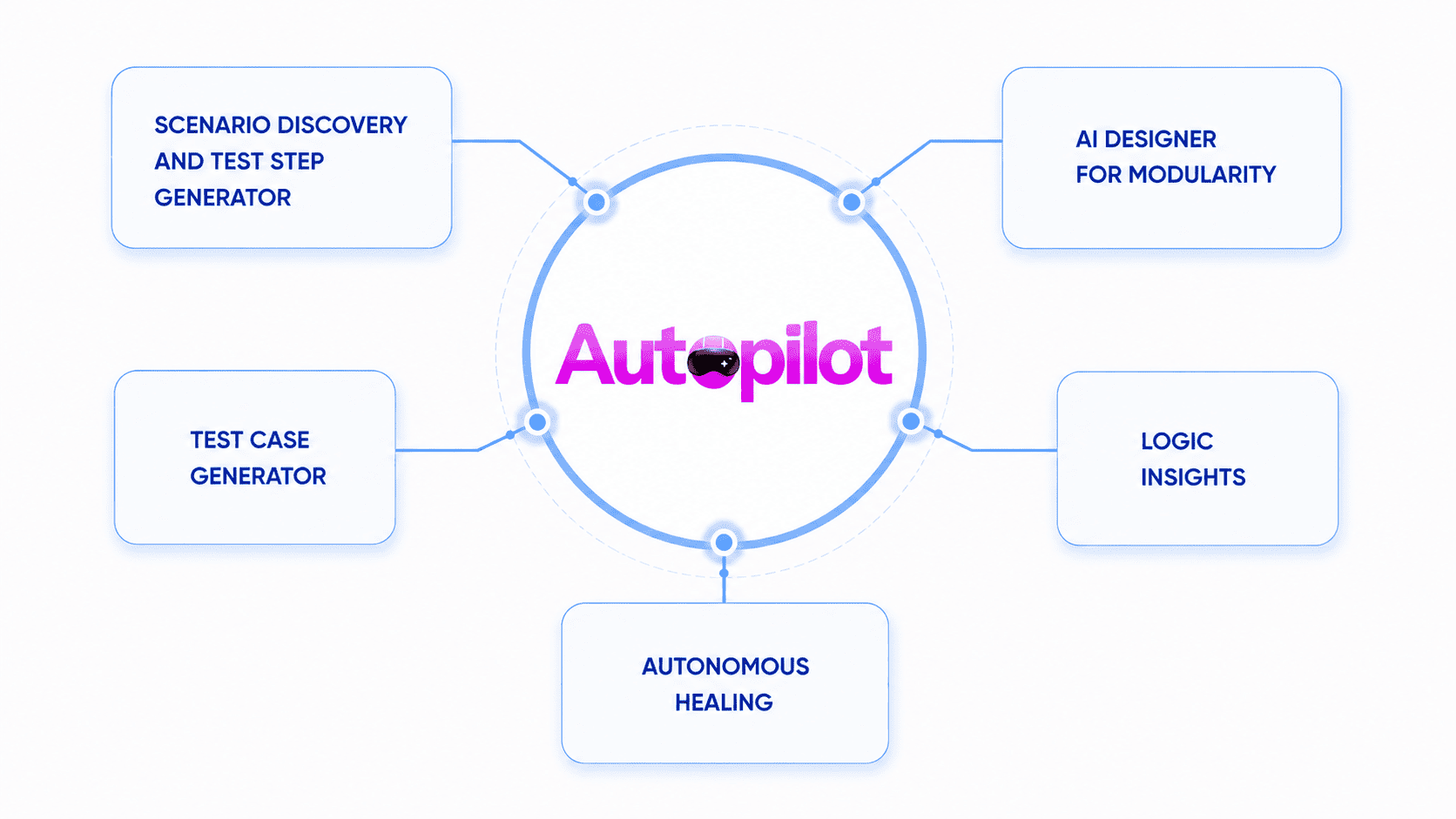
- Scenario Discovery and Test Step Generator automatically creates comprehensive test scenarios and detailed steps from plain business descriptions, covering both UI and API testing needs.
- AI Designer for Modularity structures tests into reusable, maintainable components instead of isolated, one-off scripts.
- Test Case Generator creates diverse test combinations covering multiple business scenarios and populates relevant test data automatically.
- Logic Insights provides contextual optimization suggestions, embedding years of test architecture expertise directly into the tool.
- Autonomous Healing adapts to application changes automatically, including complex modifications like element type changes, with AI-augmented troubleshooting support.
This makes Autopilot a strong candidate for enterprises exploring agentic AI testing tools who want the model to hold up under real-world complexity, not just a clean demo. The system enforces best practices around reusability, maintainability, and reliability that would otherwise take years of hands-on experience to internalize.
The immediate value is faster test creation. The longer-term value is what most agentic automation content skips over entirely: test maintenance, scalability, and adaptation to change are handled by the same governed system, not bolted on separately.
How Can I Build or Develop an Agentic AI System?
If you are evaluating whether to build a custom agentic system rather than adopt a platform, the architecture holds regardless of use case. Four components have to work together:
-
A perception layer that reads the current state of the environment, whether that is a UI, an API response, or a database record.
-
A reasoning layer, almost always an agentic AI LLM, that interprets intent, plans the next action, and decides when a goal has actually been met.
-
An action layer that executes the plan, whether that means clicking through a UI, calling an API, or triggering a downstream workflow.
-
A memory layer that retains context across steps and runs, so the agent improves rather than repeating the same mistakes.
Building agentic AI from scratch means owning all four layers, plus the evaluation harness to prove the agent behaves reliably before it touches production data. That is a meaningful engineering investment, which is exactly why most QA and RPA teams start with a platform that has already solved perception, reasoning, action, and memory for their specific domain, and focus their own effort on defining intent and validating outcomes instead of rebuilding the agent runtime.
How Do You Test Agentic AI Systems?
Testing an agentic system is different from testing a deterministic one, because the same input will not always produce the exact same output. A continuous validation loop is required:
- Benchmark the AI agent’s decision accuracy against a known-good baseline.
- Monitor for model drift and retrain when performance declines.
- Assess explainability for every automated decision, not just the successful ones.
- Verify that testing outcomes stay aligned with defined business goals, not just technical pass or fail.
This loop is what keeps agentic AI process automation reliable and auditable in production, rather than a black box that happens to work most of the time.
Why Do Businesses Need to Adopt Agentic Automation Now?
Gartner named agentic AI one of the top technology trends for 2025, and the trajectory has only accelerated since. Gartner predicts that by 2028, 33 percent of enterprise software applications will include agentic AI, up from less than 1 percent in 2024, with at least 15 percent of day-to-day work decisions made autonomously. That is not a distant forecast. It is a shift already underway inside engineering organizations adopting agentic testing frameworks in their CI/CD pipelines today.
Organizations adopting agentic process automation over robotic process automation are already reporting real gains: less time spent on test maintenance thanks to AI-powered self-healing, fewer defects reaching production thanks to predictive detection, and broader coverage across devices and platforms without a proportional increase in headcount. Businesses that delay risk falling behind on speed, agility, and release quality, not eventually, but within the next few release cycles.
Conclusion: Why Agentic Automation Is the Future of Software Testing
Agentic AI is not another automation trend. It is the natural next step after script-based testing hits its ceiling, and most QA teams have already felt that ceiling firsthand.
Instead of chasing broken scripts or maintaining outdated frameworks, QA teams get to spend their time on strategy, coverage, and business impact. Self-learning, predictive detection, and autonomous execution work together so teams ship faster with less human-dependent maintenance standing in the way.
The bottom line: the future of QA belongs to systems that understand what they are testing, not just execute what they are told. Agentic process automation is how teams get there, and the cost of waiting compounds with every release.
Connect with our experts to see agentic automation applied to your own test suite.
FAQ's
Is agentic automation the same as RPA?
No. Robotic process automation (RPA) executes fixed, pre-scripted workflows and breaks when the underlying application changes. Agentic automation, including agentic RPA, uses AI agents that interpret intent, adapt to change, and make context-aware decisions without a human rewriting the workflow.
Does agentic automation replace QA engineers?
No. Agentic automation removes the manual work of writing and maintaining scripts, but QA engineers still define intent, validate outcomes, and handle the edge cases and business logic decisions that require human judgment.
How is agentic automation different from AI-assisted testing?
AI-assisted testing typically speeds up a single task, such as generating a test case from a prompt, but still relies on a human or a fixed script for execution and maintenance. Agentic automation plans, executes, and adapts its own actions across the full test lifecycle without that fixed script.
How long does it typically take to move from traditional to agentic test automation?
Most teams don't do a full-suite cutover. A realistic path starts with one high-maintenance test suite, the one eating the most engineering hours on script fixes, migrated over a sprint or two, with results validated against the existing suite before expanding coverage. Full-scale migration timelines vary by application complexity and existing test debt.
Do agentic testing tools work with existing CI/CD pipelines, or do they require a separate workflow?
They're built to integrate directly, not replace the pipeline. Agentic platforms plug into the same triggers (Jenkins, GitHub Actions, GitLab, Azure DevOps) already gating a release, adding autonomous test generation and healing inside that existing pipeline rather than requiring a parallel process.



Nishan Joseph
VP Sales Engineering
Nishan is a tech strategist with expertise in Test Automation and roles at giants like TCS, Microfocus, and Parasoft. At ACCELQ, he champions Strategic Alliances, cultivating global tech partnerships. Educated at Leeds University and Symbiosis Pune, he also possesses an engineering background from Bangalore.


You Might Also Like:
 AI Agent for Defect Prediction: Is Your QA Strategy Future-Ready?
AI Agent for Defect Prediction: Is Your QA Strategy Future-Ready?
 AI Agents in Testing: Smarter Automation Beyond Chatbots & Assistants
AI Agents in Testing: Smarter Automation Beyond Chatbots & Assistants
 Supercharge Testing with AI: Automate & Accelerate Efficiency