







Best Playwright Alternatives in 2026 (By the Reason You’re Actually Leaving)
Switching from Playwright rarely solves the actual problem, because teams pick a new framework instead of diagnosing which of three separate failures they’re hitting: locator maintenance, coverage that stops at the browser, or a QA team that isn’t all engineers. Move to Cypress or Selenium and the same maintenance cycle continues under a different syntax.
- Diagnose the Real Problem: Teams leave Playwright over locator re-work after every redesign, a roadmap reaching SAP, Oracle, or Salesforce that Playwright was never built to touch, or a non-technical QA analyst locked out of a code-only suite.
- Match the Fix to the Gap: Mabl’s auto-healing closes the locator-maintenance gap while staying close to code; testRigor gives non-technical testers plain-English ownership; Selenium, Cypress, and WebdriverIO solve narrower scripting complaints (language range, debugging experience, mobile reach) without touching the root problem.
- Consider a Unified Platform When Problems Stack: ACCELQ removes locators entirely, reading application structure instead, and natively covers SAP, Oracle Cloud, Salesforce, and ServiceNow alongside web, API, and mobile, solving coverage and maintenance together rather than patching Playwright twice.
Why You’re Reading This
An engineer on your team just lost most of a sprint re-pointing 40 broken locators after a routine UI redesign, the fourth time this quarter. The QA analyst who knows the product cold can’t touch the suite, because none of it is written in a language she knows. Next quarter’s roadmap adds a Salesforce integration Playwright was never built to reach, and someone above you wants a plan before the sprint review, not a rewrite six months from now that just relocates the same problem.
There’s no single best Playwright alternative. There’s a best one for your specific breaking point. Teams drowning in locator maintenance want self-healing platforms. Teams blocked on non-technical ownership want codeless authoring. Teams hitting Salesforce, mobile, or API gaps need coverage Playwright doesn’t attempt. This guide sorts tools by which failure you’re solving, not by feature checklist.
Playwright automated testing does what it says on the box. Chromium, Firefox, and WebKit all run through one Playwright browser API, auto-waiting is genuinely good, and the developer experience beats Selenium’s. That’s not the complaint. The complaint is what Playwright was never designed to solve: locator maintenance, non-technical ownership, and coverage that stops at the browser.
So instead of another flat list of six tools with the same pros-and-cons format, this breaks down by the actual reason people go looking for a Playwright alternative. Find your reason, skip to that section.
| If you’re leaving Playwright because of… | Your route |
|---|---|
| A roadmap that includes SAP, Oracle, or Salesforce | Route 1: Beyond the Browser |
| Locators breaking every release, but your team still wants to stay close to code | Route 2: Stop Re-Fixing Locators |
| A QA team that isn’t all engineers | Route 3: Non-Technical Ownership |
| Nothing wrong with scripting itself, just want a different flavor of it | Route 4: Staying Scripted, Just Better |
Route 1: Beyond the Browser
Playwright wasn’t built to reach SAP, Oracle Cloud, or Salesforce, and no amount of custom scripting changes that. If the CTO’s roadmap includes a packaged enterprise application, staying in the Playwright ecosystem means bolting on a second tool anyway. The question is whether you do that now, deliberately, or in six months, under pressure.
The Tool: ACCELQ
ACCELQ doesn’t generate locators at all. Its AI engine reads application structure and updates tests when elements move or rename, removing the maintenance cycle Playwright creates by design. It’s also the only platform in this comparison with native support for SAP, Oracle Cloud, Salesforce, and ServiceNow, not web wrappers, not custom connectors, sitting in the same environment as web, API, and mobile.
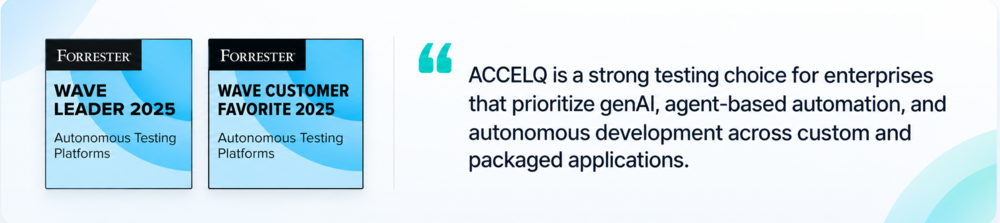
Reported outcomes from teams making this switch: 7.5 times faster automation, 72 percent lower maintenance, and a 53 percent cost reduction.
See the full Playwright vs ACCELQ comparison for a side-by-side breakdown, or go straight to how ACCELQ handles SAP test automation or Salesforce test automation if one of those is the specific gap on your roadmap.
Route 2: Stop Re-Fixing Locators
If the actual complaint is “we write good Playwright tests, we just spend every release re-fixing the ones the redesign broke,” the fix isn’t a different scripting syntax. Cypress and Selenium have the identical failure mode. They just break in a different dialect.
The Tool: Mabl
Mabl sits between a scripted framework and a codeless platform. When a UI element changes between releases, its auto-healing detects the change and updates the test reference without pulling an engineer into a locator repair session. Visual regression detection catches layout breaks alongside functional ones, and it slots into an existing Continuous Integration and Continuous Delivery (CI/CD) pipeline without new infrastructure.
If you want to see how far the self-healing model can go past what Mabl offers, self-healing test automation breaks down the mechanics and where a fully codeless approach picks up the rest.
Route 3: Non-Technical Ownership
Playwright requires JavaScript, TypeScript, Python, .NET, or Java. That’s a hard requirement, not a soft preference, and it’s the reason a QA analyst who understands the product better than anyone on the team still can’t touch the suite.
The Tool: testRigor
A tester writes “click the login button, enter the username and password, verify the dashboard loads,” and testRigor executes it. No locators, no code. When that button gets redesigned three months later, the plain-English description stays valid, because it was never anchored to an HTML element in the first place.
testRigor isn’t the only tool built on this idea. Scriptless test automation covers the same “no locators, plain language” model from a codeless-platform angle, worth a look if non-technical ownership is only part of what you need.
Route 4: Staying Scripted, Just Better
Nothing here says Playwright’s core model is wrong. If your team is developer-led, comfortable in code, and the complaint is narrower (a language Playwright doesn’t support, a debugging experience that’s slower than it should be, or mobile coverage Playwright’s plugin ecosystem doesn’t reach), three different tools solve three different versions of that complaint. Pick the one that matches your actual gap.
If the gap is language range: Selenium Selenium supports Java, Python, C#, Ruby, JavaScript, and Kotlin against Playwright’s five, so a team inheriting an existing 400-test Java suite gets a drop-in alternative instead of a rewrite project. The cost: no built-in test runner, assertions, or reporting, browser driver management is a recurring task, and locator maintenance is fully manual. Selenium doesn’t touch the root problem either.
If the gap is developer experience: Cypress Developers write passing tests within an hour. The in-browser time-travel debugger shows exactly what the application looked like at each step, and async waits are handled automatically. The trade-off is real coverage: Cypress runs Chrome primarily, Safari support lags Playwright’s, and multi-tab testing isn’t supported.

Where a QA Partner Fits
Picking a route closes the tooling gap. The testing process around it still needs owners: someone to decide what gets covered, keep regression suites current, and fit test runs into every release.
ACCELQ handles much of that inside the platform. Its AI agents generate test scenarios from your application and heal tests when the UI changes. They run web, API, mobile, and packaged-app tests for Salesforce, SAP, and Oracle in one flow. That cuts the maintenance load that pushes teams off Playwright in the first place, especially when test maintenance becomes harder to scale.
Some teams still need extra hands during a migration or a period of fast growth. A QA partner can plan test coverage, move existing Playwright or Selenium suites to a new platform, run manual and regression testing, and train internal teams to own automation after handover. ThinkSys is one example. This helps most when an internal team is short on time or testers, or when the product is growing faster than the QA team.
The platform and the partner cover different layers. ACCELQ’s agents carry the automation, and a partner adds the people and process that keep it running release after release.
The Anxiety Matrix
A Different Question: Playwright MCP Alternatives
If you landed here searching “MCP Playwright” or “Playwright MCP alternatives,” you’re asking about a different product entirely. Playwright MCP is Microsoft’s Model Context Protocol server that lets AI agents, including Claude, Cursor, and Windsurf, control a browser using Playwright’s engine underneath. It’s built for agentic workflows, not QA regression suites, and none of the six tools above are relevant to this question.
The complaint driving these searches is token cost: a single navigation call can return a large accessibility snapshot, and that adds up fast across a multi-step agent session. Microsoft’s own newer Playwright CLI, launched in early 2026, addresses this directly by saving snapshots to disk instead of streaming them into context, for roughly a 4x token reduction on a typical task, per the Playwright team’s own benchmarks. Stagehand takes a different approach, focused on self-healing agent automation rather than raw browser control, and Chrome DevTools MCP offers a comparable snapshot approach through a different engine.
If the actual need is agentic browser control for AI coding tools, evaluate that landscape on its own terms. It has nothing to do with the test-automation decision above.
SUGGESTED READ - How to Get Started with ACCELQ – A Comprehensive Guide
Which Route Is Actually Yours
Six months after switching from Playwright to Cypress, plenty of teams report the same maintenance problem, just spelled differently. The framework changed. The reason they left didn’t get solved.
Locators, coverage, and staffing are three separate problems, and no single tool fixes all three by accident. If yours is locator maintenance without wanting to leave code, Route 1 is the shortest path. If it’s coverage past the browser, that’s Route 2, and it’s worth solving once rather than twice. If it’s staffing, a team that isn’t all engineers, that’s Route 3. If none of those apply and you just want a better version of scripting, Route 4 has three separate answers depending on which gap you’re actually closing.
FAQ's
What are the best alternatives to Playwright in 2026?
ACCELQ leads for codeless enterprise automation across SAP, Oracle, and Salesforce. Cypress fits JS/TS teams wanting simpler debugging. Selenium fits multi-language teams and existing suites. Mabl fits AI-driven CI/CD testing. testRigor fits non-technical QA staff. WebdriverIO fits Node.js teams needing Appium mobile coverage.
Is Playwright better than Cypress?
For cross-browser coverage, multi-tab testing, and language range, Playwright wins. For developer experience and debugging speed, Cypress wins. Neither solves test maintenance, both break the same way when locators change.
Which is better, Selenium or Playwright?
Playwright for a team starting a new suite today. Selenium for a team protecting an existing multi-language suite, since it supports six languages against Playwright's five. Neither addresses the underlying maintenance cycle.
What is Playwright MCP, and is it the same as Playwright test automation?
No. Playwright MCP is Microsoft's Model Context Protocol server for AI agents to control a browser, built for agentic workflows rather than QA testing. Playwright itself is the scripted test framework covered throughout this guide.
What is the best Playwright alternative for less maintenance?
ACCELQ and testRigor remove the root cause rather than a symptom of it: neither anchors tests to HTML locators, so UI changes don't break them the way they break Playwright, Cypress, or Selenium tests.
When should you NOT switch from Playwright?
If your team writes JavaScript or TypeScript, your suite sits under 500 tests, and cross-browser web coverage with multi-tab support is the primary need, Playwright handles this well. Evaluate alternatives once maintenance exceeds 20 percent of QA time or packaged enterprise apps enter scope.



Geosley Andrades
Director, Product Evangelist at ACCELQ
Geosley is a Test Automation Evangelist and Community builder at ACCELQ. Being passionate about continuous learning, Geosley helps ACCELQ with innovative solutions to transform test automation to be simpler, more reliable, and sustainable for the real world.


You Might Also Like:
 How Automated Testing Accelerates the Path to Digital Transformation
How Automated Testing Accelerates the Path to Digital Transformation
 A Beginner’s Guide to Cross-Browser and Cross-Platform Testing
A Beginner’s Guide to Cross-Browser and Cross-Platform Testing
 NLP Test Automation: Shaping the Future of Software Testing