








AI for Regression Testing: Sharper Coverage, Faster Delivery

Release cycles keep getting shorter. Business demands keep growing. And traditional regression testing just wasn’t built for that pace. Testing every function by hand, or running a massive automated suite top to bottom, burns time where teams don’t have much time, which shows up later as delayed releases and rising costs. It’s part of why regression testing and machine learning have become such an active pairing in QA circles lately.
AI for regression testing takes a different angle. It looks at what really changed, figures out which business-critical areas that change touches, and makes sure those get tested initially. Instead of grinding through thousands of tests regardless of whether they’re relevant, teams in the high-risk spots get sharper coverage and ship faster without cutting quality. This isn’t a minor tweak to the old process. It’s a unique way of thinking about how QA keeps up with DevOps.
- The Problem with Traditional Regression Testing
- What is AI-Prioritized Regression Testing
- AI-Prioritized Regression Testing for Enterprise & ERP Ecosystems
- AI-Prioritized Regression Testing's Main Advantages
- How Does AI Improve Regression Testing Coverage
- Limitations of AI-Prioritized Regression Testing
- Metrics & ROI: How to Measure AI Regression Testing Success
- How ACCELQ Enables AI-Prioritized Regression Testing
- Best Practices for AI-Driven Regression Implementation
- AI vs Traditional Regression Testing
- Conclusion
- Impact analysis and machine learning team up here to test the riskiest areas first, not the whole suite, every time.
- It reads the pull request diff, maps out exactly which components a change touches, and only pulls the tests tied to that risk. Cycle time drops. Coverage doesn’t.
- Self-healing scripts take a real bite out of the maintenance work that usually eats QA’s time.
- Enterprise and ERP apps – Salesforce, SAP, Oracle, ServiceNow, Workday benefit the most, since vendor-driven releases and heavy customization make regression risk genuinely hard to track otherwise.
- And none of this should be taken on faith. Track suite reduction percentage, defect escape rate, and cycle time saved to know if it’s actually working.
The Problem with Traditional Regression Testing
Regression testing exists for one reason: to catch anything new code might break. Simple enough in theory. Though it turns into one of the biggest problems in the release cycle as an application grows. Every release adds more features, dependencies, integrations, and the test suite grows right along with it, except it’s slow, repetitive, and eating up resources it shouldn’t need to.
Key Challenges with Traditional Regression Testing
- Suites take forever to run. Multiple manual or automated tests can mean days, sometimes weeks, before a release is cleared, and that’s time most teams don’t have.
- Scripts need constant maintenance. Every UI tweak, every integration change, every workflow update means someone has to go back and fix the regression scripts by hand. It never really stops.
- There’s no real sense of risk. Traditional testing can’t tell you which parts of the system a change actually touches. So teams end up over-testing areas that didn’t change and barely touching the ones that did.
- The same things get tested over and over. Different test cases end up checking the same functionality, which just burns execution time without adding any real coverage.
None of this is a small inconvenience; it’s the exact gap AI-prioritized regression testing was built to close.
SUGGESTED READ - Regression Testing Tools To Cut Maintenance Debt
What is AI-Prioritized Regression Testing
AI-prioritized regression testing uses machine learning to decide which tests are really important for a given change, rather than running the entire suite each time. Almost every AI-powered regression testing tool works the same way: they combine impact analysis with historical defect data, even if the interface looks different from one tool to the next.
Here’s the shift. Rather than testing everything, AI looks at what code changed, what’s broken before in similar spots, and which workflows matter most to the business. It uses all that to choose tests likely to actually catch bugs, not only tests that happen to exist.
The payoff is straightforward: the parts of the app most likely to be affected get tested first. Feedback comes faster. Teams stop re-running the same redundant checks release after release. And because coverage is risk-based instead of exhaustive, releases ship quicker with fewer defects slipping through.
AI-Prioritized Regression Testing for Enterprise & ERP Ecosystems
Most discussions of AI for regression testing focus on web and mobile apps, but enterprise and ERP systems face a fundamentally different regression problem, and it’s one that gets far less attention. Looking at how top AI companies manage end-to-end regression testing across their own product suites is instructive here, since the same vendor releases, integrations, and customizations show up at enterprise scale.
Why Enterprise Apps Need a Different Regression Approach
ERP applications follow the vendor’s calendar. Salesforce ships three major releases a year, ServiceNow twice a year, while SAP and Oracle push patches and updates on their own schedules. Each of those releases can shift underlying behavior that can ripple through your customizations, workflows, and integrations, creating regression risk that originates completely outside your development cycle.
On top of that, enterprise apps tend to involve custom objects, business rules, approval workflows, and middleware connections between Salesforce, SAP, and ServiceNow. That complexity makes AI regression testing much harder.
How AI Prioritization Adapts to Packaged and ERP Apps
- Mapping vendor changes to business impact. AI can correlate a vendor’s release notes against your particular customizations and configurations, flagging which of your workflows are at risk rather than leaving teams to manually go through changelogs after every vendor release.
- Prioritizing around customizations and integrations, not only UI elements. In a custom Salesforce or SAP instance, the real regression risk often lives in a custom approval flow or an integration touchpoint, not a button that moved on screen.
- Handling low-visibility systems. Mainframe processes, backend batch jobs, and API/EDI layers common in enterprise environments don’t lend themselves to visual AI the way a web app does. Prioritization in these environments needs to lean more heavily on dependency mapping and historical defect data.
Whether you’re running Salesforce, Oracle, or Workday, AI-prioritized regression testing works best when it accounts for your customizations and integration map, in addition to the vendor’s base product. ACCELQ also extends this same approach to MS Dynamics, Pega, and Coupa environments.
AI-Prioritized Regression Testing Main Advantages
Adopting AI in regression testing enables a more adaptive, intelligent AI in QA approach that balances risk and speed. Looking at how leading tools apply AI to regression testing today, prioritization is the common thread. It means focusing test execution where risk is highest, rather than adding more automation to an already bloated suite.
Main Benefits of AI in Regression Testing
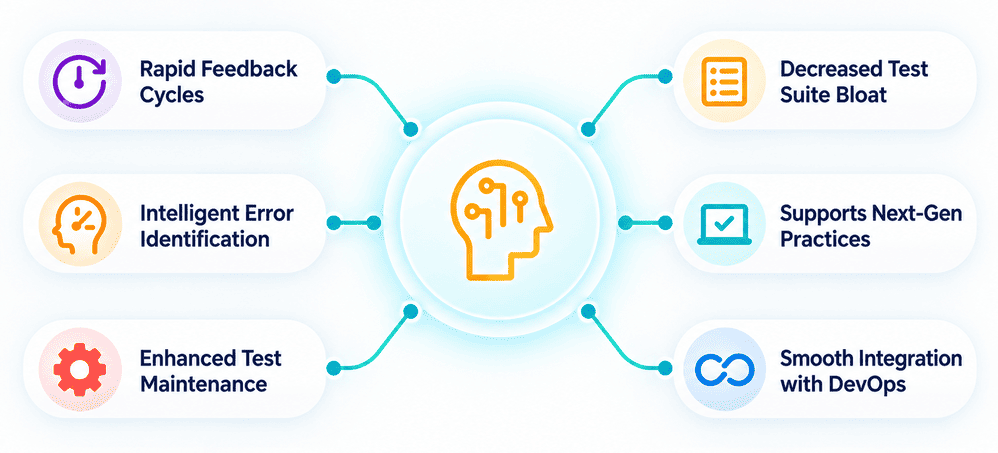
- Quick feedback cycles focus execution on high-risk scenarios, dramatically cutting test times.
- Reduced test suite bloat removes low-value or redundant test cases, cutting wasted execution time.
- Predictive defect detection uses predictive analytics to catch flaws earlier in the cycle.
- Supports next-gen practices to enable approaches like AI visual regression testing, which catches even subtle layout or UI changes.
- Better test maintenance due to continuous updates as test priorities change as applications change.
- Smooth integration into DevOps as it fits naturally into CI/CD pipelines, supporting continuous testing and delivery.
How Does AI Improve Regression Testing Coverage
AI improves test coverage by mapping test execution to the areas of greatest business and technical risk. Rather than running every test case, it evaluates usage patterns, impact, and defect history so that critical paths and edge cases get tested first. The result is risk-aware, broader coverage with fewer test executions, sharper coverage, and faster delivery.
PR-Level Impact Analysis: How AI Picks the Right Tests
Here’s what that looks like in practice, at the level of an individual pull request:
AI reads the PR diff not just “code changed,” but what changed is functions, modules, APIs, or UI components. It cross-references that diff against a map of dependencies and past defect history to flag which application areas are genuinely at risk. From the risk map, it selects only the regression tests tied to the impacted components, instead of defaulting to the full suite.
A simple example:
- A developer opens a PR touching the checkout module.
- AI scans the diff and identifies checkout, the payment-gateway integration, and order-confirmation as impacted.
- It pulls the regression tests mapped to those three areas. Let’s say a few tests instead of the full test suite.
- Tests run in minutes instead of hours, with coverage still focused on what actually matters.
This is the mechanism behind the headline promise of AI-prioritized regression testing. It cuts test cycle time without cutting corners, because the reduction is targeted.
Limitations of AI-Prioritized Regression Testing
AI-prioritized regression testing isn’t a plug-and-play fix, and it’s worth going in with a clear picture of where it takes effort to get right.
- The cold-start problem: AI prioritization needs a baseline of historical test and defect data to work well. New projects, or teams early in adoption, will see less benefit in the beginning because there isn’t enough history to learn from yet.
- Transparency: Teams may not immediately trust why a given test was ranked high or low risk. Developing confidence in AI-driven prioritization takes visibility into the reasoning, not just the output.
- Baseline maintenance: Visual AI and self-healing still depend on periodically refreshed baselines. They can create false confidence rather than catching real issues if not maintained.
- Not a replacement for exploratory testing: AI-prioritized regression testing validates known, previously tested behavior. It doesn’t replace the judgment involved in usability testing or exploring real new edge cases.
None of this is a reason to avoid adoption; it is to plan the rollout deliberately, with realistic expectations about what AI will and won’t catch on day one.
Metrics & ROI: How to Measure AI Regression Testing Success
Adopting AI for regression testing is only half the equation. Proving it’s working requires tracking the valid numbers.
Core KPIs to Track
- Test suite reduction percentage: the share of tests skipped relative to the full suite, without missing real defects.
- Defect escape rate: bugs found in production versus those caught during regression.
- Regression cycle time: total time to run regression, before AI prioritization versus after.
- Maintenance hours saved: script fixes avoided thanks to self-healing automation.
- Flaky test rate: how often tests fail without an underlying real regression.
A Simple Before/After Framework
Let us imagine your team runs more than 1,000 regression tests that take hours, and AI prioritization identifies the 300 highest-risk tests, covering half a percent of recent defect history. You cut cycle time to roughly 6 hours while retaining coverage of the areas that matter most. The actual numbers will vary by application and how much historical data you have, yet this is the shape of the tradeoff to expect and measure against.
How to Start Measuring
- Baseline first. Record your present test suite size, cycle time, and defect escape rate before rollout.
- Track the same KPIs after rollout for 2 to 3 release cycles to compare against a stable baseline rather than a single release.
- Re-tune prioritization rules based on what shows up in production versus what was predicted. This feedback loop is what makes the model improve over time.
How ACCELQ Enables AI-Prioritized Regression Testing
ACCELQ is purpose-built to bring agility and intelligence into regression testing. As one of the platforms that simplify AI regression testing end-to-end, it consolidates impact analysis, self-healing, and execution into a single codeless workflow. As such, reducing the setup overhead that often slows AI-powered QA regression testing initiatives. Key capabilities of the platform offer for AI-prioritized regression testing:
- AI-driven impact analysis detects which areas of the application are likely to be affected by current changes.
- Intelligent test selection runs only the highly relevant regression tests instead of the entire suite, saving your time and resources.
- Self-healing automation automatically updates test scripts when UI or system changes happen.
- End-to-end coverage extends regression testing across API, ERP systems, including Salesforce, SAP, Oracle, ServiceNow, and Workday, mobile, and web.
Teams can adopt AI for regression testing with confidence using ACCELQ, reducing test cycle times and improving release quality.
Best Practices for AI-Driven Regression Implementation
Implementing AI-driven regression testing in Salesforce or other applications is not only tooling. It requires a deliberate approach that balances risk, automation, and coverage.
Regression Testing Best Practices:
- Start with high-value systems to apply AI-based prioritization to business-critical processes first.
- Leverage data-driven insights to use impact analysis and defect history to refine AI prioritization over time.
- Integrate with CI/CD pipelines to ensure automated regression runs alongside development for fast feedback.
- Maintain baselines to keep them current for both AI visual regression testing and functional testing, avoiding false positives.
- Track the right metrics from day one to baseline suite size, cycle time, and defect escape rate before rollout, and track them consistently afterward (see the Metrics & ROI section above).
- Review and adapt regularly to support periodic audits of AI-driven test selections to confirm accuracy and business alignment.
Following these practices helps teams get real value from AI in regression testing and achieve intelligent coverage at scale.
AI vs Traditional Regression Testing
The most common question QA teams ask: why is AI better than traditional regression testing methods?
Traditional regression testing runs the whole suite regardless of impact. AI-prioritized regression testing analyzes code changes, usage patterns, and defect history to prioritize the critical tests, resulting in quick feedback, lower costs, and stronger reliability in catching necessary defects.
| Aspect | Traditional Regression Testing | AI-Prioritized Regression Testing |
|---|---|---|
| Test Execution | Runs the complete regression suite regardless of impact. | Runs only impacted, high-risk regression cases. |
| Cycle Speed | Slower cycles as the suite grows. | Faster cycles, focused on critical paths. |
| Coverage | Often redundant or uneven. | Risk-based, adaptive, and intelligent. |
| Maintenance | Requires ongoing manual script updates. | Self-healing automation reduces maintenance effort. |
| Defect Detection | Reactive; issues often found late. | Predictive; issues flagged earlier using AI-driven insights. |
| Handling Growth | Struggles with complex, frequent-release applications. | Built for DevOps and regression testing in Agile environments. |
 Also Read: Regression Testing and Retesting
Conclusion
Traditional regression testing just can’t keep pace with today’s release cycles anymore. That’s the real problem AI for regression testing solves. When you prioritize tests by code impact, defect history, and actual risk, QA teams stop wasting hours on suites that don’t reflect what changed. Coverage gets sharper. Errors surface sooner. And releases move faster, without the usual tradeoff of cutting corners.
The teams getting this right aren’t just adding AI on top of their existing process, but they’re rethinking test selection itself, and backing it up with real metrics instead of gut feel. This is exactly where ACCELQ will be useful. It is an AI-driven platform that supports self-healing automation and impact-based prioritization, so teams can cover tests quickly without losing confidence.
Ready to change your regression testing with AI? Contact ACCELQ to see how smart automation can accelerate your QA journey.
FAQ's
What is AI-prioritized regression testing?
AI-prioritized regression testing uses machine learning and impact analysis to identify the test cases most likely to catch defects after a code change. Instead of running the entire regression suite by default, it runs the highest-risk tests first.
Why is AI better than traditional regression testing methods?
AI reduces redundancy, speeds up execution, and delivers risk-based coverage by analyzing code changes, test history, and defect patterns. Instead of running every test regardless of relevance, it helps teams focus on the tests most likely to uncover issues.
Can AI regression testing fully replace manual regression testing?
No. AI-prioritized regression testing is strongest at quickly validating known, previously tested behavior. Exploratory testing, usability checks, and judgment-based validation for genuinely new scenarios still benefit from human testers.
What AI approaches help teams detect regressions earlier in development?
Key approaches include PR-level diff analysis to identify impacted components before a full test run, predictive defect modeling based on historical patterns, and self-healing test scripts that automatically handle UI changes. Together, these approaches move regression detection earlier into the pull request stage instead of waiting for a complete regression cycle.
How do you measure ROI from AI regression testing?
Track metrics such as test suite reduction percentage, defect escape rate, regression cycle time, and maintenance hours saved. Ideally, baseline these metrics before implementation and compare results across two to three release cycles.
Does AI regression testing work for Salesforce, SAP, or ServiceNow?
Yes, but it requires prioritization logic that accounts for specific customizations and integrations, not just the vendor's base product. Much of the regression risk in enterprise platforms like Salesforce, SAP, and ServiceNow comes from custom workflows and integration points rather than the core application UI.



Balbodh Jha
Associate Director Product Engineering
Balbodh is a passionate enthusiast of Test Automation, constantly seeking opportunities to tackle real-world challenges in this field. He possesses an insatiable curiosity for engaging in discussions on testing-related topics and crafting solutions to address them. He has a wealth of experience in establishing Test Centers of Excellence (TCoE) for a diverse range of clients he has collaborated with.


You Might Also Like:
 From Code to Cognition- Tracing the Journey of AI and its Impact on Test Automation.
From Code to Cognition- Tracing the Journey of AI and its Impact on Test Automation.
 AI Agent for Defect Prediction: Is Your QA Strategy Future-Ready?
AI Agent for Defect Prediction: Is Your QA Strategy Future-Ready?
 Why AI Isn’t Replacing Testers? It’s Empowering Them