







RSAT Limitations: What Dynamics 365 Regression Testing Doesn’t Cover

Quick Answer
RSAT (Regression Suite Automation Tool) is Microsoft’s native regression testing tool for Dynamics 365 Finance and Operations. It records UI-based business processes with Task Recorder, runs them through Azure DevOps Test Plans, and covers F&O only. It does not cover Sales, Customer Service, Field Service, Supply Chain, or Business Central. Its main limitations are no cross-module coverage, no support for integration testing, UI-time-bound recordings that must be re-recorded every release wave, and licensing that’s free only within F&O.
So far, RSAT has solved a straightforward problem. Microsoft ships Dynamics 365 Finance and Operations updates on a fixed cadence. Someone has to prove that order-to-cash, procure-to-pay, and month-end close still work after each one. RSAT does that.
But there’s a lot that RSAT cannot do, and a lot of it is necessary to a testing pipeline. That’s what this piece covers: what RSAT can do and what RSAT limitations sit outside that scope.
RSAT’s blind spot is that it’s built on UI-recording via Task Recorder, scoped to Finance and Operations. This is great for stable F&O business-cycle testing. But it breaks down when coverage needs to cross into Sales, Customer Service, or integration scenarios. Microsoft’s own documentation directs teams away from RSAT for integration testing.
Paired with recordings that need re-recording every release wave and licensing that stops at F&O, there are a few RSAT limitations that lead to migration away from it.
- Diagnose the Real Problem: Teams outgrow RSAT from cross-module coverage gaps, integration testing Microsoft doesn’t recommend it for, re-recording overhead that grows with library size, and licensing that only covers F&O.
- Map the Real Migration Scope: Start with what RSAT covers, i.e., F&O processes run through Azure DevOps. Then list what sits outside it: Sales, Customer Service, Field Service, or Business Central processes, integration and data-flow testing, and test cases absorbing re-recording costs each wave. That second list is the real migration scope.
- Consider a Unified Platform: ACCELQ covers F&O, Sales, and Customer Service, and the integrations between them in one suite. It also offers self-healing that adapts to release-wave UI changes instead of requiring re-recording; ideal for hitting module, integration, and maintenance gaps at the same time.
What RSAT Does Well
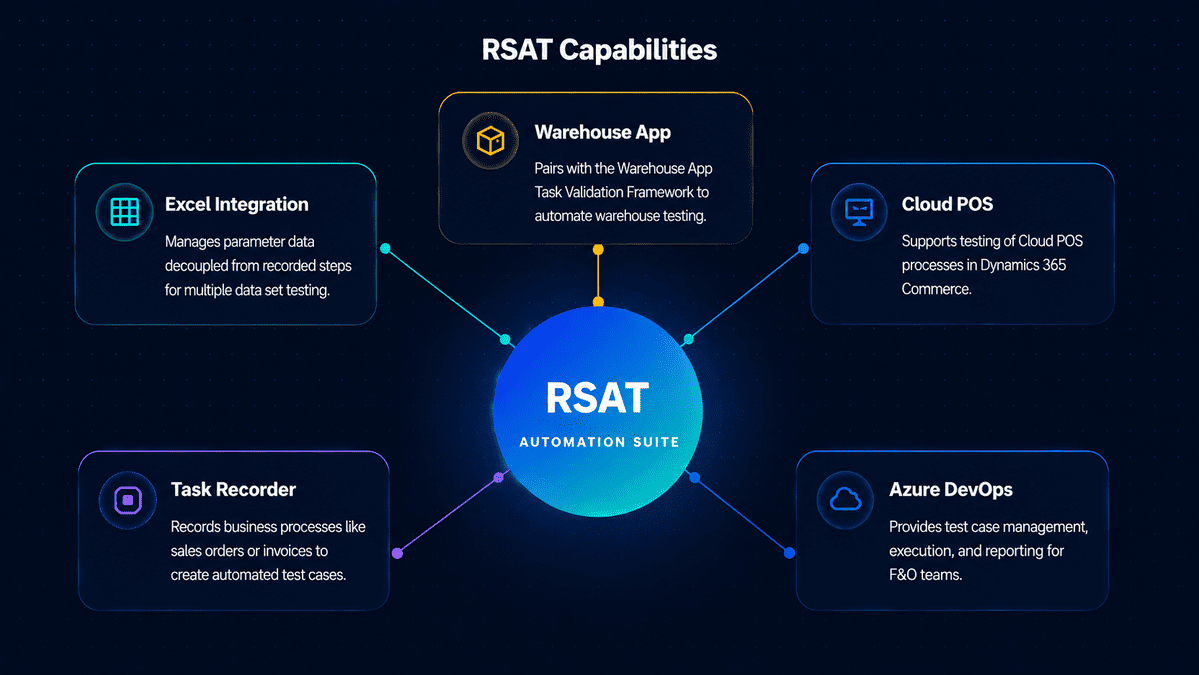
RSAT is key for functional teams who need regression coverage without writing code. A power user records a business process, like creating a sales order, posting a vendor invoice, running a month-end close, using Task Recorder. RSAT converts that recording into a repeatable, automated test case.
No developer needs to be involved.
This is a big deal. Before RSAT, F&O user acceptance testing (UAT) before a One Version update required manual click-through. It was run by consultants who understood the business process but had no technical background.
RSAT gave teams a way to build a regression library that scaled with their process footprint, without pulling developers to write and maintain test scripts.
It’s also fully integrated with common tools for F&O teams. Azure DevOps for test case management, execution, and reporting. Excel for parameter data, decoupled from the recorded steps so the same test case can run against multiple data sets without being re-recorded.
That decoupling is why RSAT held up as well as it did for such a long time.
RSAT does support testing Cloud POS processes in Dynamics 365 Commerce. It can be paired with the Warehouse App Task Validation Framework to automate warehouse process testing. It’s definitely more than a bare-bones recorder-and-playback tool.
For standard F&O business-cycle testing on a reasonably stable environment, RSAT does exactly what it was built to do, without a licensing line item.
Further Reading: Excelling Regression Testing in MS Dynamics 365, if you want a deeper look at regression strategy before moving into the limitations.
What Are RSAT’s Main Limitations?
RSAT’s boundaries all trace back to the fact that it was built for F&O UI regression, using Azure DevOps as the system of record. Here’s everything this design prevents the tool from covering.
Does RSAT Support Dynamics 365 Sales, Customer Service, or Other Modules?
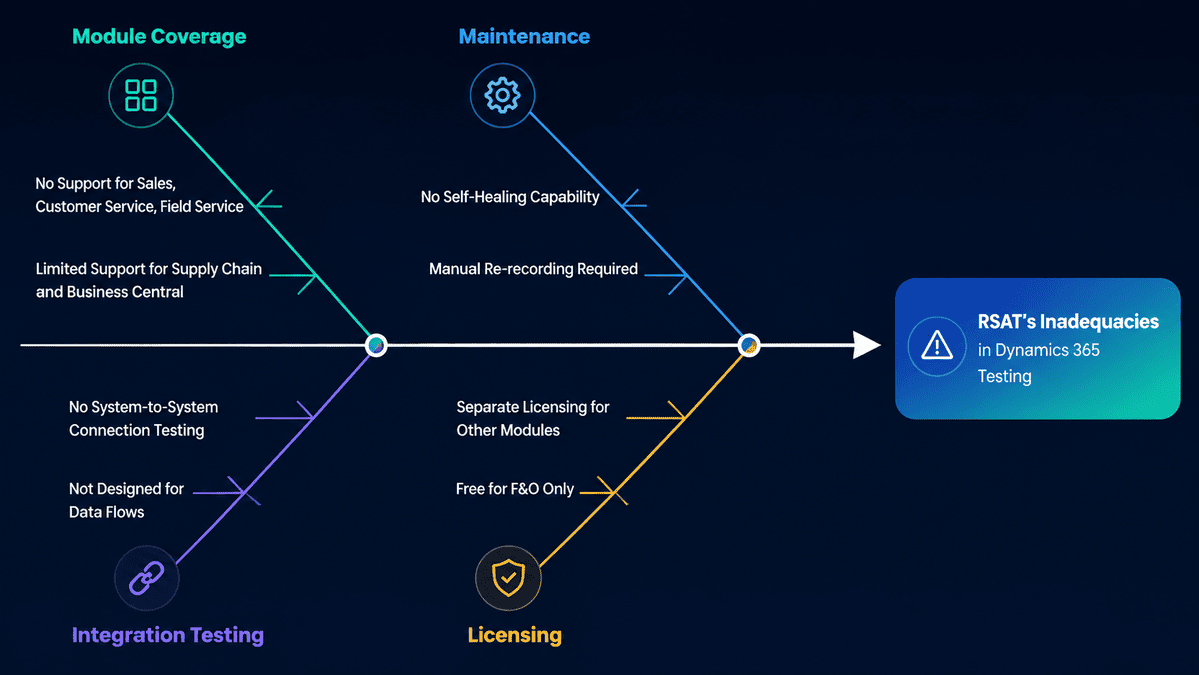
RSAT was designed for Finance and Operations, not for the wider Dynamics 365 ecosystem across the rest of the Customer Engagement suite:
| Dynamics 365 Module | RSAT Coverage |
|---|---|
| Finance and Operations (F&O) | Yes; native, purpose-built |
| Dynamics 365 Commerce (Cloud POS) | Yes; via Test recorder/RSAT for Cloud POS |
| Warehouse processes | Yes; via Warehouse App Task Validation Framework |
| Dynamics 365 Sales | No |
| Dynamics 365 Customer Service | No |
| Dynamics 365 Field Service | No |
| Dynamics 365 Supply Chain (outside F&O core) | No |
| Business Central | No |
For enterprises running F&O alongside Sales or Customer Service, RSAT can only ever be part of the regression picture.
Because of this, teams have to stitch together separate tools per module, one for F&O, another for Sales or Customer Service, and another for Business Central.
Each of those tools has its own recording format, maintenance rhythm, and reporting output. A release wave that touches both F&O and a connected CRM workflow will need teams to run two separate regression cycles and manually reconcile the results into one picture.
Does RSAT Support Integration Testing?
Microsoft’s official RSAT documentation states that RSAT should not be used for integration tests. It directs teams to the data management framework (DIXF) instead, which is the clearest source of the RSAT integration testing limitations most F&O teams eventually run into.
RSAT was not built to test the data flows and system-to-system connections that move information between D365 and the surrounding application landscape: ERP-to-CRM sync, third-party logistics feeds, EDI, custom API integrations.
Why Does RSAT Maintenance Increase With Every Release Wave?
A recording captures the exact sequence of clicks, fields, and screens as they exist at the moment of recording. When a release wave moves a button, renames a field, or changes a form layout, every affected recording needs to be re-recorded.
RSAT has no self-healing capability to adjust automatically; a user has to notice the failure, open Task Recorder, and capture the process again from scratch.
A team with 50 test cases can usually absorb a wave’s worth of re-recording within a sprint. A team with 500 cases across a mature F&O footprint is looking at a maintenance cycle that competes directly with the deadline it’s meant to protect, often run by the same functional staff who are also expected to validate the release.
The cost compounds with scale. Two release waves per year are the baseline maintenance tax for any RSAT library, and it grows in proportion to the extent of the business process footprint the team automates.
Is RSAT Free? What Does RSAT Licensing Actually Cover?
Any conversation about RSAT licensing cost starts with the fact that RSAT itself carries no separate license fee. It’s included with F&O licensing.
But “free” only covers F&O. When a team needs regression coverage for Sales, Customer Service, or any non-F&O system, that coverage has to come from somewhere else with its own licensing cost.
Suggested Read: 9 Dynamics 365 Automated Testing Tools (2026) for a look at how RSAT compares to other tools on module coverage, maintenance, and surviving release waves.
What Does This Mean for a 2027 RSAT Migration Decision?
F&O teams have worked around RSAT’s boundaries for years, adding separate tools for other modules. They’ve put in extra hours for re-recording after each wave.
Microsoft’s support for RSAT ends May 15, 2027. After that, the gaps will no longer be a manageable side cost. Instead, they become a coverage risk with no fallback.
Start by mapping what RSAT covers: F&O business processes, run through Azure DevOps. Then see what sits outside that boundary: Sales, Customer Service, Field Service, or Business Central processes; integration and data-flow testing; and any test cases currently absorbing high re-recording costs each wave.
That second list is the real migration scope.
From there, decide whether to solve each gap with a separate tool, or with a single platform that can cover F&O regression, cross-module Dynamics 365 testing, and integration testing together. If you’re weighing the single-platform route, ACCELQ’s RSAT alternative for Dynamics 365 covers F&O processes and the systems they touch, such as Sales, Power Platform and SAP
A consolidated approach reduces the re-recording work, since tests are built on object recognition rather than screen coordinates. They can adapt to UI changes instead of breaking.
FAQ's
Does RSAT support Dynamics 365 Sales or CRM?
No. RSAT is built for Dynamics 365 Finance and Operations. It does not automate Dynamics 365 Sales, Customer Service, Field Service, or other Customer Engagement modules. Teams running these modules alongside F&O need separate tools to manage that coverage.
What are RSAT's main limitations?
RSAT is scoped to Dynamics 365 Finance and Operations UI regression testing only.
Its main limitations include no coverage for Dynamics 365 Sales, Customer Service, Field Service, Supply Chain, or Business Central. Microsoft also recommends against using RSAT for integration testing.
RSAT relies on UI-based recordings, which may require re-recording after release-wave changes. While RSAT itself does not have a separate license cost for F&O, testing other Dynamics 365 modules requires separate tools and licensing.
Is RSAT free?
RSAT itself has no separate license cost and is included with Dynamics 365 Finance and Operations licensing. However, it requires Azure DevOps Test Plans entitlement for managing test cases.
The free scope applies only to F&O testing. Testing other Dynamics 365 modules requires separate tools with their own licensing costs.
Does RSAT test integrations with other systems?
No. RSAT is designed for UI-driven business process testing within Dynamics 365 Finance and Operations. It does not validate system-to-system data flows or external integrations.
Microsoft recommends using the Data Management Framework (DIXF) for integration-related validation rather than RSAT.



Nishan Joseph
VP Sales Engineering
Nishan is a tech strategist with expertise in Test Automation and roles at giants like TCS, Microfocus, and Parasoft. At ACCELQ, he champions Strategic Alliances, cultivating global tech partnerships. Educated at Leeds University and Symbiosis Pune, he also possesses an engineering background from Bangalore.


You Might Also Like:
 Mastering Quarterly SAP S/4HANA Public Cloud Releases: A QA Blueprint
Mastering Quarterly SAP S/4HANA Public Cloud Releases: A QA Blueprint
 Streamline test assets for effective test automation. Use ACCELQ universe.
Streamline test assets for effective test automation. Use ACCELQ universe.
 What Is SFDC Testing? Achieve Better Testing Outcomes with These Best Practices