








Synthetic Test Data Generation: The Complete QA Guide for 2026

Synthetic test data generation is the practice of creating artificial datasets that mirror the statistical properties, business rules, and referential structure of real production data, without containing any personally identifiable information. It is how modern QA teams test at speed and scale without touching a single real customer record.
Traditional test data approaches are breaking under the weight of modern software delivery. Waiting days for masked production extracts, building manual spreadsheets record by record, or reusing the same shared dataset across every sprint: each of these creates bottlenecks, coverage gaps, and compliance risk that slow teams down precisely when they need to move faster. This guide covers everything a QA team needs to understand, adopt, and scale synthetic test data generation effectively.
- What is Synthetic Test Data Generation?
- Types of Synthetic Test Data
- What is the Difference Between Mock and Synthetic Data?
- Synthetic vs Real Test Data
- Test Data Masking vs Synthetic Test Data: Which to Use?
- Synthetic Test Data Generation Using Generative AI
- Synthetic Test Data for API Testing
- How Does Synthetic Test Data Generation Fit Into a Shift-Left Testing Strategy?
- How to Implement Synthetic Test Data Generation: 5 Steps in Enterprise Testing
- Benefits and Limitations of Synthetic Test Data in Software Testing
- Use Cases for Synthetic Test Data
- Synthetic Test Data Generation in a Unified QA Platform
- Common Pitfalls to Avoid
- Conclusion
What is Synthetic Test Data Generation?
Synthetic test data generation is the way artificial data is created for software testing and quality assurance. Because this data mimics real data but not derived from real-world sources, it complies with data privacy laws, also ensures greater data diversity. Synthetic test data not only assures compliance with data protection regulations. Yet it covers a wide range of scenarios than real data, which facilitates comprehensive testing and reduces reliance on scarce real-world data.
Enterprises generate synthetic data to test software applications without the risk of exposing Personally Identifiable Information (PII). Synthetic test data generation can be controlled precisely, enabling specific conditions testing, and improving quality assurance. And since it’s inherently scalable, synthetic test data can be generated in huge volumes to evaluate system performance under various loads. Created via generative AI models, a roles engine, cloning, masking and more, synthetic data generation is a practice suited for data privacy protection, application testing and reliability.
Key Characteristics of Synthetic Test Data:
- Contains zero personally identifiable information (PII).
- Mirrors the statistical distributions of production data and business logic.
- Scalable to millions of records in minutes.
- Maintains referential integrity in related entities.
- Generated on demand without production database access.
Difference Between Synthetic Data and Synthetic Test Data
Synthetic data is AI-generated information that is created from scratch using AI models, rather than collected from any real-world source. Still, it mimics the patterns and characteristics of real-world data. Synthetic test data is a fake version of real test data to develop and test applications. It is a type of data that mimics real data to permit better data security as well as fill the gaps during testing with information that would otherwise be unavailable.
Types of Synthetic Test Data
The data type you want to create depends on your needs in the provided test scenarios. As your test scenarios can vary widely in context, here are a few types of synthetic test data you can apply:
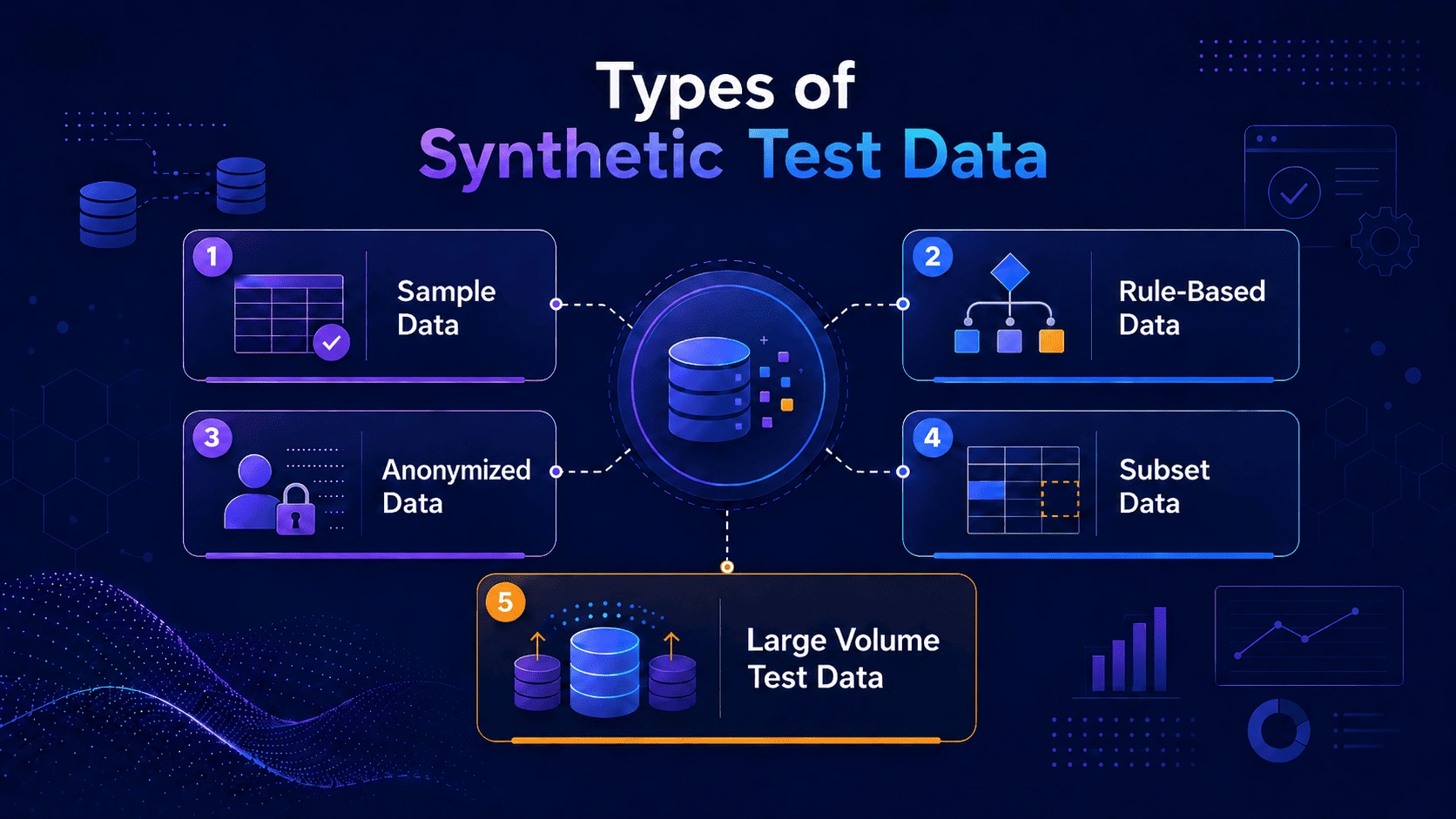
- Sample data: It is synthetic data at its simplest. This type is largely impromptu data created by developers in a testing sprint. Sample data is used primarily to ensure that every data field is occupied. The benefit of sample data is that it can be used for a specific test to produce a desired response or to test a particular feature (for example, a credit card number). The downside, however, is that it is poorly suited for large-scale testing because bugs dramatically increase.
- Rule-based data: When using test data, there are often specific parameters around what is required for any given test. Rule-based data is designed to accommodate those parameters. This type of data is generated intentionally rather than sample data. That means the test data generated is directly correlated to data fields like first and last names, addresses, and postal codes. Rule-based data can come in the form of numerical values, reserved words like “NULL,” blank data, long or short data chunks, or data with special characters.
- Anonymized data: Replacing real data with anonymized data is a good choice to preserve data security. Masking real data enables testers to use the real data essence without exposing sensitive information. Retaining the essence of real data means replacing real names with fake names or completely randomized characters.
- Subset data: Going the route of subset data will help you tailor your synthetic data for your specific use cases. Doing so will create datasets for your unique test environments and simulations while avoiding unwanted data. Subset data is a great way to address bugs. Unlike anonymized data, subset data does not protect the data within a subset; it only minimizes the exposure risk.
- Large volume test data: Large-scale testing often requires large amounts of data. Manually doing takes up significant amounts of time, so large volume test data is primarily synthetic test data generated automatically. With this approach, your testing relies less on the specific data and more on the sheer volume and velocity of test data. Large volume test data is an excellent way to test your application performance or load. When generating large volumes of data, teams must ensure alignment with database testing approaches that validate schema integrity, referential constraints, and query performance under realistic data volumes.
What is the Difference Between Mock and Synthetic Data?
Mock and synthetic data are not equal because they serve distinct purposes. They are used when actual data is not available or cannot be shared. Yet the way they are created and applied makes them unique. Understanding these differences helps your team to choose the right type for testing surveys or product development.
| Aspect | Mock Data | Synthetic Data |
|---|---|---|
| Purpose | Test applications, layouts, or forms before real data is available | Realistic analysis, AI training, and simulation when real data is unavailable or restricted |
| Creation Method | Created manually or with random data generators and mock APIs | Generated through machine learning, simulations, or statistical models |
| Data Privacy | Protects privacy by utilizing fake values. But not suitable for detailed analysis | Protects privacy because it does not utilize real personal information |
| Data Quality | Lower quality; focuses on functionality | High-quality and logically consistent; can mimic real-world distributions |
| Complexity | Simple to create with manual input or generators | Requires advanced tools and algorithms to generate |
| Value for Analysis | Low value for analysis; only useful for testing processes | High value because it can be used for realistic modeling and decision-making |
| Example | Fake names and email addresses were used to test a sign-up form | A synthetic dataset that simulates hospital records for medical research |
Synthetic vs Real Test Data
Synthetic data scales quickly and lets you test your ideas early. Real data validates final behavior. For early development, stress-testing, and edge-case design, synthetic data fits. Real data is essential for grounding your model in true conditions and measuring final accuracy. When you combine both, you can reduce bias and speed up deployment. Below is a comparison table with insights to guide your decision:
| Category | Synthetic Test Data | Real Test Data |
|---|---|---|
| Availability | Unlimited and fast to generate | Limited and time-consuming to collect |
| Annotation | Automatic and consistent | Manual or slightly-automatic, error-prone |
| Realism | Depends on rendering quality | Naturally high |
| Privacy | No PII or legal constraints | Requires strict compliance |
| Edge Cases | Easy to simulate | Often rare or expensive |
Test Data Masking vs Synthetic Test Data: Which to Use?
The main difference between test data masking and synthetic test data is that masked data is a demographically accurate, yet synthetic replacement for a real value. While synthetic data is entirely artificial and may not always capture the patterns of real data.
Synthetic test data is ideal when customization and flexibility in your testing environment are required. For example, when testing extreme edge cases or creating data for new features. Test data masking is preferred when working with legacy systems or performing regulatory-compliant testing on production datasets.
| Aspect | Synthetic Test Data | Test Data Masking |
|---|---|---|
| Data Source | Generated from source metadata or defined by operators or AI | Derived from real production data, while protecting sensitive data values with realistic, synthetic data |
| Risk of Exposure | No risk, as data contains no personal information | No risk if masking is properly applied |
| Customization | Highly customizable and adaptable for edge cases | Limited to the structure of the original data. |
| Use Cases | New feature development, stress testing, chaos testing, API testing | Data privacy, regulatory compliance, realistic testing, analytics |
Synthetic Test Data Generation Using Generative AI
Gartner estimates that by 2030, synthetic data will entirely replace real data in AI models. The benefits of synthetic data generation using generative AI extend far beyond preserving data privacy. A few process of synthetic data generation using generative AI are as follows:
The Collection of Sample Data
Synthetic data is sample-based data. So the first step is to fetch real-world data samples that can serve as a guide for creating synthetic data.
Model Selection and Training
Choose a suitable generative model based on the data type to be generated. The deep machine learning generative models, such as Variational Auto-Encoders (VAEs), Generative Adversarial Networks (GANs), and transformer-based models like large language models (LLMs), require minimal real-world data to deliver results. Here’s how they differ in the context of synthetic data generation:
- VAEs are best for reconstruction tasks, such as anomaly detection and privacy-preserving synthetic data generation.
- GANs are best applicable for generating high-quality images, videos, and media with accurate details and realistic characteristics, as well as for style transfer and domain adaptation.
- LLMs are primarily used for text generation tasks, including natural language responses, creative writing, and content creation.
Actual Synthetic Data Generation
After being trained, the generative model can produce synthetic data by sampling from the learned distribution. For example, a GAN could design graphics pixel by pixel. It is possible to generate data with particular traits under control using methods like latent space modification. This allows the synthetic data to be modified and tailored to the required parameters.
 Also Read: What Is Data Masking
Synthetic Test Data for API Testing
API testing presents data generation requirements that differ from database testing. API tests validate request and response behavior, and the synthetic data matches the API schema precisely, such as, correct field names, types, enumeration values, nesting structures, and relationships between request parameters and expected responses.
The common failure in API test data is using static, manually maintained payloads that drift from the original API contract as it changes. Each time the API schema changes, the test data files need manual updates. This maintenance burden is the root cause of API test coverage stagnating in fast services.
- Schema-driven generation: Tools that read OpenAPI/GraphQL schema definitions automatically generate valid, realistic synthetic payloads, eliminating the manual maintenance problem. When the schema updates, the generation rules are automatically updated.
- Stateful sequence generation: Multi-step API workflows require synthetic data that maintains consistency across calls. A create-order flow needs a synthetic product ID from an earlier call to be used correctly in a subsequent order placement call. Entity-based generation that tracks state across a test scenario handles this automatically.
Teams using codeless test automation platforms that embed API testing alongside web and mobile testing benefit from data generation that is consistent across all test layers, ensuring that synthetic customer records use
How Does Synthetic Test Data Generation Fit Into a Shift-Left Testing Strategy?
Shift-left testing is the practice of moving quality validation earlier in the development lifecycle, closer to the point where code is written, rather than waiting for a dedicated testing phase before release. The single most common barrier to genuine shift-left testing is test data availability. Development environments rarely have access to realistic data because the provisioning process for masked production data is slow, controlled, and environment-specific.
For example, a developer writing a checkout flow can generate an actual synthetic customer set of data with payment methods, addresses, and order histories on the day the feature is defined, without waiting for a QA environment to be provisioned or a DBA to approve a production extract.
- Sprint-zero data design: The most mature shift-left teams define their synthetic data requirements during sprint planning, alongside acceptance criteria. By the time the first line of code is written, the test data generation configuration is ready.
- CI/CD pipeline integration: Synthetic data generation integrated into build pipelines ensures that every automated test run uses a freshly generated, consistent dataset. Tests never fail because a shared dataset was modified by another team member or is in an unexpected state.
- Developer-owned data generation: When synthetic data tools are codeless or provide simple API calls, developers can generate their own test data without depending on a centralized QA team or DBA. This is the shift-left ideal: quality owned at the point of development.
World Quality Report found that, on average, 69% of testers still rely on spreadsheets to manually generate test data, and they spend between 30% and 60% of their time provisioning data rather than testing. Synthetic test data generation is the most direct intervention available to reclaim that time and redirect it toward actual quality work.
SUGGESTED READ Why Does DevOps Recommend Shift-Left Testing Principles?
How to Implement Synthetic Test Data Generation: 5 Steps in Enterprise Testing
Successful synthetic test data adoption follows a consistent pattern across organizations regardless of size or sector. The teams that struggle are usually those that attempt to replace all existing test data processes at once. The teams that succeed start with a bounded pilot and expand from demonstrated value.
The five steps that take an enterprise testing from production-data dependency to scalable, privacy-safe synthetic generation are as follows:
Step 1: Assess Present Test Data Practices
Before selecting a platform or defining a rollout plan, understand where the current program is actually losing time and creating risk. Areas to assess:
- How test data is currently provisioned: In production copies, manual creation, masked data, or a combination.
- Time required for data request: Is it based on availability, including approval delays and preparation overhead?
- Privacy and security exposure: Where production data containing sensitive information is used in testing, who has access, and what controls exist?
- Whether the current test data adequately represents: Production complexity, and what percentage of testing uses oversimplified datasets?
- Total cost: Including storage, governance overhead, and cost from delayed testing.
Whether you’re a startup or an agile team in a larger organization, adopting scalable automation approaches ensures synthetic data generation evolves with your testing maturity without requiring proportional resource increases.
Step 2: Selecting a Synthetic Data Generation Platform
Platform capabilities determine whether synthetic data implementation succeeds or fails. Evaluate on these dimensions:
- Generation quality: How closely does synthetic data match production characteristics? Request a proof of concept produced from a sample production dataset and validate statistically.
- Privacy guarantee: Does the platform offer differential privacy? Is compliance certified for GDPR and HIPAA regulations?
- Automation and integration: Can the platform integrate with CI/CD pipelines to automate provisioning, reducing efforts by manual testers’?
- Scalability: Can the platform generate test data volumes in timeframes for performance testing at production scale?
- Usability: Can QA teams and developers generate synthetic data independently, or does it require data science expertise that creates a new bottleneck?
Low-code automation platforms allow QA teams to develop test data generation workflows without heavy coding, reducing time and maintain enterprise-grade quality.
Step 3: Piloting Before Complete Rollout
Rather than attempting an organization-wide deployment, pilot with a focused use case in which synthetic data addresses a clear pain point. Good pilot candidates:
- Testing using production data copies can create compliance risk.
- Testing requires complex relational data that takes significant manual effort to create.
- Performance testing needs production-scale volumes that manual creation cannot reach.
- Run identical tests using synthetic data. Compare defect detection, execution reliability, and testing cycle time. Quantify the impact before rollout.
Step 4: Scaling Across the Organization
After a succeeding pilot, expand data frequently instead of all at once:
- Depending on business value and bottleneck severity, prioritize extra scenarios.
- Add synthetic data generation into CI/CD pipelines.
- Create reusable generation templates for common testing scenarios such as customer testing, transaction testing, and integration testing patterns.
- Establish governance, defining quality standards and usage policies without replicating the heavyweight governance that production data requires.
Step 5: Maintaining Synthetic Data Quality Over Time
Synthetic data requires ongoing maintenance as applications evolve. Key practices to follow are:
- Maintaining data quality requires test observability practices that offer real-time insights into data generation pipelines and consumption patterns.
- Refresh production analysis models quarterly or semi-annually as data patterns change.
- Implement automated validation, statistical similarity checks, relationship integrity checks, and business rule compliance.
- Feed testing discoveries back to generation models: if synthetic data misses a specific edge case that caused a defect, that scenario should be incorporated.
- Monitor performance as data volumes expand to make sure the platform scales without cost increase.
Benefits and Limitations of Synthetic Test Data in Software Testing
Testing is a software development process critical part, and quality test data forms its base. When the production data usage is not possible due to security or availability reasons, one viable option is synthetic test data. But is it a solution to all testing challenges? Let us see its benefits and limitations:
Benefits
- Synthetic test data does not consist of confidential information, so it is safe. This is important in the healthcare and finance sectors.
- Testers have the opportunity to create precisely defined test cases, including exception situations and edge cases. This improves test coverage and allows for the evaluation of the system’s operation in various scenarios.
- Automatic test data generation enables continuous test data generation for the development process and CI/CD pipelines without delays. This accelerates development cycles and supports agile methodologies.
- Synthetic data helps to prevent the challenges regarding copying, masking, and managing production data. This reduces risks and facilitates the standardization of processes.
Limitations
- Synthetic data depends on predefined rules and models. It often does not completely replicate the diversity of production data or unexpected user behaviors. This can lead to errors in the production environment.
- Producing quality synthetic data needs an extensive understanding of the application’s operation, data structures, and business logic. For this reason, the initial investment can be significant.
- If the system is tested only with synthetic data, a false perception of its stability may arise. In real scenarios, production data can detect problems that synthetic testing can’t.
- Synthetic data works well in unit and integration testing, but it is not always suitable for performance testing, or behavior-driven testing, which require original use cases and data complexity.
Use Cases for Synthetic Test Data
In testing software, there are two primary ways that teams discover issues: manual testing where humans exercise tests, and automated testing where computer exercises tests.
Manual Testing Use Cases
- Eliminates privacy and security risks.
- Generates data similar in shape to that in a production environment.
- Creates massive amounts of data very quickly to simulate a production-sized data set and get more realistic test results.
Automated Testing Use Cases
- Ensures automated tests are deterministic, meaning the tests are more reliable and repeatable due to the type and quality of the data that is generated.
- Can be applied to negative test scenarios when there is a need to validate proper error handling. This is handled both on the user interface and API interfaces.
- Can be created programmatically on the fly during an automated test run.
Other Testing Use Cases
- Synthetic test data can help testers evaluate integration points between applications and find places where data does not transmit properly between them.
- Testers can generate huge volumes of synthetic data to test an application’s ability to function under high traffic levels.
- If code changes introduce new bugs or break application functionality, testers can use synthetic data.
- Testers can use synthetic data to test individual application units in isolation.
Synthetic Test Data Generation in a Unified QA Platform
The common pain point in synthetic test data adoption is toolchain fragmentation. Teams use one tool to produce data, another to manage, inject it into test scenarios, and another to verify the results. Each integration adds maintenance and slows the feedback loop that shift-left testing is supposed to speed up.
Platforms that embed synthetic test data generation directly into the test design and execution workflow eliminate this fragmentation. Rather than exporting a synthetic dataset to a file and importing it into a separate test automation tool, the data generation is part of the test scenario definition itself.
ACCELQ Autopilot takes this integrated approach: test scenarios define their data requirements alongside their test logic, and data generation runs automatically as part of each test execution. Non-technical team members can design real synthetic data scenarios through a visual interface without writing scripts or maintaining separate data files. The platform preserves referential integrity in related entities, supports entity-based generation for complex business process scenarios, and integrates with CI/CD pipelines to trigger fresh data generation on every run. For enterprise teams testing web, mobile, API, and packaged applications like Salesforce and SAP in a single platform, this integration removes the need for a separate synthetic data toolchain entirely.

Common Pitfalls to Avoid
Some pitfalls and how to overcome them are as follows:
- Oversimplified data: Clean mock data does not reflect real-world messiness. So, include realistic variations, edge cases, and data quality issues.
- Unrealistic relationships: Data fields that don’t correlate naturally. As such, ensure logical relationships between related data fields.
- Insufficient volume: Testing with too little data to reveal performance issues. So, generate data volumes that match or exceed expected production loads.
- Privacy violations: Utilizing sensitive customer data in non-production environments. Try to implement proper data masking or use synthetic alternatives.
- Environment contamination: Accidentally modifying or corrupting production data during testing. So, use read-only copies or isolated environments for testing.
- Data staleness: Using outdated real data that doesn’t reflect current patterns. As a result, regularly refresh test datasets or supplement with current mock data.
Data quality issues, maintenance overhead, and environment synchronization represent common test automation pitfalls that synthetic data generation must actively address through design principles and governance.
Conclusion
Testing bottlenecks can halt the testing process’s. Working with inaccurate or incomplete test data slows testing, wastes your time, and money. That is why synthetic test data can be useful.
The future of test data lies in unified AI-powered test automation platforms like ACCELQ that blends intelligent data generation with autonomous test creation, execution, and maintenance to eliminate traditional silos between data and test logic. With these platforms, teams can take greater control of the testing process by tailoring their test data to suit their specific testing needs.



Balbodh Jha
Associate Director Product Engineering
Balbodh is a passionate enthusiast of Test Automation, constantly seeking opportunities to tackle real-world challenges in this field. He possesses an insatiable curiosity for engaging in discussions on testing-related topics and crafting solutions to address them. He has a wealth of experience in establishing Test Centers of Excellence (TCoE) for a diverse range of clients he has collaborated with.


You Might Also Like:
 Role of Quality Engineering in Automation Testing
Role of Quality Engineering in Automation Testing
 Top 6 Tricentis Alternatives for Enterprise QA Teams (2026)
Top 6 Tricentis Alternatives for Enterprise QA Teams (2026)
 Automated Testing with Azure DevOps: Step-by-Step Guide for Smarter CI/CD