







Most Salesforce DevOps Tools Buying Guides Skip the Most Important Step – Here It Is
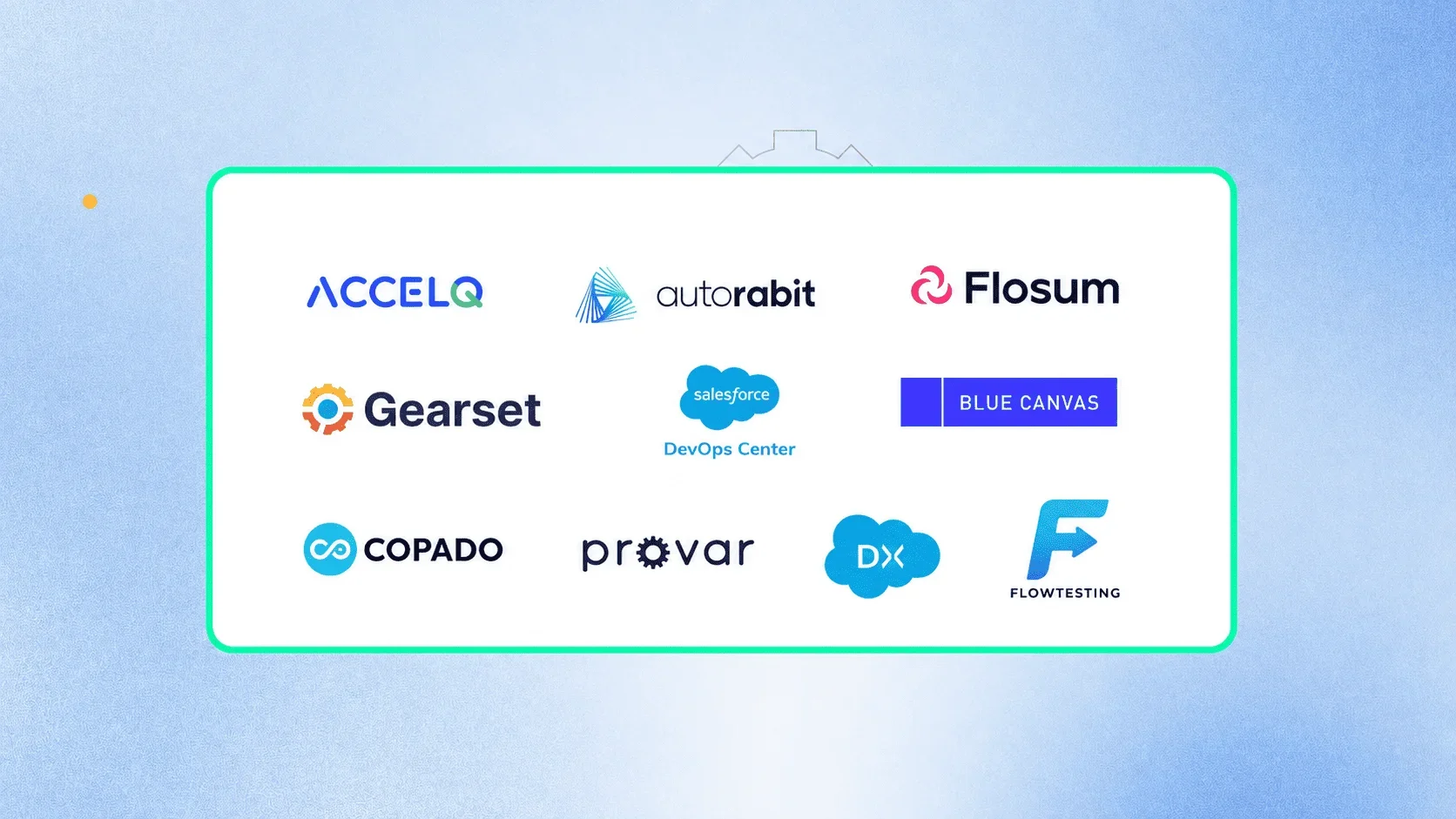
The 10 best Salesforce DevOps tools in 2026 are ACCELQ, Autorabit, Flosum, Gearset, Salesforce DevOps Center, Blue Canvas, Copado, Provar, Salesforce DX (SFDX), and Flowtesting.io. They are compared here on deployment reliability, test automation depth, version control approach, post-deployment ops coverage, and one dimension no other comparison page addresses: whether the tool catches a metadata conflict before it breaks a live Salesforce environment, not after.
Your Salesforce seasonal release shipped Friday night. By Monday morning, the CPQ flow that calculates every quote is broken, and the sprint team is diagnosing a metadata conflict instead of shipping new functionality. The sales director wants to know why. You don’t have a clean answer because the deployment tool did exactly what it was bought to do and the failure still happened.
Here is what that mismatch looks like in practice. The team ran a deployment tool. The metadata is promoted cleanly. The Salesforce UI passed the manual smoke check. Nobody tested the external pricing API that the CPQ flow calls on every quote calculation. The deployment succeeded.
What Are the 4 Categories of Salesforce DevOps Tools?
For Salesforce specifically, the four categories map to the four distinct DevOps problems that Salesforce teams face.
| Category | What It Does | When You Need It | Tools on This List |
|---|---|---|---|
| Salesforce deployment tools | Move metadata and code from sandbox to production; manage change sets, deployment pipelines, and conflict resolution | Every Salesforce release; whenever developers and admins need to promote changes without manual change sets | Autorabit ARM, Flosum, Gearset, Copado, Blue Canvas, Salesforce DevOps Center |
| Test automation tools | Automate functional and regression testing of Salesforce applications across UI, API, and mobile channels | Before every deployment; when release frequency exceeds what manual testing can reliably validate | ACCELQ, Provar, Flowtesting.io |
| Version control and source management | Manage Salesforce metadata in Git repositories; track changes, enable branching strategies, and support collaborative development | Always; teams doing collaborative Salesforce development need Git-based source control | Autorabit (with VCS), Flosum, Gearset, Copado, Salesforce DevOps Center |
| Post-deployment operations | Monitor production environments, validate data integrity, manage backups, and ensure deployments function correctly | After every deployment; regulated industries with audit requirements and teams managing data migrations | Autorabit Vault (backup), Blue Canvas (monitoring), Copado (observability) |
Most enterprise Salesforce teams need tools from at least two of these categories:
- Deployment + Test Automation: the highest-value pairing. Faster releases and validation that what shipped actually works. This is where measurable gains in both velocity and quality happen together.
- Deployment only (no test automation): releases move faster, but there is no safety net confirming the deployment did the right thing.
- Test Automation only (no deployment tooling): defects get caught earlier, but release velocity stays slow because promotion to production is still manual.
- Version control only (no deployment tooling): a clean audit trail of every change, but nothing automates getting those changes to production.
What Makes Salesforce DevOps Uniquely Hard: The Challenges DevOps Tools Address
Generic DevOps tools built for code repositories and containerized applications don’t solve Salesforce’s specific problems. Salesforce metadata-driven architecture, org-based development model, and dynamic UI components create challenges that standard CI/CD and test automation platforms weren’t designed for.
| Salesforce DevOps Challenge | Why It Happens | How DevOps Tools Address It |
|---|---|---|
| Metadata conflicts and org drift | Multiple developers and admins make changes in separate sandboxes without synchronization; many teams still rely on manual change sets | Automated metadata comparison and conflict detection (Gearset, Flosum); Git-based source control as the single source of truth |
| Change set limitations | Salesforce change sets do not reliably track dependencies; missing components can cause deployment failures that are difficult to diagnose | Deployment tools with dependency analysis (Autorabit ARM, Copado); full metadata manifest management outside change sets |
| Lack of automated regression coverage | Testing Salesforce UI components such as Flows, Lightning pages, and dynamic iframes requires Salesforce-specific handling that generic web tools often lack | Salesforce-native test automation (ACCELQ codeless, Provar scripted); platform-specific element recognition without XPath maintenance |
| Cross-system integration failures | Salesforce is rarely tested in isolation; integrations with external APIs, connected applications, and third-party systems can fail silently when only the UI layer is validated | End-to-end automation across Salesforce, APIs, and connected systems (ACCELQ); API validation alongside UI testing |
| Release velocity vs quality trade-off | Faster release cycles and frequent changes increase regression risk; manual testing cannot scale to modern CI/CD frequencies | Automated regression testing integrated into CI/CD pipelines (ACCELQ + Jenkins/Azure DevOps, Provar + Copado); deployment quality gates |
“The Real State of DevOps in Salesforce 2026” report found that 41.8% of admins rely on change sets as their primary deployment method. Change sets have hard-coded limitations: they don’t track dependencies reliably, don’t support rollback, don’t integrate with version control, and create coordination bottlenecks when multiple team members are making concurrent changes. Every deployment tool on this list was built specifically because manual change sets don’t scale past small teams and infrequent releases.
Quick Comparison: Best Salesforce DevOps Tools (2026)
| Tool | Category | Best For | Codeless | Pricing | Salesforce Coverage | Key Differentiator |
|---|---|---|---|---|---|---|
| ACCELQ | Test automation | Codeless Salesforce + cross-system full-stack testing | Yes, 100% | Contact for pricing | Web, API, Mobile, Desktop, Salesforce apps | Only codeless platform covering Salesforce + APIs + web + mobile + connected systems in one flow |
| Autorabit | CI/CD + deployment | Salesforce release management and version control | Partial | Contact for pricing | Full Salesforce stack, metadata, and data | ARM provides end-to-end CI/CD pipeline automation; Vault adds backup and recovery |
| Flosum | Deployment + VCS | Salesforce-native DevOps pipeline management | Partial | Contact for pricing | Metadata, deployment, VCS | Built entirely on Salesforce with no external infrastructure dependencies |
| Gearset | CI/CD + deployment | Drag-and-drop CI/CD with change monitoring | Partial | From ~$150/user/month | Metadata, deployment, VCS, data | Fast onboarding and strong metadata comparison and conflict detection |
| Salesforce DevOps Center | Native / built-in | Salesforce-native ALM for click-and-code teams | Partial | Free (included) | Metadata deployment, VCS | Native Salesforce tool included with licensing; no third-party vendor relationship required |
| Blue Canvas | Deployment + VCS | Continuous deployment with automatic backup | Partial | Contact for pricing | Metadata, backup, deployment | Continuous backup of Salesforce metadata with simplified deployment workflows |
| Copado | CI/CD + DevOps | End-to-end Salesforce DevOps with Agile management | Partial | Contact for pricing | Full Salesforce DevOps stack | Combines story-to-code workflows, deployment automation, and Agile planning |
| Provar | Test automation | Salesforce scripted UI and API test automation | No | From $200/user/month | Salesforce web, API, mobile | Deep Salesforce object recognition and page-model-based automation |
| Salesforce DX (SFDX) | Dev + VCS + CLI | Developer-led org management and metadata automation | No | Free (CLI) | Developer tooling, scratch orgs, VCS | Official Salesforce CLI and foundation for modern Salesforce DevOps practices |
| Flowtesting.io | Test automation | No-code Salesforce Flow and automation testing | Yes | Contact for pricing | Salesforce Flows and automations | Purpose-built for Salesforce Flow testing, an area often underserved by general automation tools |
Pricing reflects publicly available information as of early 2026. Contact vendors for enterprise quotes.
1. ACCELQ
After 2 Wrong Tool Picks, Here’s Why I Now Recommend ACCELQ for Enterprise Salesforce Testing
Forrester Wave 2025 Leader | G2: 4.8/5 | Pricing: Contact for enterprise quote

NOTE: ACCELQ leads this list not because it handles deployment, it doesn’t, but because cross-system test automation is where the highest-impact Salesforce failures hide, and it is the only codeless tool that covers that layer completely.
ACCELQ’s Salesforce-specific advantage is the same one it holds in the Workday and SAP markets: it is the only codeless platform that covers Salesforce alongside every connected system (APIs, web, mobile, legacy) in one unified test flow. Most Salesforce test automation tools test within the Salesforce UI boundary. A business process that starts in Salesforce, triggers a call to an external API, updates a connected ERP system, and confirms a result in a web portal requires four separate tools to cover completely – unless the automation platform spans all four layers from the start.
The platform addresses Salesforce-specific testing challenges: dynamic Lightning page elements, iFrames embedded in Salesforce views, Salesforce data model-driven test case generation, and in-sprint automation aligned with Agile Salesforce development cycles. The Salesforce Universe provides pre-defined test assets and real-time release alignment. Teams report 7.5x faster release testing (ACCELQ customer benchmarks, 2025) and a 72% reduction in maintenance. Treat as directional; validate in your environment.
Honest limitation: ACCELQ is a test automation platform, not a Salesforce deployment tool. Teams with active CI/CD deployment pipelines typically run ACCELQ alongside Autorabit or Gearset – the two tools solve different problems and complement each other well in enterprise Salesforce DevOps programs.
Key Features
- Codeless Salesforce web, API, mobile, and desktop automation without scripting at any layer
- Handles Salesforce dynamic elements, Lightning pages, and embedded iFrames without locator maintenance
- Salesforce Universe pre-defined test assets with real-time release alignment
- In-sprint automation aligned with Agile Salesforce development and DevOps release cycles
- Native CI/CD integration with Jenkins, Azure DevOps, GitLab, Bamboo for Salesforce quality gates
- Self-healing automation reduces maintenance when Salesforce UI changes between releases
- Most organizations plateaued at 25% automation coverage using traditional scripted testing platforms (Forrester, Q4 2025) – the ceiling that codeless, AI-driven platforms are specifically built to break through.
Pros & Cons of ACCELQ
- Handles Salesforce-specific elements like Lightning pages, dynamic iFrames that generic web tools miss
- Salesforce Universe delivers pre-built test assets with real-time release alignment, cutting test build time significantly
- In-sprint automation designed for Agile Salesforce development cycles, keeping quality gates inside DevOps pipelines
- Test automation only: complement with a dedicated Salesforce deployment tool like Gearset or Autorabit
- Enterprise platform depth exceeds single-org Salesforce teams with basic testing requirements
- No public self-serve pricing tier for evaluation before engaging sales

2. Autorabit
Pricing: Contact Autorabit. Enterprise licensing. ARM and Vault sold separately or combined.

Autorabit ARM (Automated Release Management) is the most comprehensive Salesforce CI/CD pipeline tool on this list. It handles the full release lifecycle: branch management, sandbox synchronization, conflict resolution, deployment validation, and release scheduling across environments. The Vault platform adds automated data backup and recovery alongside ARM, which makes Autorabit the tool of choice for enterprises needing both release automation and data protection from one vendor.
ARM can manage and merge branches from multiple developers, handle full metadata migration, and synchronize releases across sandboxes in a structured release process. Vault Connect extends the ability to view archived Salesforce data from external sources. The reported challenges are real: the initial setup is complex, third-party integrations are more limited than Gearset, and real-time data sync is not always seamless.
Pros & Cons of AutoRABIT
- ARM + Vault covers both CI/CD release automation and Salesforce data backup from one platform
- Full-featured metadata and data migration with branch management across development teams
- Sandbox synchronization and structured release process across multiple environments
- Setup is more complex and time-consuming than simpler Salesforce deployment tools like Gearset
- Third-party integrations more limited compared to competitors with open integration ecosystems
- Real-time data visibility can be inconsistent in some configuration scenarios
3. Flosum
Pricing: Contact Flosum. Enterprise licensing.

Flosum is built entirely on the Salesforce platform – which is both its strongest differentiator and its boundary condition. There’s no external server or third-party infrastructure to manage; Flosum runs inside your Salesforce org. This is the specific advantage for organizations with data residency, compliance, or vendor relationship requirements that prevent sending Salesforce metadata to external servers. The intuitive drag-and-drop UI and centralized metadata repository make it accessible to admins alongside developers.
Reusable dynamic pipelines automate deployment and validation with semantic-based comparison that minimizes conflicts. Impact analysis detects potential overwrites before deployment happens. The limitations: delay issues have been reported under high-load conditions, and test automation is not built into Flosum itself – it integrates with external test tools rather than providing them.
Pros & Cons of Flosum
- Salesforce-native: runs inside your Salesforce org with no external infrastructure required
- Pipeline control with impact analysis that detects potential metadata overwrites before deployment
- Intuitive interface accessible to Salesforce admins who aren't developers
- Delay issues reported under high-load deployment scenarios
- Test automation requires external tool integration; Flosum does not include test automation capabilities
- No built-in test customization: testing is handled by third-party tools connected to the Flosum pipeline
4. Gearset
Pricing: From approximately $150/user/month. Free trial available.

Gearset is consistently cited as the fastest-to-productive Salesforce CI/CD tool by teams evaluating the category. The drag-and-drop CI/CD pipeline builder, strong conflict detection for metadata changes, and intuitive comparison interface across sandboxes make it the most accessible deployment tool for teams that are moving away from change sets without a DevOps engineer to configure complex pipeline tooling.
Gearset integrates with Git hosting providers, project tracking tools like Jira, and testing tools. Reporting, auditing, and automated services are available via API. The cited limitations: initial setup can still be complex for very large orgs with many components, extensibility for custom DevOps platform requirements is limited compared to enterprise tools, and real-time sandbox sync is not always available.
Pros & Cons of Gearset
- Fastest setup among Salesforce deployment tools; teams are productive before competitors finish configuring
- Excellent conflict detection that catches metadata overwrites before they reach production
- Transparent pricing with a published per-user rate and a free trial available for evaluation
- Setup complexity grows with org size; very large Salesforce estates require more configuration effort
- Limited extensibility for custom DevOps platform requirements compared to Copado or AutoRABIT
- Real-time sandbox sync not always available, depending on org configuration and size
5. Salesforce DevOps Center
Pricing: Free, included with Salesforce licenses. No additional cost.

Salesforce DevOps Center is Salesforce’s own native answer to the change set problem. It supports Git-based source control, metadata change tracking with real-time visibility, and deployment across environments with click or code. For teams that want to move from change sets to a proper source-control-based workflow without budget for a third-party tool, DevOps Center is the obvious starting point at zero additional cost.
The Salesforce DevOps Center limitations are specific and documented. It currently supports only GitHub as the Git hosting provider, which limits flexibility for teams on GitLab or Bitbucket. It supports only org-based development (not DX scratch org workflows), which limits adoption for teams doing DX-native development. And it is positioned as a foundational tool: teams with complex multi-sandbox environments, compliance requirements, or high release frequency will outgrow it and need to evaluate third-party tools.
Pros & Cons of Salesforce DevOps Center
- Free with Salesforce licenses: zero additional cost for teams already paying for Salesforce
- Native Salesforce tool: no third-party vendor relationship, no external data exposure
- Real-time change tracking provides visibility into what changed and when across the pipeline
- GitHub only: teams on GitLab, Bitbucket, or Azure Repos need an alternative
- Org-based development only: DX scratch org workflows require a different toolchain
- Limited scalability for large teams with complex multi-sandbox orchestration requirements
6. Blue Canvas
Pricing: Contact Blue Canvas. Enterprise licensing.

Blue Canvas is designed specifically for the Salesforce admin and developer workflow rather than for generic DevOps engineers. It tracks all Salesforce metadata changes automatically and backs them up continuously, which provides a safety net for reversion without requiring Git expertise from every team member. Deployment conflict detection prevents one admin’s changes from overwriting another’s. Salesforce deployment tools that require Git fluency from all contributors often exclude admins; Blue Canvas reduces that barrier.
The continuous backup of all Salesforce metadata is the specific feature that differentiates Blue Canvas: teams can revert any metadata change from the last 90 days without maintaining their own backup process. Jira, Git, and Slack integrations streamline workflow coordination.
Pros & Cons of Blue Canvas
- Continuous automatic metadata backup with 90-day reversion capability without manual Git management
- Admin-friendly design: source control without requiring Git expertise from all contributors
- Deployment conflict detection prevents concurrent admin changes from overwriting each other
- Optimized for sandbox-based development; DX scratch org workflows require a different approach
- Test automation not included: requires integration with external test automation tools
- Contact-only pricing makes early cost comparison harder than tools with published tiers
7. Copado
Pricing: Contact Copado. Enterprise licensing. Various modules available separately.

Copado is the most complete Salesforce DevOps platform on this list in terms of end-to-end coverage: it combines story-to-deployment workflow management, Agile board integration, environment management, compliance dashboards, and observability in one platform. For large enterprises where Salesforce DevOps needs to span from product backlog to production deployment with full governance and audit trail, Copado addresses that scope from one vendor.
The Agile workflow integration (user stories linked directly to Salesforce changes and deployments) is Copado’s specific differentiator versus pure deployment tools like Gearset or Autorabit.
The limitation: Copado’s full value is realized only when the full platform is adopted. Teams that want just deployment automation will find Gearset or Autorabit simpler and more cost-effective.
Pros & Cons of Copado
- End-to-end Salesforce DevOps from Agile story to production deployment in one platform
- Compliance dashboard and release governance built in for regulated enterprise Salesforce teams
- Observability and production monitoring alongside deployment management in one toolchain
- Full value requires full platform adoption; partial adoption reduces the benefit relative to simpler tools
- Complexity exceeds the needs of small teams or teams wanting deployment automation only
- Contact-only pricing and modular licensing make total cost assessment require vendor engagement
8. Provar
Pricing: From approximately $200/user/month. Contact Provar for enterprise pricing.

Provar is the scripted alternative to ACCELQ in Salesforce test automation. Where ACCELQ is 100% codeless, Provar uses a page model approach with scripted test creation that gives technical QA engineers fine-grained control over Salesforce UI element handling. Provar’s deep SFDC element recognition understands Salesforce’s object model natively, which means test scripts are more resilient to Salesforce UI changes than generic Selenium scripts aimed at Salesforce.
The trade-off versus ACCELQ: Provar requires scripting expertise and technical QA contributors. Non-developer QA team members and business analysts cannot use Provar without technical support. For developer-led Salesforce QA teams that want scripted control and Salesforce-specific element handling, Provar is the strongest tool in that specific combination.
Pros & Cons of Provar
- Deep Salesforce element recognition with page model approach reduces maintenance vs generic Selenium
- Covers Salesforce web, API, and mobile testing from one test automation platform
- Transparent pricing with published per-user rate for easier budget evaluation
- Requires scripting expertise: non-developer QA contributors cannot use Provar without technical support
- Scripted maintenance overhead increases as Salesforce orgs evolve and UI changes accumulate
- Higher per-user cost than alternatives; enterprise-scale Salesforce testing can become expensive
9. Salesforce DX (SFDX)
Pricing: Free. Official Salesforce CLI tool included with developer access.

Salesforce DX is the official Salesforce CLI and the foundation for all modern Salesforce DevOps tooling. It enables scratch org-based development (disposable Salesforce environments created on demand), metadata management in source format rather than org format, and command-line deployment operations that integrate directly with CI/CD pipelines. Every modern Salesforce DevOps tool on this list either builds on top of SFDX or is designed to work alongside it.
SFDX is not a complete DevOps solution on its own: it provides the foundational primitives (scratch orgs, metadata retrieval, deployment, test execution) that other tools use. Teams that want a full DevOps pipeline need to layer deployment orchestration (Gearset, Copado, Autorabit) and test automation (ACCELQ, Provar) on top of the SFDX foundation. For developer-led teams that want to build custom Salesforce DevOps pipelines without paying for managed tools, SFDX plus Git plus a CI server is the free alternative.
Pros & Cons of Salesforce DX
- Free: no additional licensing cost for Salesforce teams already paying for Salesforce licenses
- Official Salesforce CLI: the foundation of all modern Salesforce DevOps tooling
- Scratch org-based development enables isolated, reproducible Salesforce development environments
- CLI only: no GUI, no visual pipeline management, no conflict detection UI for non-developer users
- Not a complete DevOps solution: deployment orchestration and test automation require additional tools
- Technical depth required: Salesforce admins without command-line experience cannot use SFDX independently
10. Flowtesting.io
Pricing: Contact Flowtesting.io. Plans available for teams and enterprises.

Flowtesting.io fills a gap that most Salesforce test automation tools leave unaddressed: Salesforce Flows, Process Builder automations, and declarative Salesforce logic that doesn’t appear in the UI but controls critical business processes. Generic web automation tools test what users see on screen. Flowtesting.io tests what happens behind the screen when Salesforce declarative automation runs. For organizations where Salesforce Flows are central to business process implementation, testing those Flows before deployment is as critical as testing the UI.
The no-code approach means Salesforce admins who built the Flows can also test them without scripting knowledge. The scope limitation: Flowtesting.io covers Salesforce Flows and automations specifically. It is not a full-featured Salesforce test automation platform for UI regression, API testing, or cross-system validation. It is best evaluated as a specialist tool for Flow testing, complementing a broader test automation platform.
Pros & Cons of Flowtesting.io
- Dedicated Salesforce Flow testing: addresses the gap that most automation tools leave completely uncovered
- No-code: Salesforce admins who build Flows can test them without scripting knowledge or tool expertise
- Validates Salesforce declarative automation before deployment where UI-only testing misses it entirely
- Flow-specific scope: not a full-featured Salesforce test automation platform for UI and API regression
- Limited market presence and documentation compared to established Salesforce testing tools
- Contact-only pricing makes early budget assessment harder
Which Salesforce DevOps Tools Work Best for Enterprises?
Enterprise Salesforce implementations have requirements that the free or entry-level tools on this list can’t address. Multi-sandbox orchestration, compliance audit trails, cross-system integration testing, release governance workflows, and scalable automation for non-developer QA contributors all require tools designed specifically for enterprise-scale Salesforce DevOps programs.
| Enterprise Requirement | Why It Matters for Salesforce Teams | Tools With Native Support |
|---|---|---|
| Multi-sandbox orchestration | Enterprise Salesforce organizations often maintain development, UAT, staging, and production sandboxes that must be synchronized without introducing metadata drift | Autorabit ARM (full sandbox synchronization), Copado (environment management), Gearset (sandbox comparison) |
| Audit trails and compliance | SOX, HIPAA, and financial services regulations require complete documentation of every Salesforce production change | Autorabit (deployment audit trail), Copado (compliance dashboards), ACCELQ (test execution traceability) |
| Cross-system testing coverage | Enterprise Salesforce environments connect to ERP platforms, HR systems, custom APIs, and SaaS applications that must be validated together | ACCELQ (only codeless platform covering Salesforce, APIs, and connected systems in a single flow) |
| Release governance | Enterprise approval workflows require structured change management, test evidence, approvals, and stakeholder sign-off before deployment | Copado (work item to deployment governance), Autorabit (approval gates within ARM pipelines) |
| Scalable test automation without scripting | Large QA organizations with business users and non-developer contributors cannot maintain scripted Salesforce automation at enterprise scale | ACCELQ (100% codeless Salesforce automation), Flowtesting.io (no-code Salesforce Flow testing) |
The enterprise Salesforce DevOps stack that covers all requirements:
Most enterprise Salesforce teams need at minimum two tools from this list: one deployment and release management tool (Autorabit, Copado, or Gearset based on scale and governance needs) and one test automation tool (ACCELQ for codeless cross-system coverage, Provar for scripted Salesforce-specific automation). ACCELQ plus Gearset or Autorabit is the most common enterprise combination for teams that need both deployment velocity and quality validation in one connected pipeline.
How to Choose a Salesforce DevOps Tool: A Buying Framework
The fastest path to the wrong Salesforce DevOps tool is starting with a feature comparison. Start with the category. The criteria below determine the right tool before any feature comparison.
| Criterion | What to Ask | Why It Matters |
|---|---|---|
| Primary DevOps need | Is the core challenge deployment and release management, test automation, version control, or all three? | Tools optimized for deployment (Gearset) solve different problems than tools optimized for testing (ACCELQ); choosing the wrong category leaves critical gaps |
| Salesforce architecture type | Are you on Salesforce Classic, Lightning, DX scratch orgs, or a combination of environments? | Some tools are designed for DX-native development workflows, while others better support traditional sandbox-based processes |
| Team composition | Are contributors primarily developers, or do admins, business users, and QA teams also participate? | Tools requiring scripting expertise (Provar, SFDX) can limit participation from non-technical stakeholders involved in testing and release validation |
| Integration scope | Does Salesforce connect to external systems such as APIs, ERP platforms, or HR systems that must be tested as part of the same release? | Most Salesforce DevOps platforms stop at the Salesforce boundary; cross-system failures require automation that validates the entire business process |
| Compliance requirements | Are you subject to SOX, HIPAA, or financial services regulations that require deployment audit trails and test evidence? | Regulated industries need built-in governance, change documentation, traceability, and audit-ready reporting—not just deployment logs |
| Scale and team size | Are you a small team handling occasional releases or a large enterprise managing weekly or daily Salesforce deployments? | Enterprise platforms such as Autorabit and Copado provide governance and scale, while lighter tools may be a better fit for smaller teams |
Quick decision paths by team profile:
- Small team, moving from change sets, zero budget: Salesforce DevOps Center (free) for source-control-based deployment on GitHub. SFDX (free) for developer-led CLI-based pipeline. Blue Canvas for continuous backup without Git expertise requirements.
- Mid-market team wanting fast deployment tooling without complex setup: Gearset is consistently the fastest path to productive Salesforce deployment automation. Published pricing, free trial, and strong conflict detection make evaluation straightforward.
- Enterprise team needing end-to-end DevOps governance: Copado for story-to-deployment workflow with compliance dashboard. Autorabit ARM for CI/CD plus Vault for data protection from one vendor.
- Teams needing codeless Salesforce test automation for non-developer contributors: ACCELQ for full-stack codeless coverage (Salesforce plus all connected systems). Flowtesting.io as a specialist complement for Salesforce Flow testing.
- Developer-led QA teams wanting scripted Salesforce-specific test automation: Provar for deep SFDC element recognition with page model approach. Supplement with SFDX for CLI-based test execution in the CI/CD pipeline.
- Enterprise teams testing Salesforce alongside connected systems: ACCELQ is the only tool on this list that covers Salesforce plus external APIs, web, mobile, and enterprise apps in one codeless test flow. For cross-system integration testing, the choice is binary: ACCELQ or building a multi-tool custom automation stack.
Elite DevOps performers deploy 182 times more frequently than low performers, with 8x lower change failure rates (DORA State of DevOps 2024) – a gap that closes only when automated testing is integrated into the deployment pipeline, not run separately after it.”
Conclusion
The 10 Salesforce DevOps tools in this guide cover every major category: deployment and release automation, test automation (codeless and scripted), version control and source management, and post-deployment operations. Most enterprise Salesforce teams need tools from at least two of these categories, which means the guide’s value is in helping teams build a stack rather than pick a single tool.
The 41.8% of Salesforce admins still using manual change sets represents the largest opportunity for improvement in Salesforce DevOps programs. The deployment tools in this guide (Gearset, Autorabit, Copado, Flosum, Blue Canvas, Salesforce DevOps Center) all address that specific gap at different price points and complexity levels. The test automation tools (ACCELQ, Provar, Flowtesting.io) address the quality validation gap that deployment tooling alone doesn’t solve.
For enterprise teams where Salesforce connects to other systems, the cross-system testing gap is where the highest-impact failures hide and where most Salesforce-specialist tools stop short. The Salesforce UI passes the test; the external API fails silently. Testing that connection requires a platform that covers both layers in one automated flow.
Frequently Asked Questions
What are the main challenges of Salesforce DevOps and how do tools solve them?
The main Salesforce DevOps challenges are metadata conflicts and org drift (41.8% of admins still use manual change sets), change set limitations (no dependency tracking, no rollback, no version control integration), lack of automated regression coverage for Salesforce-specific UI elements like Lightning pages and dynamic iFrames, cross-system integration failures at the API layer that UI testing misses, and release velocity vs quality trade-offs. Salesforce deployment tools (Autorabit, Gearset, Copado) solve the change set and metadata problems. Salesforce test automation tools (ACCELQ, Provar) solve the regression coverage problem. The Salesforce-specific challenges section in this guide maps each challenge to the tool category that addresses it.
What are the 4 categories of Salesforce DevOps tools?
The four categories are: (1) Salesforce deployment tools that automate metadata and code promotion between environments (Autorabit ARM, Gearset, Copado, Flosum, Blue Canvas, Salesforce DevOps Center), (2) test automation tools that validate Salesforce functionality before and after deployment (ACCELQ, Provar, Flowtesting.io), (3) version control and source management tools that track Salesforce metadata changes in Git repositories (Autorabit, Flosum, Gearset, Copado, Salesforce DX), and (4) post-deployment operations tools that monitor production and manage backups (Autorabit Vault, Blue Canvas, Copado observability). The 4-category table in this guide maps all 10 tools to their primary category.
Which Salesforce DevOps tools work best for enterprises?
Enterprise Salesforce requirements include multi-sandbox orchestration, compliance audit trails for SOX or HIPAA, cross-system integration testing, release governance with approval workflows, and scalable codeless test automation for non-developer contributors. For deployment and governance: Autorabit ARM plus Vault (CI/CD and data backup), Copado (end-to-end Agile DevOps with compliance dashboard), or Gearset at smaller enterprise scale. For test automation: ACCELQ for codeless cross-system coverage including Salesforce plus connected APIs and systems, Provar for scripted Salesforce-specific testing. The enterprise requirements table in this guide maps each requirement to the tools that address it natively.
What is the best Salesforce DevOps Center tools alternative?
Salesforce DevOps Center is free and Salesforce-native but has specific limitations: GitHub only (no GitLab or Bitbucket), org-based development only (no scratch orgs), and limited scalability for complex enterprise environments. The best alternatives depend on the specific limitation: for multi-Git-provider support, Gearset or Autorabit support all major Git providers. For DX scratch org-based development, Salesforce DX plus Copado or Autorabit provides that workflow. For teams that need the Salesforce-native approach without the GitHub restriction, Flosum is the Salesforce-native alternative that supports other Git providers.
How do I choose a Salesforce DevOps tool?
The buying framework in this guide covers six criteria: primary DevOps need (deployment vs test automation vs version control), Salesforce architecture type (Classic, Lightning, DX scratch orgs), team composition (developers only vs admins and non-technical QA contributors), integration scope (Salesforce-only vs connected systems), compliance requirements, and team scale. The quick decision paths at the end of the buying framework section map common team profiles to specific tool recommendations: free options for budget-constrained small teams, fast-setup tools for mid-market teams, and enterprise governance tools for regulated large-scale Salesforce programs.
- 3x faster automation development
- 70% less test maintenance
- Covers Classic, Lightning & LWC



Geosley Andrades
Director, Product Evangelist at ACCELQ
Geosley is a Test Automation Evangelist and Community builder at ACCELQ. Being passionate about continuous learning, Geosley helps ACCELQ with innovative solutions to transform test automation to be simpler, more reliable, and sustainable for the real world.


You Might Also Like:
 ACCELQ vs RSAT: Comparing Dynamics 365 Regression Testing Approaches
ACCELQ vs RSAT: Comparing Dynamics 365 Regression Testing Approaches
 Optimizing Salesforce CI/CD for High-Performance Software Delivery
Optimizing Salesforce CI/CD for High-Performance Software Delivery
 RSAT Deprecation 2027: What Dynamics 365 Teams Must Know