







Top 5 Salesforce Automation Testing Tools
Salesforce pushes three major platform updates a year. That’s three windows where your automations can break, your regression suite can fall behind, and your release cycle can stall. The right Salesforce automation testing tool changes that equation. In this guide, we compare the top five Salesforce automation testing tools in 2026 – covering key features, real strengths and weaknesses, and which team types each platform suits best.
With multiple platforms available, from AI-driven automation to script-based frameworks, teams often struggle to identify the best Salesforce test automation tools that align with their business workflows and Salesforce architecture.
In this guide, we compare the top Salesforce automation testing tools in 2026, covering key features, strengths, and ideal use cases to help you choose the right solution for your needs.
What Are Salesforce Automation Testing Tools?
Salesforce automation testing tools, also referred to as SFDC testing tools, are platforms designed to validate Salesforce applications, workflows, and integrations across different environments.
These tools help QA teams address one of the biggest challenges in Salesforce testing: validating complex workflows, integrations, and user journeys across frequent platform updates. They support testing across Salesforce Classic, Lightning, Lightning Web Components (LWC), APIs, and connected business processes.
By enabling end-to-end testing across UI, API, and backend systems, these tools help teams maintain release stability, ensure compatibility, and deliver reliable CRM performance in evolving Salesforce environments.
SUGGESTED READ - Getting started with Salesforce test automation
Salesforce Automation Testing Tools Comparison
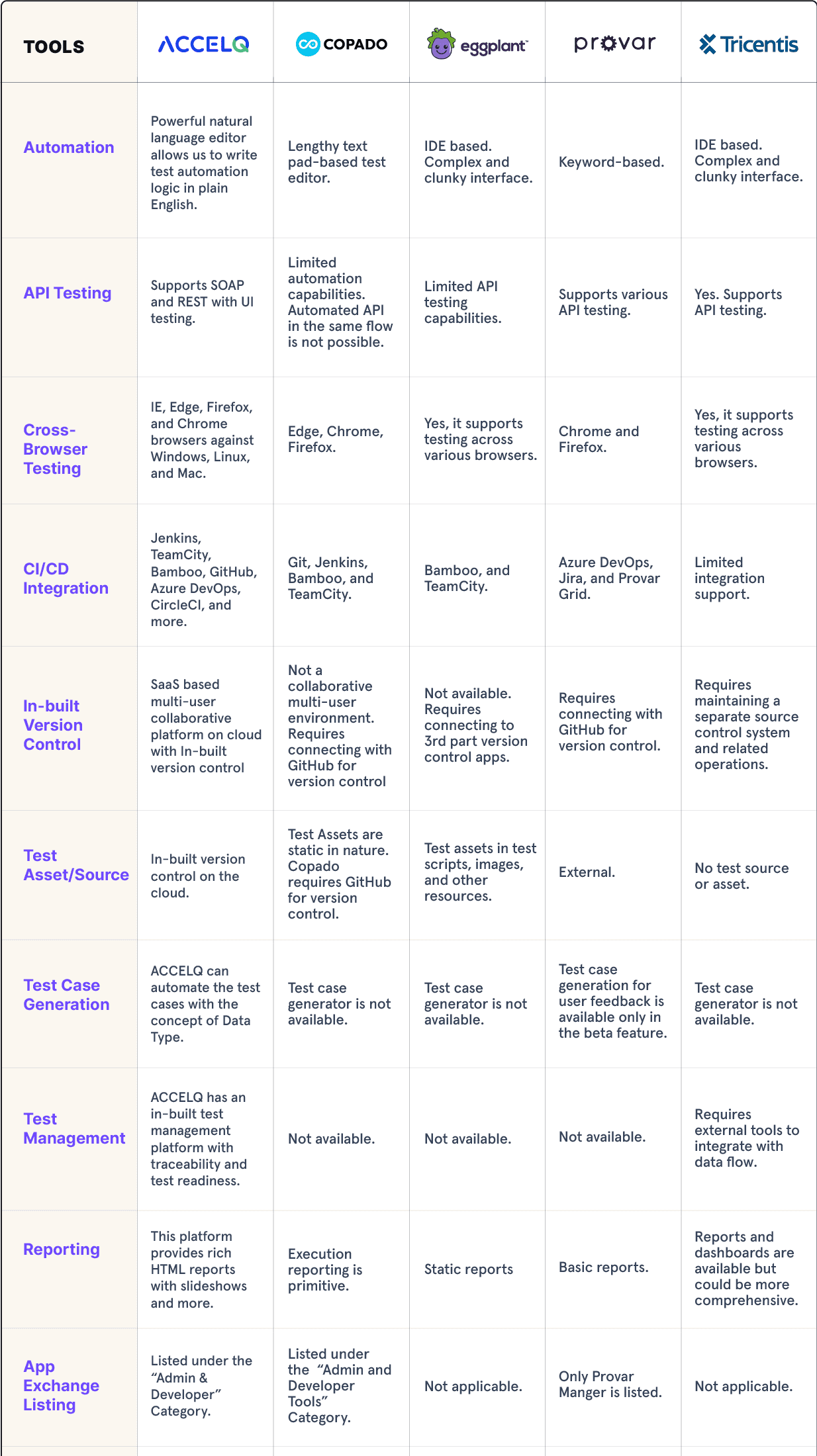
Here is a side-by-side comparison of the best Salesforce automation testing tools based on key capabilities:
5 Best Salesforce Automation Testing Tools
The platforms below represent some of the best Salesforce test automation tools available today, each suited to different testing maturity levels, team structures, and Salesforce environments.
1. ACCELQ

ACCELQ is an AI-powered continuous testing platform built specifically for enterprise Salesforce environments. It covers end-to-end testing across web, API, and mobile – all in one platform, without scripting. What sets it apart is the model-driven architecture. Instead of maintaining brittle test scripts, teams build once against ACCELQ’s application model.
When Salesforce updates, the platform self-heals – not the tester. That’s why ACCELQ customers report up to 70% less test maintenance overhead and 3x faster automation development. ACCELQ has been named a Leader in the Forrester Wave™ for Automation Testing Platforms 2025 and holds a 4.8/5 rating on G2.
Key features:
- AI-powered automation: Automates test case generation and execution workflows to reduce manual effort and improve coverage.
- Salesforce release alignment: Stays aligned with Salesforce seasonal releases to reduce upgrade-related test maintenance.
- No-code automation: Enables teams to build and maintain tests without extensive programming knowledge.
- Cross-platform coverage: Supports Salesforce Classic, Lightning, and Lightning Web Components across web, API, and mobile channels.
- Integrated test management: Combines automation, execution, traceability, and reporting in one platform.
- ACCELQ Autopilot: It is the platform’s GenAI engine – it automatically discovers test scenarios from your application, generates them without manual authoring, and executes them autonomously. Teams using Autopilot report significantly reduced scenario creation time and improved coverage without additional QA headcount.
Test Salesforce end-to-end — Classic, Lightning & LWC
No-code AI automation that self-heals after every Salesforce release. No scripting required.
Cons: Teams new to codeless, model-based automation may require initial onboarding.
Best for: Enterprise teams automating Salesforce across complex workflows and integrations.
Why teams choose it:
- 3x faster automation development
- 70% less maintenance overhead
- 50%+ cost savings
- Supports scalable end-to-end automation across Salesforce environments
- Integrates with CI/CD pipelines and enterprise QA workflows
- Improves release readiness with built-in reporting and traceability


2. Copado

Copado is a DevOps platform designed specifically for Salesforce. This platform aims to improve the quality and speed of Salesforce applications through CI/CD tools. Copado’s standout strength is version control. The platform checks the changes to see whether the Salesforce environment is appropriately tracked and managed.
Features:
- Copado supports Git-based version control to record changes made to Salesforce code.
- This platform can deploy and track configuration data across various cloud services, including Financial Services and Commerce.
- The QForce library by Copado (a Robot Framework library containing Salesforce keywords) simplifies functional testing automation.
- This platform provides Salesforce Metadata Intelligence to monitor and maintain your organization’s health by offering change alerts, automated conflict detection, and resolution strategies.
- The Copado Command Line Interface (CLI) is a tool that allows development teams to develop and deploy top-notch Salesforce applications.
- Copado provides detailed compliance and governance features, making this platform a choice for organizations with severe security needs.
Cons: Primarily focused on DevOps workflows, not full test automation depth
Best for: Teams focused on Salesforce CI/CD and release management

3. Eggplant

The Eggplant now part of Keysight Salesforce tool is an AI-assisted test automation solution that addresses the complexities of testing. This tool extends with other Salesforce testing tools that rely on verifying the scripts. The following is how the Eggplant tool can help organizations with their capabilities –
Features:
- Eggplant offers a single model-based approach to auto-generate user journeys that span different devices, browsers, and operating systems.
- This tool can interact with text or images on a screen to validate the UI. When validating the UI, testers can use the same test snippets across versions of Salesforce.
- AI-assisted automation enables intelligent testing to create crucial user flows across Salesforce.
- The AI engine monitors how Salesforce generates tests based on user journeys.
- This tool enables anyone in your organization to easily create test flows by clicking through a model to design a user journey.
Cons: Requires learning model-based testing approach
Best for: Teams focusing on UI-driven testing across devices
4. Provar

This tool offers integrated quality management and test automation solutions for Salesforce. Its primary objective is to maintain a high level of quality for your Salesforce system and catch any potential issues early on. With its advanced features, it helps you keep Salesforce running cleanly.
Features:
- The Provar Automation tests stay compatible with every Salesforce release and the latest web browser updates.
- Testers and developers can instantly begin and build a test case in minutes with a simple, user-friendly design. The low-code interface allows teams to use an intuitive test-building approach.
- Provar Automation reduces risk to your organization due to poor environment setup, loose password management, and insecure storage of test cases and business logic.
- Salesforce users can utilize this tool to test their complete business flow from beginning to end.
- Provar Automation enables the automation of various systems, including Apex, message queues, APIs, websites, email, and databases. It provides a detailed solution for automating your testing process.
Cons: Requires technical expertise for complex automation scenarios
Best for: Salesforce-focused QA teams with technical testers
5. Tricentis

Tricentis, a test automation tool, allows software development teams to create UI tests for Salesforce applications. It handles end-to-end testing across your CRM and connected apps after every update. Tricentis’ Test Automation for Salesforce is a cutting-edge tool designed exclusively for testing Salesforce.
Features:
- Configure and customize stable tests that include API steps to extend scenarios beyond the Salesforce app while using this tool.
- Tricentis Test Automation for Salesforce enables you to create test cases using pre-built actions tailored to your environment.
- End-to-end testing of Salesforce is supported by this tool, including third-party apps.
- Tricentis Test Automation for Salesforce works with any version of Salesforce. Teams can scale testing, orchestrate automated testing, and develop and release applications.
- The tool provides easily readable dashboards that allow quick problem identification based on test results.
Cons: Higher setup complexity for enterprise environments
Best for: Large enterprises with structured QA processes
How to Choose the Best Salesforce Automation Testing Tool?
When selecting from the best Salesforce automation testing tools, consider:
- Support for Salesforce-specific technologies like Lightning and LWC
- Ability to automate end-to-end workflows across UI and API
- Maintenance effort required for test updates
- Integration with CI/CD pipelines and DevOps tools
- Ease of use for both technical and non-technical users
The right tool should align with your team’s testing maturity and Salesforce ecosystem complexity.
- 3x faster automation development
- 70% less test maintenance
- Covers Classic, Lightning & LWC
Conclusion
Salesforce teams need testing tools that can keep pace with frequent platform updates, complex business workflows, and growing release expectations. The best Salesforce automation testing tools help improve coverage, reduce maintenance effort, and support reliable end-to-end validation across CRM environments.
Every tool on this list can automate Salesforce. The real differentiator is what happens after your test suite is built – when Salesforce releases a new update, your UI shifts, or your team grows. That’s where maintenance cost, self-healing capabilities, and platform depth separate the good options from the right one. For teams that want AI-driven, codeless automation that scales with Salesforce releases, ACCELQ Autopilot – ACCELQ’s GenAI engine for autonomous test generation and execution – is worth a close look. Contact us.
FAQs
Salesforce automation testing tools are specialized platforms designed to automate testing in Salesforce environments. They help validate the functionality, reliability, and performance of Salesforce applications by automating repetitive testing tasks, reducing manual effort, and improving testing efficiency.
Automation testing is essential for Salesforce due to its highly customizable and complex nature. It reduces testing time, helps identify defects earlier in the development cycle, and ensures that frequent updates or changes do not break existing functionality.
Yes, most leading Salesforce automation testing tools provide seamless integration with the Salesforce platform. This allows teams to efficiently test standard features, customizations, and integrations whenever updates or changes are introduced.
Popular Salesforce automation testing tools include ACCELQ, Provar, and Tricentis. Each tool offers distinct capabilities, catering to different testing needs such as codeless automation, enterprise scalability, and deep Salesforce integration.
Selecting the right tool depends on factors such as the complexity of your Salesforce implementation, team expertise, and budget. Key evaluation criteria include integration capabilities, ease of use, scalability, and total cost of ownership to ensure long-term value.



ACCELQ Team
ACCELQ is an AI-powered Codeless Test Automation platform on cloud that seamlessly automates Web UI, API, Mobile, and Desktop. ACCELQ was analyzed as a leader in the latest Continuous Test Automation platform Forrester research.


You Might Also Like:
 How AI-Powered Automation Speeds Up Salesforce Delivery?
How AI-Powered Automation Speeds Up Salesforce Delivery?
 ACCELQ vs RSAT: Comparing Dynamics 365 Regression Testing Approaches
ACCELQ vs RSAT: Comparing Dynamics 365 Regression Testing Approaches
 Testing MS Dynamics 365 with ACCELQ