








Test Automation Pitfalls: Why Most Automation Fails and How to Fix It?

Test automation was never meant to replace testers. It was meant to help them. Yet across teams and industries, automation still fails far more often than it succeeds.
- Not because automation is flawed.
- Because the way it’s implemented usually is.
When test automation fails, it rarely fails loudly. It slowly becomes expensive, brittle, and ignored. Scripts break. Maintenance grows. Trust erodes. Eventually, teams stop relying on it.
- These are not isolated incidents. They are patterns.
Let’s break down the most common test automation pitfalls, why they happen, and how teams can avoid repeating the same mistakes.
- The Original Promise of Test Automation
- What Are Common Test Automation Pitfalls?
- Why Does Test Automation Often Fail?
- Modern Automation Platforms Change the Equation
- ACCELQ Addresses Core Test Automation Pitfalls
- Autopilot and the Shift Toward Intelligent Automation
- Common Test Automation Mistakes and Solutions
- How Can Teams Avoid Automation Maintenance?
- Manual Testers Are Not at Risk. They Are Central.
- Final Thoughts
The Original Promise of Test Automation and Where It Went Wrong?
Automation entered QA with a clear purpose, often discussed in the context of what is test automation. Reduce repetitive work and Speed up regression. Let testers focus on thinking instead of clicking.
Instead, many organizations created two disconnected roles. Manual testers on one side. Automation engineers on the other. Work moved through handoffs. Context was lost. Feedback slowed down.
What this really means is that automation often drifted away from quality ownership.
Instead of reinforcing testers, automation became a parallel activity. And that’s where most problems begin.
What Are Common Test Automation Pitfalls?
Let’s be direct. These are the issues teams run into again and again.
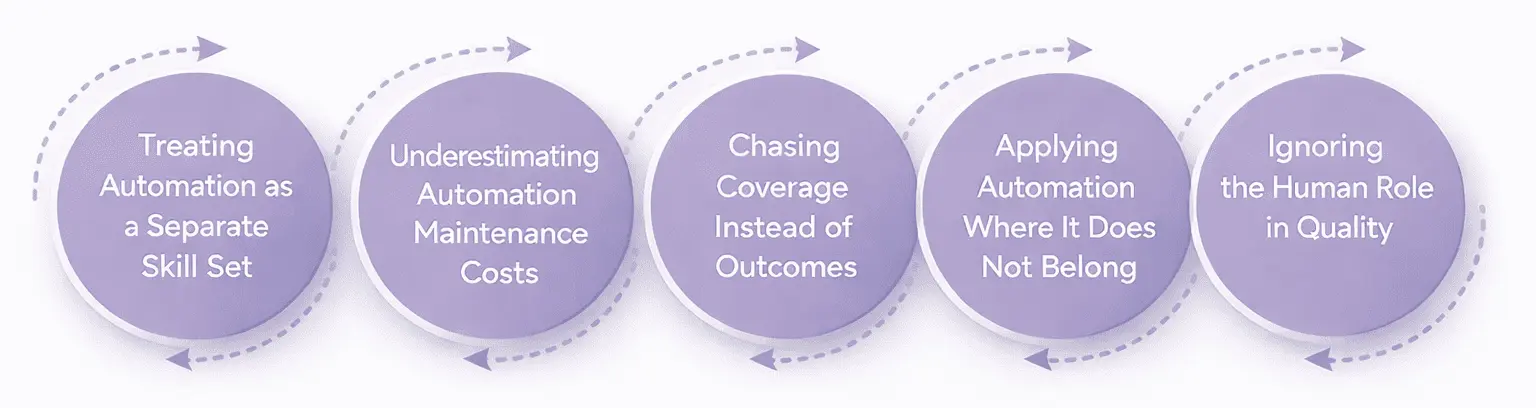
1. Treating Automation as a Separate Skill Set
One of the biggest test automation pitfalls is assuming automation belongs only to specialists.
When manual testers are excluded, automation becomes detached from real testing intent. Scripts validate mechanics, not behavior. Edge cases are missed. Scenarios lack business depth.
Automation works best when testers drive it, a principle central to scriptless test automation. Tools should adapt to testers, not the other way around.
2. Underestimating Automation Maintenance Costs
Automation maintenance costs quietly kill test initiatives.
Every UI change breaks scripts. Every release adds rework. Over time, teams spend more effort fixing automation than running it.
This usually happens because:
- Scripts are tightly coupled to implementation details
- Locators are brittle
- Tests are not modeled around business flows
When automation maintenance grows faster than test coverage, teams stop trusting results. That’s when automation becomes shelfware.
SUGGESTED READ - The Top 7 UI Test Automation Best Practices
3. Chasing Coverage Instead of Outcomes
Another common mistake is measuring success by the number of automated tests.
High test counts do not equal high confidence.
Automating low-value scenarios while missing critical workflows leads to false assurance. Teams feel covered until production proves otherwise.
Automation should focus on what breaks the business, not what is easiest to script.
4. Applying Automation Where It Does Not Belong
A critical but often ignored question is: When should you avoid test automation?
Not everything benefits from automation.
- Exploratory testing
- Usability feedback
- Emotion-driven user behavior
These require human judgment, which is why exploratory testing remains essential.
Trying to automate everything creates bloated suites with little insight. Smart teams automate what needs consistency and repeatability, and leave discovery to humans.
5. Ignoring the Human Role in Quality
This is the most damaging pitfall of all.
- Quality is not binary. It is contextual. It involves interpretation, intent, and risk assessment.
- Automation executes. Humans decide.
- When teams expect automation to replace thinking, failure is guaranteed.
 Also Read: Why AI Isn’t Replacing Testers?
Why Does Test Automation Often Fail?
If we zoom out, most test automation failures stem from the same root causes.
- Tools that require heavy coding create dependency bottlenecks
- Automation is bolted on after development instead of integrated early
- Test logic mirrors UI structure instead of business behavior
- Ownership is unclear between roles
What this really means is automation becomes fragile because it is built on the wrong abstraction.
Scale low-code testing with confidence.
Discover the evaluation framework used to select the right automation platform.
How Modern Automation Platforms Change the Equation?
The conversation around automation has shifted.
Today, the question is not whether to automate.
It’s how to automate without increasing complexity.
Modern platforms focus on approaches increasingly shaped by AI in software testing, including:
- Business-centric modeling instead of script-level logic
- No-code or low-code creation that testers can own
- Resilient automation that adapts to change
- Continuous execution across CI pipelines
This is where platforms like ACCELQ come into the picture.
ACCELQ was designed to break the very silos that caused automation to fail in the first place.
Where ACCELQ Addresses Core Test Automation Pitfalls?
ACCELQ approaches automation as an extension of testing, not a replacement for it.
Instead of scripts, it uses a model-based approach where applications are represented as business flows. Tests are created using natural language and visual logic rather than code.
This has direct impact on the biggest failure points:
- Automation maintenance costs drop because tests are not tied to UI structure
- Manual testers can create and evolve automation without handoffs
- Coverage aligns with business behavior, not technical steps
Autopilot and the Shift Toward Intelligent Automation
One of the newer shifts in ACCELQ’s ecosystem is Autopilot.
Autopilot does not automate blindly. It assists.
It helps teams generate automation from existing flows, user stories, and test intent, reflecting advances in generative AI in software testing. It reduces repetitive setup work and accelerates test creation without removing human control.
What this really means is testers stay in charge of quality decisions while automation scales execution.
Common Test Automation Mistakes and Solutions
Let’s put the lessons into practical terms.
Mistake: Automating everything
Solution: Automate repeatable, high-risk flows. Keep exploration manual.
Mistake: Writing brittle scripts
Solution: Use behavior-driven, model-based automation.
Mistake: High automation maintenance costs
Solution: Reduce dependency on locators and hard-coded logic.
Mistake: Excluding manual testers
Solution: Use no-code platforms that testers can own.
Mistake: Measuring success by test count
Solution: Measure confidence, defect escape rate, and release stability.
How Can Teams Avoid Automation Maintenance Headaches?
Maintenance is not a tooling problem alone. It’s a design problem, often caused by poor test automation architecture decisions.
Teams that succeed:
- Build tests around business behavior
- Reuse logic instead of duplicating scripts
- Keep automation readable and intent-driven
- Review automation like production code
When automation reflects how users actually use the system, maintenance naturally decreases.
Manual Testers Are Not at Risk. They Are Central.
The idea that automation threatens manual testers misses the point.
Automation removes repetition. It does not replace thinking.
Manual testers bring:
- Domain understanding
- Risk awareness
- Exploratory skill
- Judgment
Automation simply gives them leverage.
The future belongs to testers who understand both quality and automation, without being buried in code.
Explore More: Manual Testers: Key Players in Test Automation
Final Thoughts: Automation Is a Tool, Not a Strategy
Most test automation failures don’t happen because teams lack tools or skills. They happen because automation is treated as a destination instead of a support system. Scripts are written without intent. Maintenance is accepted as normal. Human judgment slowly gets pushed aside.
Automation works when it reinforces how testers think, not when it tries to think for them. The moment automation drifts away from business behavior, quality starts leaking through the cracks.
Avoiding test automation pitfalls is not about writing more tests. It’s about building the right ones. Tests that reflect real workflows. Automation that adapts instead of breaking. Platforms that empower testers instead of creating silos.
When automation and human insight move together, quality scales. Releases speed up without sacrificing confidence. And testers stay exactly where they belong at the center of the QA process.
That’s not a future goal. It’s a choice teams can make today.
Join the Future of Test Automation
Boost QA productivity with ACCELQ’s codeless platform



Prashanth Punnam
Sr. Technical Content Writer
With over 8 years of experience transforming complex technical concepts into engaging and accessible content. Skilled in creating high-impact articles, user manuals, whitepapers, and case studies, he builds brand authority and captivates diverse audiences while ensuring technical accuracy and clarity.

You Might Also Like:
 How ACCELQ Simplifies Coupa Test Automation?
How ACCELQ Simplifies Coupa Test Automation?
 Best Practices for Migrating Automated Tests to ACCELQ
Best Practices for Migrating Automated Tests to ACCELQ
 Don’t use Manual Test cases for Automation