







Best ETL Testing Tools in 2026: Compared by Automation, Validation & Data Integrity
Data pipelines rarely fail in obvious ways. A missing column, a transformation change after a schema update, or a few dropped records can silently affect reports and decisions without triggering any visible errors.
That gap between “the pipeline ran successfully” and “the pipeline produced accurate data” is why ETL testing exists. In this guide, we compare the best ETL testing tools in 2026, including ACCELQ, QuerySurge, Great Expectations, dbt Tests, Datagaps ETL Validator, and other leading platforms. We evaluate each tool based on automation capabilities, data validation depth, maintenance effort, and the types of teams they fit best.
As modern data systems become more connected and change frequently, choosing the right ETL testing tool helps teams detect data quality issues before they reach dashboards, reports, and business decisions.
- The best ETL testing tools in 2026 map to where your data breaks. ACCELQ fits data validation tied to the apps and APIs that feed it, QuerySurge fits warehouse checks, Great Expectations fits Python teams, dbt Tests fits dbt-based analytics, and Datagaps ETL Validator fits visual test design.
- A successful pipeline run proves the job finished, not that the numbers are right. Silent data errors usually reach reports and decisions before anyone traces them back.
- Rules-based testing catches the failures you predicted, and AI-driven testing catches the ones you didn’t. The strongest setups use rules for known business logic and AI for change detection and coverage gaps.
- Schema changes are what decide a tool’s long-term cost. A tool that needs manual rework after every upstream change will lose adoption within months, however well it demos.
- ETL tools and ETL testing tools do different jobs. One moves the data, and the other proves the move was correct, so neither replaces the other.
- ACCELQ uses AI agents to detect schema and API changes, repair the affected tests, and generate edge-case test data, while validating data in the same flow as the applications and APIs around it.
What Are ETL Testing Tools?
At a basic level, ETL testing tools verify that data moves correctly from source to destination. In practice, a tool worth adopting needs to validate a wider set of failure modes, including source-to-target accuracy, transformation logic, schema consistency, missing or duplicate records, business rule correctness, and performance under load.
Good ETL testing tools do not stop at checking whether data arrived. They help you trust your data pipeline end to end, in the same way that modern end-to-end testing across systems validates complete flows across applications, APIs, and data layers rather than isolated components.
ETL Tools and Testing: What’s the Difference?
ETL tools and ETL testing tools solve two different problems, even though the terms get used interchangeably in search. ETL tools, such as Informatica PowerCenter, Talend, and Apache Airflow, move and transform data from source to destination. ETL testing tools sit alongside them and verify that the move happened correctly, catching the extraction, transformation, and load errors that the ETL tool itself has no way to flag on its own.
This list of ETL tools in this guide focuses specifically on the testing layer, not the pipeline-building layer, since the two require different evaluation criteria. If you are running an ETL tool comparison for a data integration project, look for platforms built around moving data efficiently across systems. If you are evaluating tools for ETL testing, look for platforms built around catching what the pipeline got wrong before it reaches a report or a dashboard.
What to Look for in ETL Testing Tools
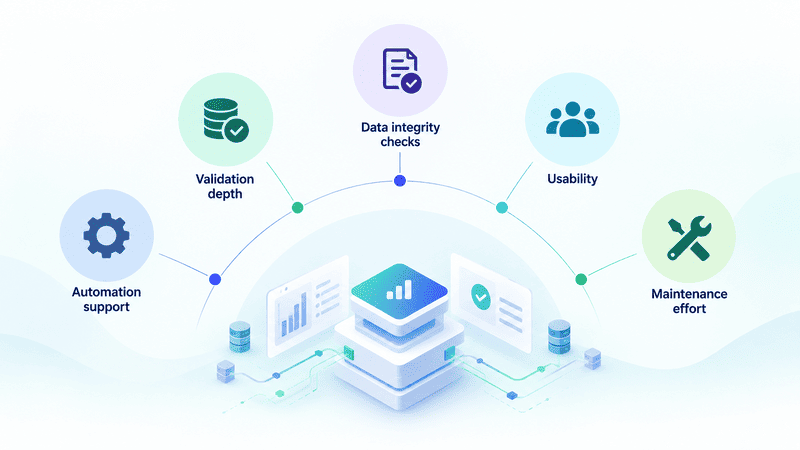
Before comparing specific products, it helps to be clear on what separates a tool that survives contact with production from one that looks good only in a sales demo. Five factors consistently determine adoption and long-term retention.
Automation support measures whether the tool can trigger validation on its own, through scheduled runs after every data load or through CI/CD pipeline integration with platforms like GitHub Actions, Jenkins, or CircleCI, rather than requiring someone to run checks by hand.
Validation depth measures whether the tool goes beyond row counts into transformation logic, business rules, and referential integrity, since a table can have the correct row count and still contain corrupted values or duplicated records.
Data integrity checks measure whether the tool catches subtle issues such as schema drift (a renamed column or a changed datatype that breaks a downstream job weeks later), truncation, and type mismatches that do not show up in a simple count comparison.
Usability measures whether the tool is designed for engineers, analysts, or QA teams, since a Python-only framework and a low-code visual tool solve the same problem for very different audiences.
Maintenance effort measures how much breaks when schemas change, which is often the single biggest predictor of whether a team keeps using a tool six months after adoption.
Most tools look reasonable in a demo. Reducing long-term effort depends heavily on reducing test automation maintenance overhead through adaptive testing approaches rather than brittle, hand-written scripts, and this is the factor that determines whether a tool actually works in production a year later.
 Also Read: Agentic Testing with ACCELQ
ETL Testing Tools Comparison: Which Platform Fits Where in 2026
Teams evaluating options should also understand how to choose the right test automation platform more broadly, since ETL validation rarely stays isolated from the rest of the QA stack for long. The table below scores each tool against the five factors covered earlier, alongside CI/CD fit, deployment type, and pricing, so it can be used as a single reference during evaluation.
| Tool | Best For | Automation | Validation Depth | Usability | Maintenance Effort | CI/CD Integration |
|---|---|---|---|---|---|---|
| ACCELQ | Data validation tied to the app and API flows that feed it | High | Very High | High (natural language authoring) | Low | Native |
| QuerySurge | Warehouse validation | High | High | Medium (query-based) | Medium | Strong |
| Great Expectations | Python teams | Medium | High | Low (code-first) | Medium to High | Custom |
| dbt Tests | Analytics workflows | Medium | Medium | Medium | Low | Native |
| Datagaps ETL Validator | Visual ETL validation | Medium | High | High (visual) | Medium | Moderate |
| iCEDQ | High-volume reconciliation | Medium | High | Medium | Medium | Moderate |
| RightData | Self-service teams | Medium | Medium | High (self-service) | Low to Medium | Moderate |
| Apache Griffin | Big data / Spark environments | Medium | High | Low (Spark-based) | High | Custom |
| BiG EVAL | BI and warehouse quality | Medium | Medium | Medium | Medium | Moderate |
| Custom frameworks | Flexible, small-scale setups | Low to Medium | Varies | Low | High | Custom |
A “High” maintenance effort score is unfavorable. It signals more rework every time an upstream schema shifts, which is the hidden cost that tends to surface months after rollout rather than during evaluation.
1. ACCELQ

ACCELQ validates source-to-target data alongside API and application layers in a single workflow instead of testing each in isolation. Test cases are built in natural language rather than code. Its Data & Config Agent generates synthetic test data that mirrors production behavior to widen edge-case coverage, and its Change Analyzer Agent detects schema and API changes, then repairs and revalidates the affected tests. That combination makes it a strong agentic AI testing platform for teams that need ETL validation tied to broader system behavior.
From the ACCELQ Help Center
Database verifications for ETL testing in ACCELQ
See how ACCELQ compares table metadata, primary keys, data types, and indexes across source and target databases, including Postgres, MySQL, and Snowflake.
Pricing and deployment: Commercial, cloud-based, quote-based pricing.
Best for: Teams whose pipelines feed or depend on applications, APIs, or packaged apps like Salesforce and SAP, and who want ETL validation in the same release workflow instead of a separate testing silo.
Watchout: May be more capability than needed for teams looking for lightweight, code-only validation on a single pipeline.
2. QuerySurge
QuerySurge validates source-to-target data using SQL-based query pairs, with built-in reconciliation reporting and CI/CD integration. It is purpose-built for structured data warehouse validation rather than cross-application testing.
Pricing and deployment: Commercial licensing, on-premises or cloud deployment options.
Best for: Teams focused specifically on warehouse validation and reconciliation rather than broader application or API testing.
3. Great Expectations

Great Expectations is a Python framework for writing and running data validation checks, called expectations, against pipeline output. Checks are written and versioned as code, which gives precise control but adds ongoing engineering overhead.
Pricing and deployment: Open-source and free to use, with paid cloud tiers available for teams that want managed infrastructure.
Best for: Data engineering teams comfortable with code-heavy workflows and existing Python expertise.
4. dbt Tests
dbt Tests run validation checks, such as uniqueness, not-null, referential integrity, and custom SQL assertions, directly inside dbt models. Tests version alongside transformation code, so there is no separate validation tool to maintain.
Pricing and deployment: Open-source core, with paid dbt Cloud tiers for orchestration and collaboration features.
Best for: Analytics engineering teams working inside dbt who need testing to live alongside their transformation logic rather than in a separate system.
5. Datagaps ETL Validator

Datagaps ETL Validator uses drag-and-drop test design for source-to-target validation, schema checks, and BI report testing. It removes the need to write scripts for most standard validation scenarios.
Pricing and deployment: Commercial, quote-based pricing, available as cloud or on-premises deployment.
Best for: Teams that prefer guided, visual workflows over writing and maintaining scripts.
6. iCEDQ

iCEDQ runs rule-based reconciliation and data quality checks across large, high-volume datasets, with support for major cloud data platforms. Initial configuration takes more effort than fully visual tools.
Pricing and deployment: Commercial, tiered licensing based on data volume.
Best for: Data engineering teams running high-volume reconciliation across multiple source systems.
7. RightData
RightData compares and reconciles datasets across sources through a self-service interface built for both technical and business users. It covers completeness, accuracy, and duplication checks without requiring scripting.
Pricing and deployment: Commercial, subscription-based, cloud or hybrid deployment.
Best for: Teams that need self-service validation without building out a dedicated test automation practice first.
8. Apache Griffin

Apache Griffin is an open-source data quality framework built for Hadoop and Spark pipelines. It profiles data quality at scale but requires Spark expertise to configure and maintain.
Pricing and deployment: Open-source and free, self-hosted.
Best for: Organizations running custom Hadoop or Spark clusters that need data quality profiling built for that scale.
9. BiG EVAL

BiG EVAL checks completeness, accuracy, and consistency across data warehouses and BI layers, sitting between fully code-first frameworks and fully visual tools.
Pricing and deployment: Commercial, quote-based.
Best for: Teams that need structured data quality monitoring alongside traditional ETL validation.
10. Custom SQL and Python Frameworks
Custom SQL and Python scripts validate exactly what a team builds them to check, with no licensing cost. They are still common in smaller environments and early-stage data teams.
Watchout: Maintenance grows fast as pipelines multiply, since each script is typically maintained independently with no shared framework.
Why Automation Matters More in ETL Testing Today
Pipelines change faster than they used to, which is exactly why ETL automation testing tools, sometimes sold as ETL automation testing software, have moved from a nice-to-have to a baseline requirement rather than a mature-team luxury. The cost of bad data is no longer a rounding error buried in a footnote.
Data is now consumed by more systems than ever, AI models train on it directly, and business decisions increasingly depend on it in near real time rather than after a quarterly review. Teams running mature ETL testing practices report catching schema drift and transformation errors before they reach production dashboards, rather than discovering them from a confused stakeholder asking why last week’s numbers do not match this week’s.
That shift is why teams are moving toward a business-value of testing approach that connects testing outcomes to real business impact instead of treating validation as a checkbox. Platforms like ACCELQ reflect that shift by connecting data validation, API validation, workflow testing, and business logic verification instead of treating each as a separate problem solved by a separate tool.
SUGGESTED READ - 10 Best Test Automation Trends to look out for in 2027
How to Choose the Right ETL Testing Tool
There is no universal best ETL testing tool, since the right choice depends heavily on your existing setup and team composition. Start by asking whether you need only validation or full pipeline automation, whether your team is code-first or low-code by preference, how often your schemas change, whether CI/CD integration is a requirement rather than a nice-to-have, and whether you are testing isolated pipelines or full business workflows that span multiple systems.
Your answers to those questions will narrow the right category of tools for ETL testing quickly, often faster than reading through another ten-tool comparison list.
Tools like AutoIt, Pywinauto, and FlaUI cost nothing to license, but the engineering hours spent maintaining locators, building CI integration, and onboarding new testers are a recurring cost that doesn’t show up on a budget line. Commercial platforms shift that cost into a subscription, and for teams running large, frequently changing desktop suites, that trade usually pays for itself in reduced maintenance time alone.
Final Thoughts
ETL testing is no longer just a technical checkpoint tucked away in a data engineering backlog. It has become a control layer for business trust, and as data pipelines grow more complex and interconnected, the cost of getting it wrong increases quietly but significantly. A missed transformation or an unnoticed schema change does not just affect the data team that owns the pipeline. It ripples into reporting, decision-making, and increasingly into AI-driven systems that were never designed to question the data they are fed.
The right ETL testing approach is not about checking tables after the fact. It is about building continuous, reliable validation into the flow of delivery itself, which is the same principle behind a broader continuous testing strategy applied across an organization’s entire release process rather than one pipeline at a time.
Some teams will solve this with focused data validation frameworks built in-house. Others, especially in enterprise environments with dependencies across dozens of systems, will need broader automation that connects data, applications, and workflows under one strategy. Every ETL setup is different, so talk to our experts to find the right approach for your data pipelines, automation needs, and long-term scalability.
FAQ's
What are the best ETL testing tools in 2026?
The strongest ETL testing options in 2026 include ACCELQ for validating data alongside the applications and APIs that produce it, QuerySurge for data warehouse validation, Great Expectations for Python-based validation, dbt Tests for analytics workflows built on dbt, and Datagaps ETL Validator for teams that prefer visual test design. The right choice depends on where data issues occur: inside the warehouse, within transformations, or between pipelines and connected systems.
What are the best practices for automating ETL testing?
Key practices include running validation through CI/CD instead of manually, checking schema, transformation logic, and business rules rather than only row counts, versioning test logic alongside pipeline code, and selecting a framework that matches your team's skills. Effective ETL testing becomes part of the deployment pipeline rather than a separate QA activity added later.
What are the most popular open source ETL tools available today?
Apache Airflow, Talend Open Studio, and Apache NiFi are widely used open source tools for building ETL pipelines. For ETL testing and validation, Great Expectations, dbt Tests, and Apache Griffin are popular options, with each fitting different environments such as Python-based workflows, dbt analytics pipelines, and large Hadoop or Spark environments.
How do I choose the best ETL tools for my data integration needs?
Start by evaluating data volume, the number of source systems, and your team's coding comfort level. High-volume, multi-source integrations often need dedicated ETL platforms with built-in orchestration, while smaller projects may work well with lighter code-first tools. Whatever ETL platform you choose, pair it with dedicated testing capabilities instead of relying only on built-in checks.
What are some free ETL tools that are reliable for small projects?
For small projects, Apache Airflow and Talend Open Studio are reliable free options for building pipelines. For testing and validation, Great Expectations, dbt Tests, and Apache Griffin provide open source ETL testing capabilities without licensing costs. Active community support is often as important as the tool's price when troubleshooting real-world data issues.



Prashanth Punnam
Sr. Technical Content Writer
With over 8 years of experience transforming complex technical concepts into engaging and accessible content. Skilled in creating high-impact articles, user manuals, whitepapers, and case studies, he builds brand authority and captivates diverse audiences while ensuring technical accuracy and clarity.


You Might Also Like:
 What Is MCP Testing? A Practical Guide to Model Context Protocol
What Is MCP Testing? A Practical Guide to Model Context Protocol
 Test Automation Pyramid Explained 2026
Test Automation Pyramid Explained 2026
 Benefits of Code Coverage QA Team Should Use in 2026