








A Complete Guide On ERP Testing

Enterprise Resource Planning (ERP) systems coordinate the fundamental business processes through tightly integrated modules, based on common data models, workflow engines, and transactional consistency in distributed settings. These systems are connected to outside APIs and legacy systems and are therefore vulnerable to schema changes, dependency breakdowns, and configuration drift. That’s why testing ERP is so necessary.
ERP testing checks process integrity end-to-end(E2E), data consistency, and system behavior under load and failover. It prevents breaking transactional accuracy, authorization logic, and integration points across the enterprise stack through customizations and extensions. Let us understand what ERP testing is, how it differs from traditional testing, and more.
What is ERP Testing, and Why is it Important?
ERP software testing is the process by which testers assess the entire performance of an enterprise resource planning system. They verify that the software’s functionality, performance, and security are satisfactory. Typically, this process extends beyond conventional software testing, as ERP software testers verify the interaction between different program units. The insufficient testing can lead to disrupted production, missed deadlines, and financial losses.
Why is ERP Testing Important?
- Reduce risk: Make sure that the industry is adhered to and no penalties are enforced.
- Make customizations: ERP systems usually need custom settings. The tests allow them to be as intended.
- Improve user adoption: A tested ERP system minimizes errors, which increases user confidence.
- Saves money in the long term: It is more expensive to correct mistakes after launch than to detect them during the testing stage.
What’s the Difference Between ERP Testing and Traditional Testing?
The differences between ERP and traditional testing are the vast scope and complexity of ERP systems that integrate numerous core business functions into a single platform. Traditional testing focuses on a single application functionality, whereas ERP testing ensures seamless, E2E business process flow across integrated modules and external systems.
| Aspect | ERP Testing | Traditional Testing |
|---|---|---|
| Scope | Covers every integrated business process (finance, HR, supply chain, etc.) and their interdependencies. | Focuses on the functionality of a single application. |
| Focus | Validates that the entire system supports an organization’s specific business needs and processes. | Majorly ensures the software functions as designed, based on your technical requirements. |
| Complexity | More complicated due to extensive customizations and integrations with internal and third-party systems. | Less complexity with predictable and linear testing paths. |
| Data | Needs volumes of complex test data that remain consistent across all integrated modules to simulate real-world scenarios. | Test data requirements are usually more specific to individual functions. |
| Regulatory Needs | Often involves stringent regulatory requirements, demanding comprehensive traceability and rigorous QA. | Regulatory needs vary by application type and industry, but are often less extensive than core ERP functions. |
Smarter, Faster, Limitless Automation Awaits!
Take AUTOPILOT for a Test Drive Today
Role of AI in ERP Testing
Integrating artificial intelligence into test automation enables innovative testing processes. Let’s understand the role of AI to enhance ERP testing:
AI-Powered Test Management
Traditional data management presents data inconsistencies, time consumption, and difficulty in managing large data volumes. AI-powered test management tools can overcome these challenges by generating realistic test data that mimics real-world applications.
Autonomous Test Generation
The LLM models use AI to generate test scripts from user stories, functional requirements, and business models. You can utilize AI for test case generation because it accelerates the testing process and enhances test coverage.
AI in DevOps
With continuous testing using AI in DevOps, tests can run automatically at every stage of development, including unit, integration, functional, and performance testing, as soon as changes are submitted. It dynamically adjusts the test execution strategies as per system performance, error rates, and test coverage.
Predictive Test Selection and Risk-Based Testing
The AI-driven analytics offer insights about high-risk areas based on historical defect patterns, usage frequency, and business impact. AI for regression testing helps prioritize test cases and minimizes test execution time.


Types of ERP Testing
The scale and complexity of ERP platforms necessitate various tests to ensure all facets of the system operate as intended. The types of tests are aimed at various aspects of ERP quality. Let’s have a look at the different types of ERP testing:
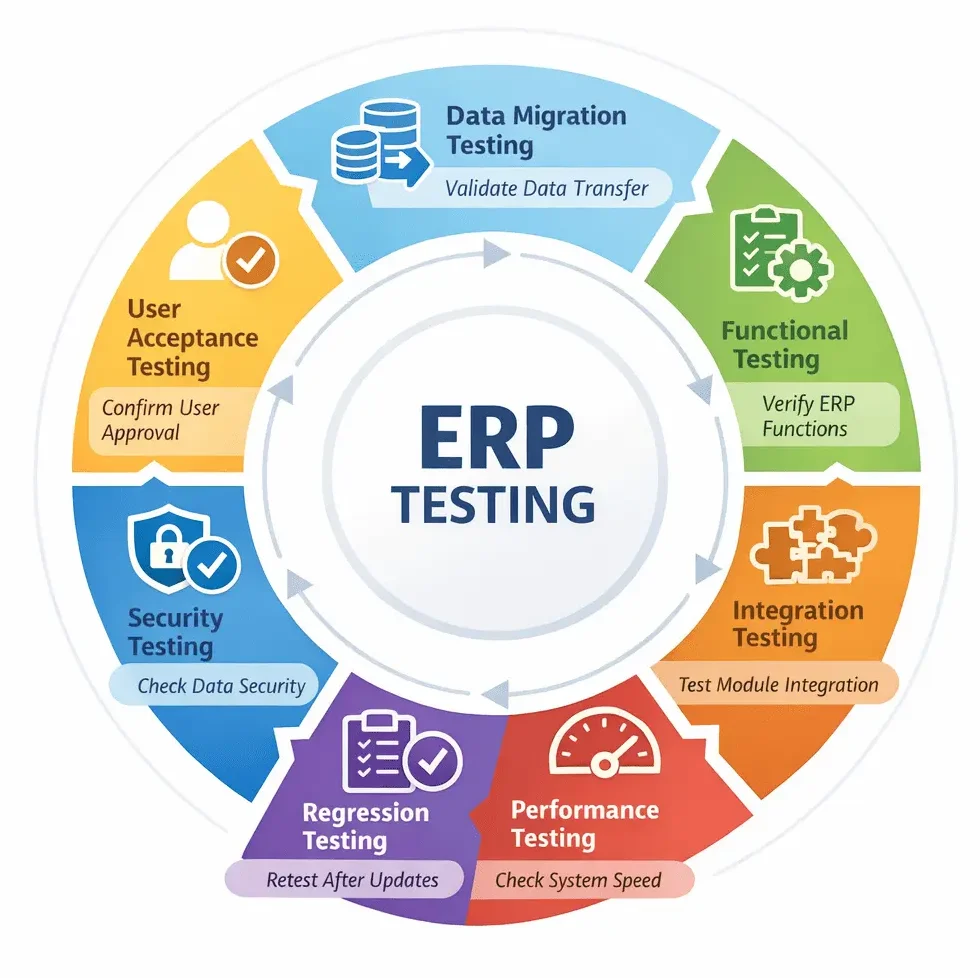
Data Migration Testing
It is a type of testing that usually entails reconciliation between the old and new systems to verify any data loss. Data migration testing is an important single test during implementation to avoid big data problems.
Functional Testing
This type of testing ensures every module and feature of the ERP is functioning as per the requirements and design. It guarantees that all business processes (e.g., finance postings, HR onboarding workflow, order processing) will work smoothly post any customizations.
Integration Testing
Tests the compatibility of the different modules and third-party applications integrated with the ERP. During integration testing, testers ensure that E2E business processes flow through the ERP.
Performance Testing
The actual testing of the ERP system is under the real workloads. This involves simulating a large number of users and transaction loads to ensure that the ERP can handle peak usage periods without performance issues.
Regression Testing
Regression tests are done to re-execute test cases that have passed earlier, once a new module is added, to make sure that new changes do not break old functionality. Frequent regression testing identifies unintended side effects early and keeps the overall stability of the ERP in the long run.
Security Testing
This type of testing involves checking user role privileges, data encryption, and vulnerability testing to see how users are gaining unauthorized access to the data or breaching it. As ERPs store sensitive data (financial records, employee data, customer info, more), security testing is essential.
User Acceptance Testing
In UAT, real users of the ERP system do the testing to ensure that the system can satisfy their requirements in a real situation. It aids in detecting problems that only actual users would recognize and ensures that users are on board with it. As soon as users sign off on the system during user acceptance testing or UAT, it increases the adoption rates after the launch.
ERP Testing Challenges
ERP projects are large and complex, which makes ERP testing complex. The following are the challenges that are likely to arise in ERP testing and how to address them:
Complicated System
The ERP systems are dynamic and highly interrelated systems with numerous modules. The complexity is addressed by breaking testing into tiny modules and testing integrations in small steps. Repetitive tests can be covered with automation, and an iterative process enables the team to test the entire system gradually.
Data Migration
ERP may work well with static data, but it may not work with real data unless it is tested. As a result, develop a dedicated test environment using quality test data. In case of data migration, do a specific migration test to verify all records and conversions. Removing the test system loading with a complete set of scenarios (edge cases and invalid inputs) will improve the test results.
Resource
Testing ERP needs specialized experts and a sufficient budget. So, start testing early in the project and consider it a central approach of your plan, rather than an afterthought.
Best Practices for ERP Testing
The most effective ERP testing best practices are:
Engaging Key Stakeholders
Successful testing starts with active collaboration among management, developers, and end users (UAT). Involving all stakeholders ensures a detailed evaluation through diverse perspectives. No-code automation testing further democratizes ERP testing, enabling non-technical users to participate effectively and improve test coverage across the organization.
Developing a Comprehensive Testing Blueprint
A well-defined testing blueprint aligns stakeholders on priorities and provides a clear roadmap for the entire ERP testing process. It enhances transparency, accountability, and workflow efficiency, ensuring each module and integration is tested systematically to support your testing plan.
Early Testing Approach
Implementing a shift-left testing approach enables early defect detection, preventing bottlenecks and costly rework later in the ERP lifecycle. Testing early fosters a proactive, quality-first mindset, ensuring issues are resolved promptly and system integrity is maintained throughout development and deployment.
Embracing Continuous Testing
Ensures consistent ERP performance by validating functionality across every stage from development to post-implementation. It is an iterative approach that helps detect bugs early, maintain system reliability, and enable faster adaptation to evolving business needs and technologies.
Employing Quality Test Data
Accurate and realistic test data are key to reliable ERP testing outcomes. Using data from audits, user surveys, or automated test data management tools helps mirror real-world scenarios, improving test accuracy and issue detection. Quality test data ensures robust results across diverse user interactions and system conditions.
Leveraging a Dedicated Test Environment
A dedicated test environment minimizes launch risks by isolating testing from production systems. It enables safe validation of configurations and integrations without disrupting business operations, ensuring system stability, data integrity, and a smooth live experience.
Conducting Functional, Integration, and Regression Testing
A balanced ERP testing strategy combines functional, integration, and regression testing to ensure stability and seamless performance. Regression testing safeguards existing features, functional testing validates new capabilities, and integration testing verifies smooth data flow across modules, minimizing post-implementation risks.
Allocating Sufficient Time for UAT
User acceptance testing validates the ERP system’s real-world functionality and usability. Allocating sufficient time for end users to test and provide feedback ensures the system meets business needs, improves user confidence, and reduces post-deployment issues.
Ensuring Regulatory Compliance
Integrating compliance checks into ERP testing ensures adherence to industry standards and legal mandates. This proactive step prevents fines, mitigates risks, and promotes the ethical implementation of systems to safeguard an organization’s reputation and ensure the long-term sustainability of its systems in regulated environments.
Build Continuous, Compliant ERP Testing
Discover how AI automation supports quality, risk control, and regulatory readiness.
📱 Read the E-book
Embrace No-Code Testing
APM tracks application metrics like throughput, error rates, and response times. It works for monoliths but struggles with distributed, API-heavy architectures.
How Does Automation Help in ERP Testing?
ERP test automation boosts productivity and guarantees steady performance. As companies increasingly depend on ERP systems to handle vital operations, automation simplifies testing procedures and guarantees smooth implementation and upgrades. Here is an overview of its benefits:
- Streamlined testing: Automation allows the team to quickly validate the updates or new modifications in the codebase to ensure that it doesn’t disrupt the existing functionality.
- Efficiency of time: ERP test automation allows repetitive and time-consuming tasks to be finished more swiftly, enabling teams to focus on critical problem-solving and system enhancement for speeding up project schedules.
Thus, automation ensures efficiency and effectiveness toward attaining organization-wide goals and objectives by improving precision, reducing expenses, and conserving time related to ERP.
Automate ERP Testing Without the Risk
See how codeless automation delivers speed, accuracy, and compliance at scale.
📄 Download the Whitepaper
ERP Test Management
ERP test management protects the business from expensive failures and brings order to the chaos of implementation. When teams test different modules in parallel without coordination, various problems arise, including test coverage gaps, wasted effort, and unexpected issues after launch. Test management for ERP provides the structure to prevent all these problems.
Conclusion
ERP testing forms a crucial control layer that guarantees transactional accuracy, configuration stability, integration integrity of modular, and event-driven enterprise systems. When deploying, customizing, or upgrading your ERP system, a focused partner provides traceable coverage, early identification of defects, and less business interruption.
ACCELQ redefines ERP test automation by auto-generating and self-healing test assets when apps change. The platform supports complete E2E validation across SAP/Oracle/Workday/ServiceNow/Coupa/Pega/MS-Dynamics/nCino. It offers seamless CI/CD for true continuous testing. You can achieve faster releases, lower maintenance effort, no brittle scripts, and no framework headaches with ACCELQ.
Contact us today to strengthen your ERP environment with an enterprise-level QA strategy and delivery.



Chaithanya M N
Content Writer
A curious individual who is eager to learn and loves to share her knowledge using simple conversational writing skills. While her calling is technology and reading up on marketing updates, she also finds time to pursue her interests in philosophy, dance and music.

You Might Also Like:
 A Comprehensive Resource On Coupa Test Automation
A Comprehensive Resource On Coupa Test Automation
 Salesforce Live – The ROI Booster
Salesforce Live – The ROI Booster
 Top 8 ERP Testing Tools