








ChatGPT for Test Automation: What It Can Actually Do in 2026?

LLMs have changed the way software teams think about test automation. Not because they magically replace testing, but because they remove the friction around ideas, scripts, data, and documentation. ChatGPT is now part of many QA workflows, yet its real value often gets misunderstood. Some people expect miracles. Others dismiss it entirely. The truth sits somewhere in the middle.
So, here’s the point of this guide. If you’re trying to understand what ChatGPT can genuinely do for test automation, how it helps testers work faster, and where it still falls short, this article will walk you through it. We’ll break down the real use-cases, the prompts that work, and how companies integrate LLMs into their pipelines without falling for the hype.
Let’s get into it.
- What ChatGPT Is, and Why Testers Use It
- How to Use ChatGPT in Software Testing
- Top Real-World Use Cases of ChatGPT for Test Automation
- Best ChatGPT Prompts for Software Testing
- Integrating ChatGPT into Test Automation Pipelines
- Benefits of ChatGPT in Test Automation
- Limitations of ChatGPT for Test Automation
- ChatGPT vs Dedicated AI Testing Platforms
- CI/CD Workflow Using ChatGPT for Test Automation
- A Practical Daily Workflow with ChatGPT
- Conclusion: ChatGPT for Test Automation
What ChatGPT Is, And Why Testers Use It?
ChatGPT is an instruction-following large language model. It reads natural language, understands the intent behind it, and generates a structured response. That could be a test case, a code snippet, a SQL query, or an explanation of why an API call is failing.
Think of it as a companion that accelerates thinking, not a tool that replaces your testing stack. ChatGPT won’t run tests, inspect DOM elements, or plug itself into your CI/CD pipeline. But it will help you make decisions faster and reduce a good amount of manual effort.
Once you accept that role, it becomes incredibly useful.
🤖 Agentic Automation That Learns and Innovates
Redefine Your Testing Game with AUTOPILOT
How to Use ChatGPT in Software Testing?
ChatGPT fits naturally into testing because most QA work starts with language.
Requirements like User stories, Acceptance criteria, Bug reports and Test ideas rely on clarity, and ChatGPT is good at creating order out of messy inputs.
Here are the practical ways testers use it every day.
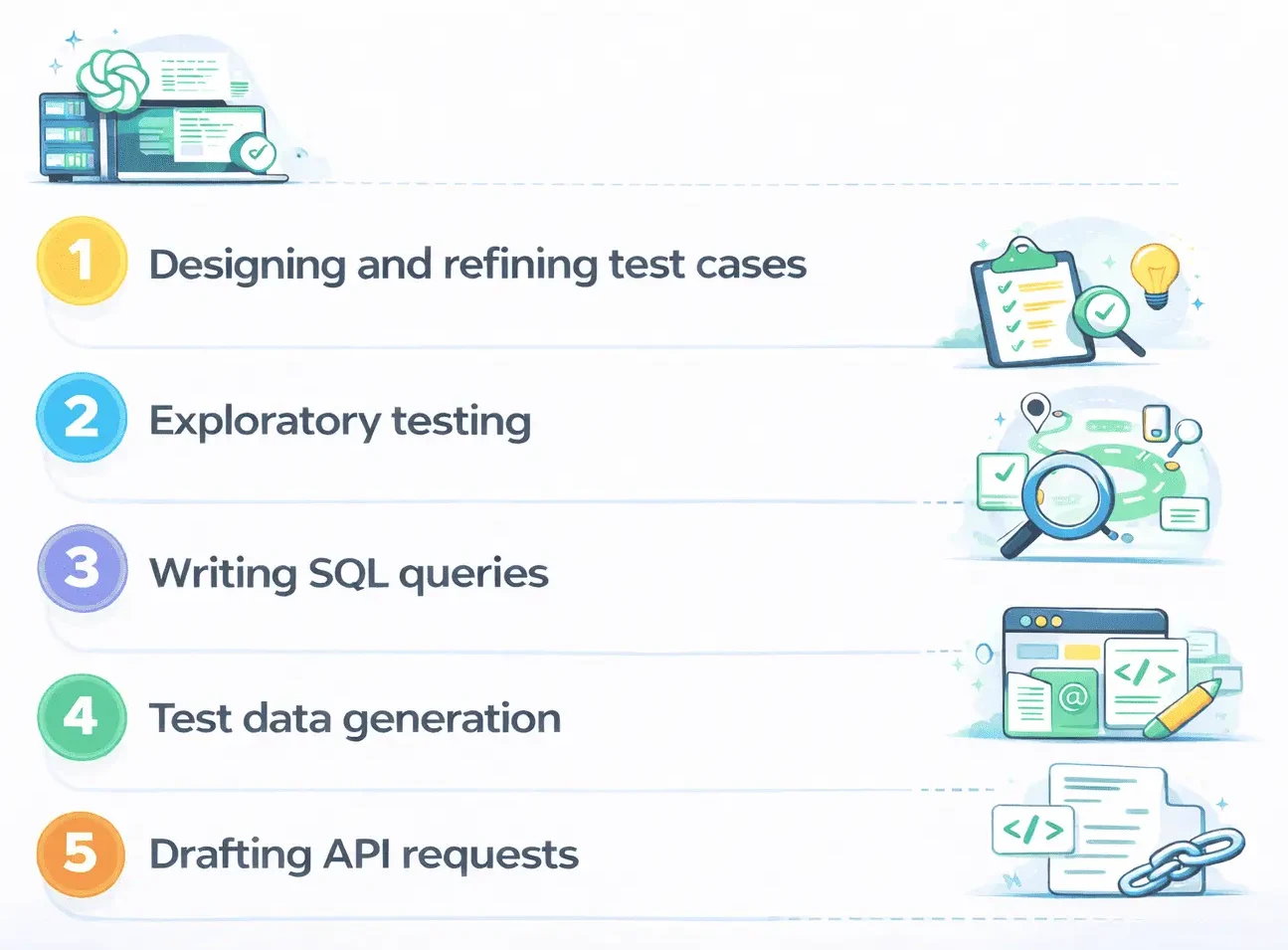
1. Designing and refining test cases
Give ChatGPT a user story and it will outline positive, negative, and edge-case tests. It often surfaces scenarios you’d normally discover much later.
2. Using ChatGPT in software testing for exploratory depth
Ask for unusual or boundary-level paths. LLMs are surprisingly good at exploring “what if” situations.
3. Writing SQL queries
This is one of ChatGPT’s strongest areas. It can turn natural language into reliable SQL for verification and validation tasks.
4. ChatGPT test data generation
From email formats to invalid date ranges, ChatGPT can produce clean edge-case data instantly.
5. Drafting API requests
Describe the API and the model will generate test-ready payloads and headers. When working with APIs, testers often start by interpreting documentation before writing requests.
This aligns naturally with API automation workflows, where testers focus on validating contracts, response structures, and behavior rather than spending time assembling boilerplate requests. When combined with structured API automation testing practices, this reduces setup effort while keeping test intent clear.
6. Explaining failures
Paste a stack trace and it can summarize likely causes. Not always perfect, but often directionally helpful.
Used well, ChatGPT becomes a thinking partner that trims hours of low-value effort.
Top 5 Real-World Use Cases of ChatGPT for Test Automation
These are the use cases teams rely on most often.
1. Better test case design
Give ChatGPT your acceptance criteria and ask it to highlight gaps. It will point out missing validations, unusual flows, or forgotten edge cases.
2. Writing automation testing scripts
This is where the query ChatGPT and automation testing principles and scripts fits naturally.
ChatGPT can produce template-level code for:
- Selenium
- Playwright
- Cypress
- API tests in Postman/Newman
- Cucumber BDD scenarios
The short version: ChatGPT helps you start, but you still refine and maintain the script.
 Also Read: How to Use Selenium Testing With ACCELQ?
3. Smarter test data generation
A simple prompt like:
“Generate 30 masked customer profiles with invalid phone formats and future birth dates.”
ChatGPT handles it with ease. This is incredibly useful for scenarios that need volume, variety, and constraints.
4. CI/CD pipeline support
This maps to ChatGPT test automation workflow for CI/CD pipeline.
ChatGPT can help you:
- Create YAML templates
- Write GitHub Actions steps
- Draft Jenkinsfile stages
- Suggest test gating rules
- Summarize test results
It won’t run the pipeline, but it reduces setup and documentation time drastically.
5. ChatGPT’s role in risk-based test automation
ChatGPT can categorize test cases by:
- Business impact
- User frequency
- Failure severity
You can feed it logs, acceptance criteria, or defect trends. It returns a priority-ordered list of what needs testing now versus later.
Not perfect. But helpful.
SUGGESTED READ - Risk-based Testing with LLMs
Best ChatGPT Prompts for Software Testing
Prompts matter.
Vague requests create vague answers.
Specific prompts give you structured, useful output.
Here’s a table your readers will refer back to.
| Prompt | What It Helps With |
|---|---|
| List edge cases for this login flow based on the acceptance criteria below. | Hidden scenario discovery |
| Convert these test cases into Playwright scripts using TypeScript | Script generation |
| Rewrite these test cases using Gherkin. | BDD clarity |
| Generate 20 negative API payloads for this schema. | Test data variation |
| Suggest regression tests for this new feature based on the product history provided. | Impact analysis |
| Rewrite this failing test log into a concise defect summary. | Faster bug reporting |
| Highlight high-risk user flows based on the business context below. | Risk-based prioritization |
These are prompts testers actually use, not theoretical examples.
Integrating ChatGPT into Test Automation Pipelines
ChatGPT won’t execute your tests, but it fits nicely into the workflow surrounding your automation.
Where it helps?
- Creating pipeline steps
- Drafting notifications
- Helping you identify missing tests after each commit
- Producing test documentation automatically
- Writing release notes summarizing test outcomes
Join the Future of Test Automation
Boost QA productivity with ACCELQ’s codeless platform
Where it stops?
Once the ideas, scripts, and data are ready, you still need a real automation platform to run, heal, and manage tests.
Teams often plug ChatGPT into GitHub Actions or GitLab as a “prep assistant,” not an executor.

Benefits of ChatGPT in Test Automation
Here’s a clean summary your SEO team can use as a featured snippet.
Core benefits
- Faster test case design
- Immediate script scaffolding
- High-quality test data
- Natural language support for complex queries
- Better onboarding for new testers
- Reduced manual prep work
- Smarter regression planning
ChatGPT is at its best when paired with a strong automation foundation.
Limitations of ChatGPT for Test Automation
This is equally important.
Where ChatGPT struggles?
- It doesn’t validate DOM elements or locators
- It cannot detect deprecated APIs reliably
- It may hallucinate methods that don’t exist
- It doesn’t run tests
- It lacks context about your real application
- It relies on what you feed it
- It can generate insecure or overly simplistic code
Contrast Table
| ChatGPT Can | ChatGPT Cannot |
|---|---|
| Generate scripts | Know if the script actually works |
| Write SQL | Validate real DB schema |
| Draft CI/CD steps | Execute the pipeline |
| Suggest tests | Understand your actual app behavior |
| Analyze logs | Guarantee root cause accuracy |
Use ChatGPT wisely. It’s a helper, not a replacement for real automation systems and workflows. Strong outcomes still depend on choosing the right test automation tools and applying them with sound testing practices.
ChatGPT vs Dedicated AI Testing Platforms: Which Do You Need?
This is where your moderate ACCELQ positioning fits.
ChatGPT helps with thinking, preparing, and drafting.
But actual automation at scale needs execution, maintenance, orchestration, coverage reports, integrations, and environment alignment.
Here’s a simple comparison.
| Area | ChatGPT | AI Testing Platform (ACCELQ Autopilot) |
|---|---|---|
| Test generation | Strong | Strong |
| Test execution | None | Full execution engine |
| Self-healing | None | Native capability |
| CI/CD integration | Assistive only | Deep integration |
| Real element detection | No | Yes |
| Enterprise security | Limited | Strong |
| Cross-platform automation | No | Yes |
If you want idea acceleration, use ChatGPT.
If you want reliable, maintainable, enterprise-grade automation, platforms like ACCELQ Autopilot handle the heavy lifting.
CI/CD Workflow Using ChatGPT for Test Automation
Here’s a simple step-by-step workflow teams actually follow:
- Start with the latest user story or commit description.
- Ask ChatGPT to generate or refine the test cases.
- Request script templates in the framework you use.
- Improve the script manually or with your automation tool.
- Add pipeline steps using ChatGPT-generated YAML.
- Commit changes and trigger the pipeline.
- Review execution results and refine tests further.
This workflow speeds up prep time but still keeps humans and automation tools in control.
Putting It All Together: A Practical Daily Workflow
If you want something concrete, here’s how a tester typically uses ChatGPT through the day:
- Drop in a user story
- Ask for missing scenarios
- Generate edge-case data
- Create pseudo-code or scripts
- Transfer scripts into your automation tool
- Run tests
- Paste logs back into ChatGPT for debugging suggestions
- Update cases based on feedback
- Document the flow using a final prompt
This turns ChatGPT into a speed multiplier without risking overdependence.
Conclusion: ChatGPT for Test Automation
ChatGPT is not a magic wand for automation. It won’t replace frameworks, pipelines, or platforms. But it will help you think better, move faster, and reduce a lot of the grunt work that slows QA teams down.
ChatGPT accelerates test planning, scripting, data generation and CI/CD preparation. It does not replace real automation frameworks or platforms, but it removes a lot of effort that slows QA teams down. The smart path is simple. Use ChatGPT for thinking. Use dedicated automation platforms for doing.
- The smart approach is simple.
- Use ChatGPT for what it’s good at.
- Use an automation platform for everything else.
If you want an enterprise-grade engine that pairs perfectly with ChatGPT for test automation, explore ACCELQ Autopilot, which handles execution, self-healing, coverage, reporting and multi-platform automation at scale.



Geosley Andrades
Director, Product Evangelist at ACCELQ
Geosley is a Test Automation Evangelist and Community builder at ACCELQ. Being passionate about continuous learning, Geosley helps ACCELQ with innovative solutions to transform test automation to be simpler, more reliable, and sustainable for the real world.

You Might Also Like:
 AIOps for Test Automation: The Future of Smarter Testing
AIOps for Test Automation: The Future of Smarter Testing
 ChatGPT for Mobile Testing – What It Actually Solves in 2026?
ChatGPT for Mobile Testing – What It Actually Solves in 2026?
 Smarter, Faster Testing with Generative AI-Powered Autopilot