







How Vibe Testing Changes the Way Teams Think About Quality

A product manager ships a feature built almost entirely by an AI coding assistant. It passes every unit test. It compiles clean. Then a real user tries to check out on mobile, the confirmation step silently fails, and nobody on the team can explain why, because nobody on the team wrote that code path by hand. This is the moment vibe testing was built for.
As AI writes a growing share of production code, the question QA teams ask has changed. It used to be, “Did it pass?” Now it is, “Does it actually do what we meant, and does it feel right to the person using it?” That shift has a name: vibe testing. This guide covers what it is, how it stacks up against traditional automated testing, real examples, the tools available today, and a governance gap almost nobody in this space is talking about.
- What Is Vibe Testing?
- How Vibe Testing Works
- Vibe Coding and AI Tools: Where Vibe Testing Fits
- How Does Vibe Coding Influence User Experience in Software Development?
- Vibe Testing vs Traditional Automated Testing
- Examples of Vibe Testing
- Vibe Testing with AI: The Governance Question Nobody Answers
- Vibe Coding QA: Where Point Tools Break Down at Enterprise Scale
- Tools for Vibe Testing
- How ACCELQ Extends Vibe Testing Across the Enterprise Stack
- Final Thought
AI-generated applications are shipping faster than traditional QA processes can validate them. Vibe testing closes that gap by letting teams describe expected behavior in plain English, then using AI to generate, execute, and maintain tests. But speed alone is not enough for enterprise teams that need governance, traceability, and coverage across complex systems.
- Understand Vibe Testing’s Three Core Shifts: Intent-first test creation, AI-powered scenario generation, and continuous self-healing replace manual scripting with adaptive quality validation.
- Evaluate Tools Beyond Prompt-Based Testing:Test generation speed is only one factor. Enterprise teams also need application coverage, maintenance reduction, and the ability to trace tests back to requirements and defects.
- Match the Approach to the Quality Challenge: Point vibe testing tools fit fast-moving web applications; enterprise platforms like ACCELQ extend vibe testing across web, API, mobile, desktop, and packaged applications with autonomous healing and audit-ready traceability.
What Is Vibe Testing?
Vibe testing is an AI-assisted quality assurance approach where testers describe expected application behavior in plain English, and an AI agent generates, executes, and maintains the test cases from that description. Instead of scripting each step, a QA engineer states the intent, for example, “A returning user updates their billing information and re-subscribes without errors,” and the AI translates that intent into working, executable tests.
The term is the direct QA counterpart to vibe coding, and it exists because vibe-coded software creates a validation gap that traditional QA was never built to close.
Three things distinguish vibe testing from a standard AI test generator:
- Intent over instructions: The tester describes an outcome, not a sequence of clicks.
- Continuous adaptation: Tests regenerate or self-heal as the UI and workflows change, instead of breaking on every release.
- Experience validation: The AI evaluates whether the interaction feels coherent to a user, not just whether each element returns the expected value.
How Vibe Testing Works
The workflow follows a conversational, iterative loop rather than a linear scripting process.

-
Define the intent: A tester describes the expected behavior in plain language, without referencing specific elements, selectors, or steps. Example: “A first-time user signs up, browses the catalog, and completes a purchase without support.”
-
AI expands the scenario: The agent translates that intent into concrete test cases, including happy paths, edge cases, and scenarios the tester did not think to specify, like boundary values or unusual input combinations.
-
Tests execute automatically: Cases run across browsers, devices, and environments without manual triggering.
-
The system self-heals. When a UI element moves or a workflow changes, the AI adjusts the affected test steps instead of failing outright and waiting for a human fix.
-
A human validates intent against output. This last step is non-negotiable. The AI confirms the software runs; a person confirms it runs the way it was actually meant to. Vibe testing amplifies QA judgment, it does not remove the need for it.
Vibe Coding and AI Tools: Where Vibe Testing Fits
Vibe coding is the development-side half of this shift. The term was coined by AI researcher Andrej Karpathy in early 2025 to describe a workflow where a developer, or a non-developer, describes what they want built in natural language and lets an AI tool generate the working code. Platforms like Replit, Cursor, and Bolt have made this approach mainstream, letting people without a programming background ship real, functioning applications through conversational prompting.
That speed comes with a cost. When nobody on the team reads every line the AI generates, nobody can confidently say the software is correct, secure, or doing what was actually intended. Vibe coding QA teams are increasingly the only checkpoint standing between a fast, AI-generated build and a production incident. ACCELQ’s own team has traced this shift in detail, arguing that autonomous testing, agentic AI, and vibe coding now form a single closed loop rather than three separate trends, a feature is updated, an AI agent observes the change, identifies a coverage gap, a tester states new intent, and autonomous execution reports back, all without a human maintaining a script by hand.

This is also the honest answer to a common search: are there popular tools or platforms for practicing vibe coding? Yes. Replit, Cursor, Bolt, and Lovable are the most widely used for AI-generated development, and each produces code at a pace that scripted QA cannot keep up with. Vibe testing exists specifically to close that gap, applying the same natural-language, intent-first approach to the QA side of the pipeline rather than the build side.
Vibe coding and vibe testing are complementary, not interchangeable:
| Vibe Coding | Vibe Testing | |
|---|---|---|
| Phase of SDLC | Build | Validate |
| Input | “Build a checkout flow with saved cards” | “Verify a returning user can check out without errors” |
| Output | Working application code | Executed, maintained test coverage |
| Who uses it | Developers, non-technical builders | QA engineers, product managers, UX leads |
How Does Vibe Coding Influence User Experience in Software Development?
This is the question most vibe testing guides skip, and it is worth answering directly, because it explains why vibe testing had to exist in the first place.
AI-generated code optimizes for “it compiles and does roughly what I asked,” not for how the resulting flow feels to a real person. A login screen an AI builds might function correctly in isolation while still confusing first-time users with unclear error states, inconsistent redirects, or a checkout step that behaves differently depending on how a field was filled. Functional correctness and experience quality are not the same thing, and vibe-coded software tends to get the first without any guarantee of the second.
That gap is precisely why vibe testing frames its main question around user experience rather than pass or fail. It is also why non-technical stakeholders, UX designers, product managers, business analysts, can meaningfully contribute to vibe testing in a way they never could to a scripted Selenium suite. They cannot read a locator string, but they can absolutely tell you whether an onboarding flow feels confusing.
Vibe Testing vs Traditional Automated Testing
Traditional automated testing assumes requirements are known upfront, test cases can be scripted in advance, and a green build means the release is safe. That assumption holds up when the codebase is stable and every line was written by a developer who understands it. It breaks down fast in environments where AI tools generate a meaningful share of the code and the UI changes every sprint.
Neither approach replaces the other. Traditional automated testing still owns performance benchmarking, security validation, and deep functional regression. Vibe testing owns the layer traditional scripts were never designed to evaluate: whether the software genuinely behaves the way a human expects it to, especially when nobody wrote a formal specification for that behavior in the first place.
Examples of Vibe Testing
Example 1: An agile product team with weekly UI changes. A SaaS team updates its navigation and checkout flow almost every sprint. Their scripted Selenium suite breaks constantly, consuming roughly half the QA team’s bandwidth just to keep tests green. After adopting vibe testing, they define test intent in plain language, such as “a returning user updates billing information and re-subscribes,” and let the AI generate and self-heal the underlying tests as the UI shifts. QA engineers redirect their time to exploratory and edge-case testing, the work that actually needs human judgment.
Example 2: A cross-functional onboarding review. Functional tests show zero errors, yet a product manager notices new users repeatedly stall out during onboarding. Rather than testing each form field in isolation, the team uses vibe testing to describe the intended onboarding experience end to end, including sequencing, microcopy clarity, and step completion. The AI surfaces several friction points that scripted checks never would have caught, and the resulting redesign measurably improves activation.
Example 3: A non-technical builder validating a vibe-coded tool. A designer builds a feedback collection form using an AI coding assistant, with no developer involved. They prompt a vibe testing tool: “Make sure the form saves responses, sends a confirmation email, handles long inputs gracefully, and looks right on mobile.” The AI generates and runs a full test suite from that single description, and the designer reviews the results directly, no QA specialist required.
Vibe Testing with AI: The Governance Question Nobody Answers
Here is the question that separates a credible vibe testing conversation from a marketing pitch: if a tool generates tests from a casual English prompt, how do you know those tests are actually valid, and how do you prove it later during an audit or a compliance review?
Most vibe testing guides gloss over this. It matters because natural language is inherently ambiguous, an AI’s interpretation of “make sure the checkout works” can miss a scenario that a formally scoped requirement would have caught. ACCELQ’s own engineering team framed this problem sharply in a recent breakdown of test coverage tools, pointing out that the 2024 CrowdStrike outage happened despite 94 percent code coverage, because high code coverage measures what ran, not what was actually meant to be validated. That distinction is exactly what shows up when a team scales vibe testing past the pilot stage.
Three governance gaps show up repeatedly once teams move past that pilot phase:
- Traceability. Can you trace a generated test back to the specific requirement, user story, or risk it was meant to cover, or does it exist only as a prompt in a chat log?
- Auditability. When pass and fail criteria are inferred by an AI rather than explicitly defined, can you reconstruct why a test passed six months later when a regulator or a customer asks?
- Coverage confidence. Does the platform tell you what it did not test, or only what it did?
This is where the difference between a point vibe testing tool and an enterprise quality engineering platform actually shows up. Bi-directional traceability, where a user story links to a test case, which links to an execution result, which links to a defect, turns a vibe-generated test suite from a black box into an auditable chain that survives a compliance review. Without it, vibe testing with AI is fast, but it is fast in a way that is hard to defend later.
Vibe Coding QA: Where Point Tools Break Down at Enterprise Scale
Nearly every vibe testing guide available today is written around the same scenario: a web app, often greenfield, often built with a tool like Replit or Cursor. That is a real and growing use case. It is also not what most enterprise QA teams actually deal with.
Enterprise vibe coding QA has to cover a mix that point-built vibe testing tools were never architected for: custom web applications sitting next to packaged systems like SAP, Salesforce, and ServiceNow, desktop clients, API layers, and in plenty of industries, mainframe systems that predate the vibe coding conversation entirely. A tool built to intent-test a single-page React app has no mechanism for validating a business process that spans a Salesforce case update and a ServiceNow ticket in the same transaction.
This is the real differentiator that gets lost in most vibe testing content: intent-first testing is only as valuable as the surface it can actually reach. A team that vibe-codes a customer portal but runs its core operations on packaged enterprise software needs vibe testing that understands both, in one connected workflow, not two disconnected tools stitched together with a spreadsheet.
Tools for Vibe Testing
The table below compares the main platforms teams evaluate for vibe testing, including where each one is architected to reach.
How ACCELQ Extends Vibe Testing Across the Enterprise Stack
ACCELQ approached this problem from the enterprise side first, and the platform reflects it. A few capabilities map directly onto what vibe testing is trying to solve:
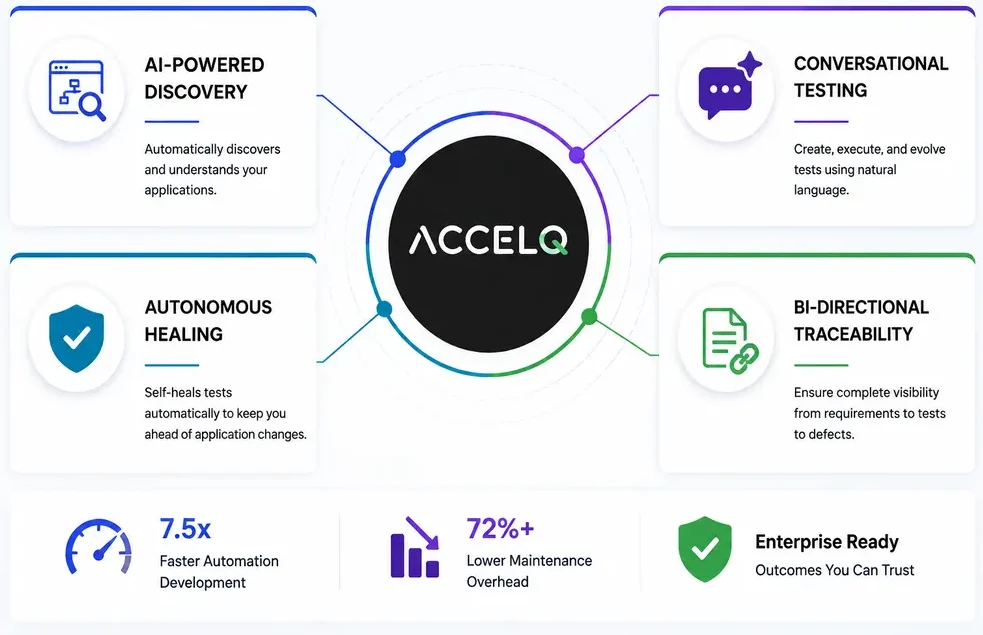
- ACCELQ Autopilot discovers business processes and generates end-to-end test scenarios from application behavior, not just from a manually typed prompt, which reduces how much a tester has to specify by hand.
- ACCELQ Converse takes the conversational, intent-first interaction that defines vibe testing and makes it persistent and stateful across the full quality engineering lifecycle, from planning through execution and analysis, rather than a one-off prompt-and-generate exchange.
- Autonomous healing adjusts tests automatically as packaged applications like SAP and Salesforce push updates, the same self-healing principle vibe testing depends on, extended to systems that update on someone else’s release schedule.
- Bi-directional traceability connects every generated test back to a requirement and a defect, answering the governance question most vibe testing tools leave open. ACCELQ’s 15 Best Test Coverage Tools guide breaks this down further for teams that need to compare requirements coverage against raw code coverage before choosing a platform.
Customers report 7.5x faster automation development and over 72 percent lower maintenance overhead using this model, which is the same outcome vibe testing promises, delivered with the audit trail enterprise teams need to actually trust it. That trend shows up in independent reviews, too.
In a verified G2 review, a mid-market reviewer credited ACCELQ's "self-healing capabilities" and object repository approach with improving test coverage on their team, consistent with the platform's 4.8 out of 5 rating across more than 114+ verified reviews.
Final Thought
Vibe testing does not replace disciplined QA. Performance benchmarking, security validation, and deep functional regression are still essential, and no amount of natural-language prompting changes that. What vibe testing changes is the framework around all of it, moving quality from a release-gate checkpoint to a continuous, shared signal that lives inside the development process instead of at the end of it.
The teams building that discipline into their culture now, not just their toolchain, are setting the quality bar their competitors will spend the next two years trying to match.
FAQ's
What is vibe testing?
Vibe testing is an AI-assisted quality assurance method where testers describe expected software behavior in natural language, and an AI agent generates, executes, and maintains the resulting test cases. It evaluates whether an application delivers the intended user experience, not only whether individual features pass or fail.
Is vibe testing the same as vibe coding?
No. Vibe coding is the development-side practice of describing an application in natural language and letting AI generate the working code. Vibe testing is the QA counterpart: it uses the same natural-language, intent-first approach to validate that the resulting software actually behaves as intended.
Are there popular tools or platforms for practicing vibe coding?
Yes. Replit, Cursor, Bolt, and Lovable are among the most widely used platforms for vibe coding today. Each lets a person describe an application in plain language and receive working code, which is exactly the workflow that creates demand for vibe testing on the QA side.
How does vibe coding influence user experience in software development?
Vibe-coded applications can be functionally correct while still delivering a confusing or inconsistent user experience, because AI-generated code optimizes for meeting the literal prompt rather than for how an interaction feels to a real user. This gap is a core reason vibe testing frames its central question around user experience rather than pass or fail alone.
What are examples of vibe testing?
Common examples include an agile team replacing brittle Selenium scripts with intent-based prompts for a fast-changing checkout flow, a cross-functional team using natural-language prompts to surface onboarding friction that functional tests missed, and a non-technical builder validating a vibe-coded app with a single plain-English test description instead of hiring a QA specialist.
Is vibe testing with AI reliable enough for production releases?
It is reliable for functional validation, user experience checks, and edge-case discovery, and well-designed platforms automatically enrich prompts with standard security scenarios. It is not yet a full substitute for structured performance testing or complex multi-system integration testing, and generated tests still need human review, along with traceability back to a requirement, before a team should treat them as audit-ready.
What is vibe coding QA, and how is it different from standard vibe testing?
Vibe coding QA refers specifically to testing applications that were built through vibe coding, where the team may not fully understand the underlying implementation. It relies on the same intent-first, natural-language approach as vibe testing, but places extra weight on discovering behavior the original prompt never specified, since nobody on the team wrote the code by hand to document it.
How does vibe testing support shift-left testing strategies?
By removing the technical barrier to writing a test, vibe testing lets product managers, designers, and other non-technical stakeholders define quality checks before development is even finalized. That pulls quality conversations upstream, from a late-stage release gate to an ongoing part of how the team builds, which is the core principle behind shift-left testing.



Yuvarani Elankumaran
Technical Consultant at ACCELQ
Yuvarani Elankumaran is a highly skilled technical consultant at ACCELQ. With over a decade of experience in the field of Test Automation, Yuvarani is a seasoned professional who is well-versed in a variety of programming languages and automation frameworks.


You Might Also Like:
 The 10 Best Usability Testing Tools in 2026
The 10 Best Usability Testing Tools in 2026
 6 Regression Testing Tools To Cut Maintenance Debt
6 Regression Testing Tools To Cut Maintenance Debt
 Performance Testing Guide: Everything You Must Know in 2026