






Types of API and Protocols – REST, SOAP, GraphQL
An Application Programming Interface (API) is a set of definitions, protocols, and tools that allow different software systems to communicate. It enables applications to exchange data and functionality without manual efforts by the user. APIs are intermediaries between different software components, ensuring they function together effectively. So, the APIs you choose can directly impact how quickly your product can evolve and scale.
APIs are essential for integrations, connecting microservices, and defining product functionality. A bad choice can lead to broken features and slow performance. Understanding different API types is crucial for addressing these issues and making informed decisions that align with your product vision and technology strategy.
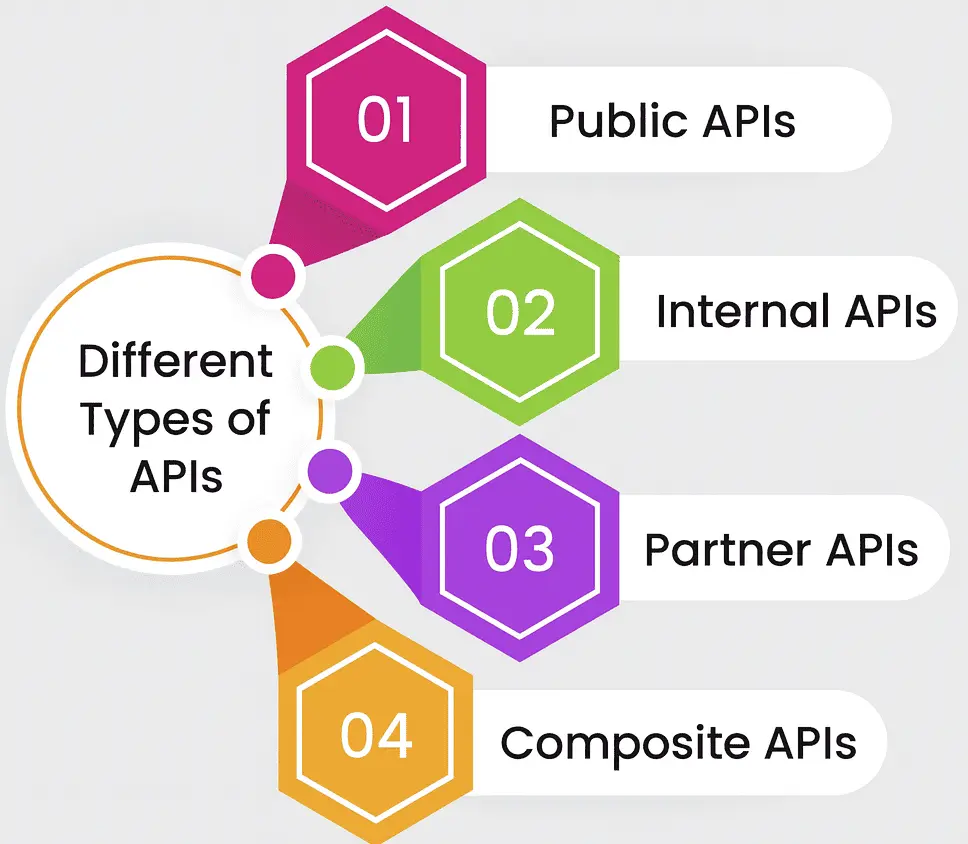
There are several different types of APIs depending on their purpose and access level. Common types are composite, internal, partner, and public APIs for particular data sharing, functionality, and integration needs. Let us dive into the main API types by access.
Different Types of APIs
APIs can be classified based on the access level they provide and the audience they are designed for. Here are the major categories:
Public APIs
A public or open API is accessible by external developers, partners, or third parties. These APIs are primarily made available to encourage third-party development and integrations. It is the most common API type used today, which involves consistency, reusability, and easy integration of services and data from different platforms.
Example: A payment gateway might open its APIs so online stores can accept transactions directly.
Internal APIs
Internal APIs are used within an organization to enhance processes and streamline operations. They connect databases and tools, automate workflows, and improve data sharing between departments.
Example: An internal API can link the HR system to the payroll system.
Partner APIs
Partner APIs are shared with specific external parties and are not open to the general public. These APIs have more control over who can access and are mostly used for business-to-business or B2B integrations. Partner APIs often require an API key or other authentication forms.
Example: A retail marketplace can link to a courier’s system so customers can track live delivery updates.
Composite APIs
Composite API combines APIs into one request, allowing data retrieval or submission from various sources at once. This reduces server load and improves performance for complex tasks.
Example: Travel apps use composite APIs to collect flight and hotel data together.
API Types and Examples
| Types of API | Examples | Use Cases |
|---|---|---|
| Composite API | PayPal | Combined payment and transaction handling |
| Internal API | HR system | Workflow automation |
| Partner API | Salesforce | Secure CRM data sharing |
| Public API | Google Maps | Location and navigation integration |
How are REST, SOAP, and GraphQL APIs Different?
The REST API uses standard HTTP methods to manage resources via URLs for exchanging data in JSON. GraphQL API allows clients to request specific data through a single endpoint. SOAP API is a protocol to exchange structured information in XML that is used in sectors like banking and healthcare. The comparison of REST vs SOAP vs GraphQL APIs is as follows:
| Aspects | REST | SOAP | GraphQL |
|---|---|---|---|
| Protocol | Majorly relies on HTTP, but can work with other protocols. | Works with HTTP/HTTPS/SMTP, and more protocols. | Works over HTTP/HTTPS. |
| Data Format | Supports JSON/XML/YAML, and more formats. JSON is used mainly. | XML is only supported. | JSON is only supported. |
| Query Flexibility | Fixed structure, may over or under-fetch. | Rigid, strict request/response structure. | Flexible, the client defines the needed data. |
| Common Use Cases | Web/mobile apps and microservices. | Banking, healthcare, and telecom integrations. | Dashboards, mobile frontends, and real-time systems. |
| Endpoint | Multiple resource specific URLs. | Single endpoint defined via Web Services Description Language or WSDL. | Single endpoint (/graphql). |
 Also Read: Test automation in healthcare
How are APIs used in Software Testing and Automation?
APIs are basic in software testing and automation because they represent the core communication layer between different software components and systems. API usage in testing can be classified as follows:
- Integration testing: APIs facilitate testing the application interactions between different modules or services. Or between an application and external systems to ensure smooth data exchange and communication.
- Regression testing: Automated API tests are effective for fast verification that new code updates have not broken existing functionality.
- CI/CD pipelines: Automated API tests are integrated into continuous integration/continuous delivery pipelines to offer feedback on code changes and prevent issues from progressing through the software development lifecycle.
Test automation platforms like ACCELQ streamline the workflows by chaining requests, handling dynamic data, and visualizing test results without excessive scripting.
Types of API Testing
To ensure extensive API coverage, you need to employ various types of testing. Let’s explore the key types:
- Functional testing: This type of testing confirms that your APIs return the right responses under defined conditions and fail when presented with invalid inputs. Such tests validate core logic, ensure consistent behavior, and are generally automated to run on every build, making them the backbone of any API test suite.
- Security testing: This type of testing is required if your APIs handle sensitive data, support user authentication, or interact with third-party services. Two types of security testing are: penetration testing, which simulates attacks by exploiting potential vulnerabilities from an attacker. Fuzz testing feeds the API endpoints with invalid or random data to surface unhandled exceptions.
- Validation testing: This testing type ensures that the API performs as needed. You use it to confirm the API aligns with business needs, handles data correctly, and adheres to specifications. Validation testing confirms that the API is fit for purpose and free from complexity.
Each testing type adds a layer of assurance that APIs perform reliably under varied conditions. Discover API testing tools that ease workflows.
Conclusion
Understanding the different types of API is basic to developing connected, reliable, and scalable software systems. From public and partner to internal and composite, API serves a distinct purpose in enabling communication between services. By distinguishing which types of API fit your architecture and automation goals, QA teams can streamline integrations, strengthen validation, and speed up delivery. With platforms like ACCELQ, testing and automating across API types becomes simple and seamless, which is aligned with your CI/CD workflows.



Chaithanya M N
Content Writer
A curious individual who is eager to learn and loves to share her knowledge using simple conversational writing skills. While her calling is technology and reading up on marketing updates, she also finds time to pursue her interests in philosophy, dance and music.

You Might Also Like:
 What are Mocking and Stubbing in API Testing? A Beginner’s Guide
What are Mocking and Stubbing in API Testing? A Beginner’s Guide
 Standalone vs Integrated API Tests
Standalone vs Integrated API Tests
 API Performance Monitoring: A Complete Guide with UI Insights