








Test Automation Myths vs Reality: What Teams Expect vs What Actually Happens

Test automation gets talked about a lot. Often with confidence. Sometimes with hype. Almost always with expectations that don’t fully match reality.
On paper, automation promises faster releases, lower costs, and fewer defects. In practice, many teams struggle with fragile tests, rising maintenance effort, and automation suites that inspire little trust.
Test automation itself is not the problem. The myths around it are.
This article breaks down the biggest myths in test automation, explains the reality teams run into, and separates what automation can genuinely solve from what it never should have been expected to fix. These are patterns we’ve seen repeat across teams, tools, and delivery models.
- Why Test Automation Expectations Drift So Easily?
- What Are the Common Myths About Test Automation?
- Why Does Test Automation Often Fail in the Real World?
- Expectations vs Reality of Test Automation in Enterprises
- What Are the Challenges of Test Automation?
- How Modern Platforms Address Automation Myths?
- How to Align Automation Expectations with Reality?
- Final Thoughts
Why Test Automation Expectations Drift So Easily?
Test automation is usually introduced during moments of pressure. Faster releases. Growing regression cycles. Limited testing bandwidth.
Under those conditions, it’s easy for expectations to inflate. Automation gets seen as a shortcut instead of a capability that needs planning, ownership, and the right approach.
That gap between promise and practice is where most test automation failures and realities begin.
What Are the Common Myths About Test Automation?
Let’s start with the most persistent misconceptions that continue to show up across teams and industries.
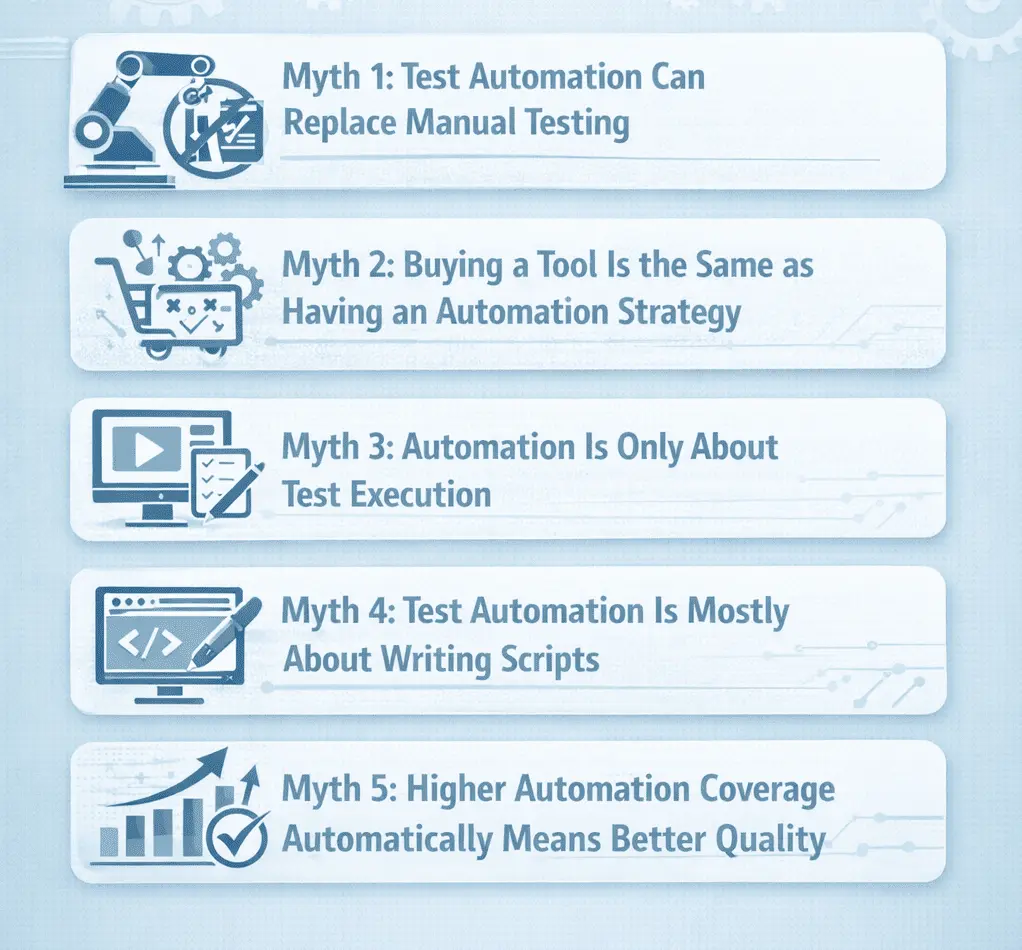
Myth 1: Test Automation Can Replace Manual Testing
This is the oldest myth and still the most damaging.
Automation is excellent at repeating known checks. It is not good at discovering unknown problems. It does not reason, explore, or question behavior.
The reality is simple. Manual testing and automation serve different purposes. Automation handles repetition and consistency. Humans handle judgment, exploration, and risk assessment.
Treating automation as a replacement for testers leads to shallow coverage and blind spots.
Myth 2: Buying a Tool Is the Same as Having an Automation Strategy
Many organizations assume that once a tool is purchased, automation success will follow.
In reality, tools only execute what they are given. Without a clear test automation strategy around what to automate, when to automate, and how to maintain automation, even the best tools struggle.
This misconception is a major contributor to automation testing myths vs reality discussions because it shifts responsibility from planning to tooling.
Myth 3: Automation Is Only About Test Execution
Test automation execution is just one slice of the testing lifecycle.
Automation that only focuses on running tests but ignores test design, data management, environment setup, and result analysis creates partial efficiency at best.
What this really means is effort moves instead of disappearing. Teams save time in execution but lose it elsewhere.
Myth 4: Test Automation Is Mostly About Writing Scripts
Script-heavy thinking is another outdated assumption.
Modern automation is less about coding and more about modeling behavior, defining intent, and managing change. When automation revolves entirely around scripts, maintenance costs rise and adaptability drops.
This myth is closely tied to many test automation challenges and truths teams experience later.
Myth 5: Higher Automation Coverage Automatically Means Better Quality
Coverage numbers look good on dashboards. They don’t always reflect reality.
Automating the wrong scenarios gives a false sense of confidence. Real quality comes from covering business-critical flows, not from inflating test counts.
Automation should reduce risk, not just increase metrics.
 Also Read: Myths about Test Automation Accelerators
Why Does Test Automation Often Fail in the Real World?
Test automation rarely fails overnight. It erodes slowly.
A few broken tests are ignored. Maintenance starts taking longer. Test results become unreliable. Eventually, teams stop paying attention.
Common reasons include:
- Automation built too close to UI implementation
- Poor ownership between manual and automation roles
- Rising maintenance with no clear ROI
- Tests that validate steps instead of outcomes
These are not tool problems. They are expectation problems that sustainable test automation is designed to address.
Understanding test automation failures and realities requires acknowledging that automation amplifies design decisions, good or bad.
Expectations vs Reality of Test Automation in Enterprises
Expectation: Automation will significantly reduce testing effort
Reality: Automation shifts effort from execution to design and maintenance
Expectation: Automation will catch most defects
Reality: Automation catches known issues consistently, not unknown ones
Expectation: Automation will simplify QA
Reality: Poorly planned automation increases complexity
Expectation: Automation success is quick
Reality: Sustainable automation is built incrementally
Recognizing these gaps early prevents disappointment later.
Choosing the right test automation tools plays a critical role in how quickly teams move from inflated expectations to realistic, sustainable outcomes.
What Are the Challenges of Test Automation?
Every automation initiative runs into challenges. The difference between success and failure is how those challenges are handled.
Some of the most common include:
- Managing automation maintenance as applications evolve
- Keeping automation aligned with business behavior
- Ensuring automation remains readable and reusable
- Scaling automation across teams and technologies
These challenges are unavoidable. Ignoring them is what causes problems.
How Modern Platforms Address Automation Myths?
One reason many myths persist is that older tools reinforced them. Script-heavy frameworks required specialists, created silos, and made maintenance expensive.
Modern platforms approach automation differently.
For example, ACCELQ is designed as a platform, not a scripting utility, and embraces no-code automation testing to reduce dependence on script-heavy frameworks. It focuses on modeling applications as business flows and enabling automation through natural language and visual logic rather than code-heavy scripts.
This directly addresses several long-standing misconceptions:
- Automation can be owned by testers, not just engineers
- Maintenance can be reduced through intelligent change handling
- Automation can span web, mobile, API, and backend in one flow
What this really means is automation becomes a shared responsibility instead of a specialized bottleneck.
SUGGESTED READ - Scriptless Test Automation
How to Align Automation Expectations with Reality?
Avoiding disappointment starts with asking the right questions.
- What problems are we actually trying to solve with automation?
- Which scenarios are truly worth automating?
- Who owns automation quality long term?
- How will automation adapt as the application changes?
Clear answers lead to realistic expectations. Vague assumptions lead to frustration.
Understanding the Role of AI in Modern Testing
Before relying on AI in automation, it’s critical to understand its strengths, limits, and impact on quality ownership.
Final Thoughts
Test automation myths survive because automation is often oversold and under-planned.
Automation is not magic. It does not guarantee quality, eliminate testers, or remove complexity. What it does offer is consistency, speed, and scale when applied thoughtfully.
Some teams address these challenges by moving toward unified automation platforms such as ACCELQ, which focus on reducing maintenance overhead and aligning automation with real business workflows rather than brittle scripts.
Understanding the myths vs reality of test automation helps teams make better decisions. It sets realistic expectations, encourages smarter strategies, and prevents automation from becoming an expensive disappointment.
When automation is treated as a capability instead of a cure-all, it delivers exactly what it should. Confidence. Predictability. And room for testers to focus on what humans do best.



Geosley Andrades
Director, Product Evangelist at ACCELQ
Geosley is a Test Automation Evangelist and Community builder at ACCELQ. Being passionate about continuous learning, Geosley helps ACCELQ with innovative solutions to transform test automation to be simpler, more reliable, and sustainable for the real world.

You Might Also Like:
 Test automation + transformation: it’s all about the people
Test automation + transformation: it’s all about the people
 Features to Look While Buying Enterprise Software for Test Automation
Features to Look While Buying Enterprise Software for Test Automation
 Cloud-Based vs. On-Premise Test Automation: What to Choose in 2026?