








Software Testing Trends to Look Out For in 2026

Software quality has never been more critical in today’s high-speed digital world, as it directly affects an end user’s experience, an economic opportunity, or a risk to a company’s brand value. And as we hit 2026, software testing is already changing fast with AI, increasing system complexity, and a growing need for speed in delivery cycles. In this world, for both companies and QA professionals, staying on top of the software testing trends defining the future is a must for quality and survival.
This blog is for anyone who is a tester, an engineering lead, and for CTOs, a strategic view on what has and is popular in terms of software testing trends, new technologies, and the must-know testing methodologies, taking into account what to expect and what is going to dominate in 2026.
Why is 2026 a Pivotal Year for QA?
Software is no longer delivered in a straight line. Agile, continuous delivery, and DevOps are now in the spotlight, and testing must no longer be an afterthought. Rather, it must be effective, connected, and automated. The prevailing trend is that reactive testing approaches are giving way to proactive, context-driven, and AI-backed testing strategies that value not just bugs, but also business risks, customer experience, and delivery speed.
The future of software testing trends is to become predictive and autonomous. Thus, QA teams will become enablers of innovation rather than stoppers of proceedings.
Major Software Testing Trends Shaping 2026
Let’s break down the most influential new trends in software testing you should be aware of:
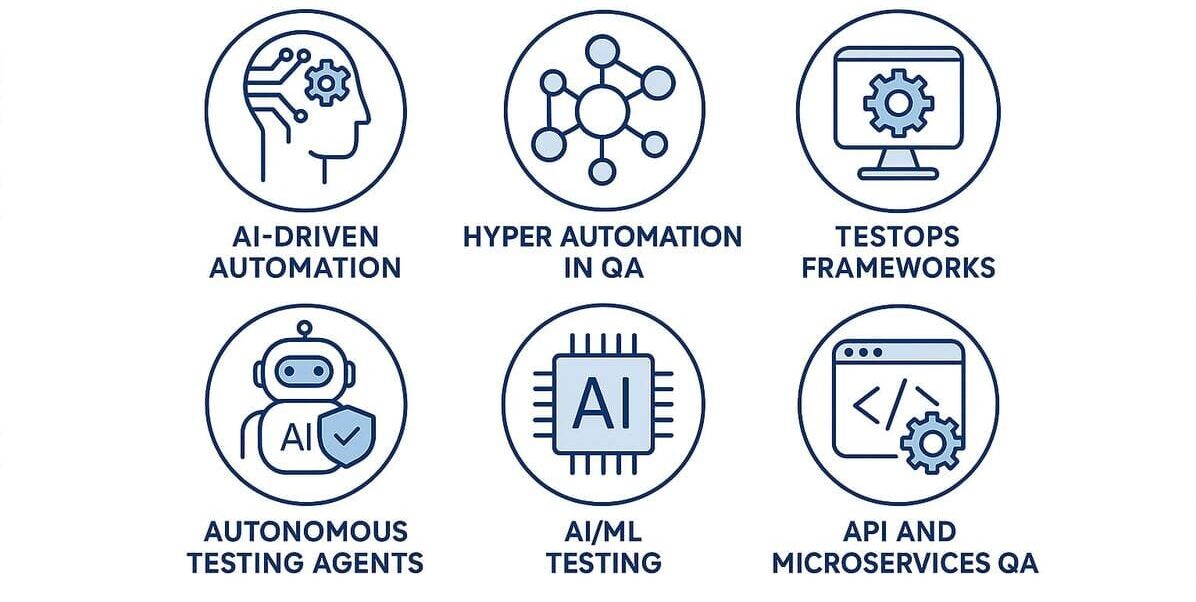
| Trend | Description |
|---|---|
| AI-Driven Automation | Smart platforms such as ACCELQ use AI to auto-create test cases, propose automation logic, detect edge-cases, and offer intelligent failure analysis. |
| Hyperautomation in QA | Integrating robotic process automation, machine learning, and analytics to automate end-to-end testing pipelines from planning to execution to defect analysis. |
| TestOps Frameworks | TestOps is about collaboration, continuous monitoring, and orchestration to put QA further into the CI/CD pipeline. |
| Autonomous Testing Agents | These agents model real-user actions, generate and execute test cases by themselves for better speed and agility. |
| AI/ML Testing | As companies integrate AI systems, testers have begun to combat algorithms, audit model biases, and stress-test ML outputs. |
| API and Microservices QA | It becomes very important to test microservices at the contract and integration levels, particularly for cloud-native and containerised architectures. |
These current trends in software testing are all geared toward one thing: increasing test coverage, speed, and accuracy with less manual effort.
 Also Read: Understanding microservices architecture
What’s New in Software Testing in 2026?
Staying updated with emerging software testing trends is necessary because it helps you to identify and fix issues, leading to high-quality software. New trends can help you find and mitigate potential risks early in development. Modern trends, such as automation, decrease the time and cost of testing while increasing coverage and accuracy.
The latest software testing trends permit effective testing of software built with emerging technologies like AI and IoT. Aligning with emerging trends ensures software meets user needs, which is critical for customer satisfaction. The latest trends to test software are as follows:
1. AI/ML in testing
AI algorithms play a crucial role in generating test cases, and ML techniques are instrumental in finding patterns and anomalies in test data. In the near future, AI can create initial code and tests, which will serve as a foundation for developers to build upon and handle more complex tasks. This shift has the potential to increase efficiency and enable developers to concentrate on more valuable aspects of software development.
As we move forward into 2026, AI in software testing is expected to rise, bringing about unprecedented changes to the industry. The combination of AI/ML in automated testing is poised for steep growth as businesses strive for faster, accurate, and streamlined testing processes.
2. QAOps
QAOps, combining Quality Assurance (QA) and IT Operations (Ops), revolutionizes software development by integrating QA into the DevOps cycle. The emergence of QAOps represents a new software process model that aims to enhance quality and efficiency. This model brings engineers, functional teams, and testers together for effective communication and collaboration.
The outcome is better products, faster delivery, and the development of advanced features. In essence, QAOps is an evolution in software development, prioritizing quality at each step and promising a more efficient development lifecycle.
3. Internet of Things (IoT)
The global IoT testing market is expected to rise at a compound annual growth rate of around 31% by 2032. This significant rise reflects the reliance on IoT devices and the need for effective testing to ensure their functionality and security. IoT testing focuses on checking the IoT devices’ performance and improving system productivity by preventing unexpected glitches. It provides greater control over devices to improve network and device efficiency, accessibility, and usage.
4. API automation
The rise of microservices architectures has significantly increased the number of application programming interfaces, making API-driven development more relevant than ever. However, using APIs comes with the risk of security breaches involving sensitive data. So, API testing is a more efficient alternative to extensive GUI testing in Agile or DevOps environments, where speed is required.
5. Mobile automation
The increasing complexity and number of mobile applications demand a shift towards more advanced mobile test automation. This need is driven by the pressure to reduce time-to-market and to cope with the rapid expansion of the mobile technology landscape. Integrating cloud-based mobile labs and tools for test automation represents a promising development, potentially elevating mobile test automation to new heights.
Fast-Track Your Automation Testing Goals
Discover the power of no-code test automation with ACCELQ’s platform
📜 Get Certified for Free
The Rise of Unified Platforms
As test scenarios and environments become increasingly complex, fragmented tooling is a burden. More and more teams use consolidated test automation solutions for cross-technology testing across web, mobile, desktop, API, and mainframe.
ACCELQ stands out in this space. It offers an end-to-end, codeless, AI-powered solution that enables teams to create and execute tests at scale, without extensive scripting knowledge. It is also one of the few platforms that offers true CI/CD integration, test asset synchronization, and live cloud execution support. These capabilities align perfectly with the demand for software testing and current trends in 2026.
What Test Leaders Should Prioritize in 2026?
As we move from trends to action, here are the key strategic areas test leaders should focus on in the popular software testing trends:
1. Early Testing in the Dev Lifecycle
Shift-left testing is an imperative nowadays. By building testing into the beginning of the design and development process, you decrease the need for expensive rework and increase overall time-to-market.
- Automate unit and integration tests early
- Enable developers to write and run tests in their IDEs
- Leverage static code analysis to catch issues pre-runtime
2. Democratization of Testing
It’s important to engage non-technical stakeholders in the test development. Natural language test authoring and visual flows using tools. The tools allow business users to participate in testing without having to write code.
ACCELQ, for example, offers a no-code/low-code automation that supports testers of all skill levels while still being robust enough for complex enterprise needs.
3. Intelligent Test Data Management
Testers spend nearly 40% of their time preparing and managing test data. AI-enabled test data tools now:
- Automatically mask sensitive data
- Generate edge-case datasets
- Identify unused or redundant test data
Efficient data use also leads to faster execution and more accurate defect detection.
4. Resilience and Scalability Testing
With applications deployed across hybrid and multi-cloud ecosystems, resilience testing becomes critical. Testers must ensure systems can withstand spikes, outages, or data corruption scenarios. This requires:
- Load testing tools integrated with production monitoring
- Chaos engineering for failure simulation
- Real-world condition modeling (network latency, device fragmentation)
5. Accessibility, UX, and Ethical Testing
In 2026, testing isn’t just about “does it work?” It is also about “is it usable for everyone?” and “is it ethically sound?” Test plans now need to include:
- Accessibility testing for compliance (WCAG, ADA)
- User experience validation via visual regression
- Bias testing in AI-based features
Transitioning to a Future-Proof QA Model
Let’s look at how you can prepare your QA function to embrace these software testing trends effectively:
| Action Area | Steps to Take in 2026 |
|---|---|
| Tools | Migrate to unified, AI-powered platforms like ACCELQ that simplify automation across technologies. |
| People | Scale up your testers with AI/ML basics, DevOps, and no-code automation. Build cross-functional teams. |
| Processes | Set up testing loops to iterate with live reporting, quality gates, and feedback cycles. |
| Metrics | Measure track test stability, investment in automation ROI, code coverage, release velocity, and CSAT. |
Organizations can now align people, processes, and tooling to help reduce test cycle times, increase defect-catch rates, and confidently release, even in the most high-frequency deployment scenarios.
How are Test Automation Tools Evolving?
The biggest evolution in testing tools is not speed, it’s intelligence. Modern tools now provide:
- Predictive analytics for test flakiness and failure root causes
- Smart test selection for regression optimization
- Auto-healing of test scripts when the UI changes
The model-based testing of platforms such as ACCELQ ensures a live abstraction of the application, which allows for decreased maintenance and increased agility of all of your test cases. It’s especially useful for agile teams that ship weekly or daily.
Final Takeaways: Testing as a Strategic Differentiator
It’s no longer just about catching bugs but protecting the business. In 2026, quality engineering will be the difference between the brands that survive and those that lag behind.
The organizations further along the continuum of testing maturity will:
- Get the features you want faster without sacrificing quality
- Drive down your TCO with scalable automation
- Achieve visibility into release status as it’s ready.
ACCELQ, with its AI-native technology and full-stack enterprise integrations, is enabling companies in the telecom, BFSI, retail, and public sectors to usher in this transformation.



Nishan Joseph
VP Sales Engineering
Nishan is a tech strategist with expertise in Test Automation and roles at giants like TCS, Microfocus, and Parasoft. At ACCELQ, he champions Strategic Alliances, cultivating global tech partnerships. Educated at Leeds University and Symbiosis Pune, he also possesses an engineering background from Bangalore.

You Might Also Like:
 BDD in Testing: Improve Automation & Team Productivity
BDD in Testing: Improve Automation & Team Productivity
 Developing an Effective Quality Strategy and Testing the Model
Developing an Effective Quality Strategy and Testing the Model
 Code Coverage vs Test Coverage: What’s the Real Difference?