








How to Build Scalable and Reusable Test Assets in Pega Architecture

Two weeks. That is what a single Pega rule update cost one enterprise automation team because their regression suite was built around screens instead of application behaviors. Every interface shift broke a test, turning every release into a complete rebuild. This is a structural test design flaw, not a Pega platform limitation.
Enterprises that invest in reusable test assets in Pega protect three critical DevOps metrics:
- Release Velocity: Accelerating deployment pipelines by eliminating redundant test script creation.
- Maintenance Overhead: Minimizing script brittleness during routine rule updates and case model adjustments.
- Regression Confidence: Ensuring consistent validation accuracy across multi-tenant business units.
When automation is tightly coupled to volatile UI screens, regular rule updates and case model changes cause constant test fragility. Building reusable, behavioral test components from the start removes this maintenance bottleneck. For organizations managing multiple Pega applications across business units, modular asset reuse is a core release management strategy.
- How Pega Application Architecture Impacts Test Automation Scale
- The Real Cost of UI-Coupled Test Automation in Pega Environments
- Why Traditional Pega Test Scripts Break During Rule Updates
- How to Design Modular and Rule-Aware Test Components in Pega
- A Diagnostic Matrix for High-Value Reuse Opportunities
- Best Practices for Reducing Test Script Maintenance in Pega
- Integrating Reusable Pega Test Assets into Continuous Delivery Pipelines
- How ACCELQ Powers Reusable Pega Assets at Enterprise Scale
How Pega Application Architecture Impacts Test Automation Scale
Pega environments change by design. Case types evolve, decision tables update, UI components undergo optimization, and integrations expand. Every release introduces incremental changes across the application landscape.
When automation is built without modularity in mind, minor rule adjustments force teams to manually overhaul vast portions of their regression suites. What begins as a single change in a decision rule routinely cascades into dozens of false-positive test failures.
In many enterprises, Pega test automation often exists, starting with PegaUnit for unit-level rule testing, but it cannot scale to end-to-end regression coverage across complex, multi-application environments. Tests are written in silos, such as per case type, per application, or per region. This duplication stretches regression cycles even when on-paper automation coverage appears high. Reusable test components alter this trajectory. Instead of anchoring automation to volatile, individual screens, teams must align automation to business intent and case-flow logic to protect release velocity.
The Real Cost of UI-Coupled Test Automation in Pega Environments
The true cost of non-reusable automation shows up in broken release cadences and ballooning maintenance logs.
Consider onboarding workflows. Multiple lines of business frequently follow similar validation rules, yet QA teams often build separate, duplicate automation scripts for each implementation. When presentation layers shift or rule logic updates, these brittle scripts break. Eventually, the manual effort required to update static locators outweighs the original value of the automation.
This architecture triggers four systemic failure points:
- Protracted Regression Cycles: Execution timelines extend despite continuous automation investments.
- Locator Churn: High engineering overhead is spent fixing fragile object mappings after routine UI refinements.
- Siloed Coverage: Inconsistent validation standards across global business applications.
- Manual Reversion: Teams lose faith in automated scripts and revert to manual validation to hit deployment deadlines.
At this inflection point, the root issue is not a lack of test coverage. It is a flawed test automation architecture.
Why Traditional Pega Test Scripts Break During Rule Updates
Enterprises frequently ask why their Pega automation scripts fail so consistently.
Pega test scripts break on rule updates because they are built around temporary implementation details, volatile UI structures, static locators, and hardcoded data assumptions rather than the permanent business abstractions that rule changes don’t cover. Traditional scripts depend on visual UI structures instead of case progression. They rely on static locators rather than rule-aware logic, and they embed rigid data assumptions instead of parameterizing business conditions.
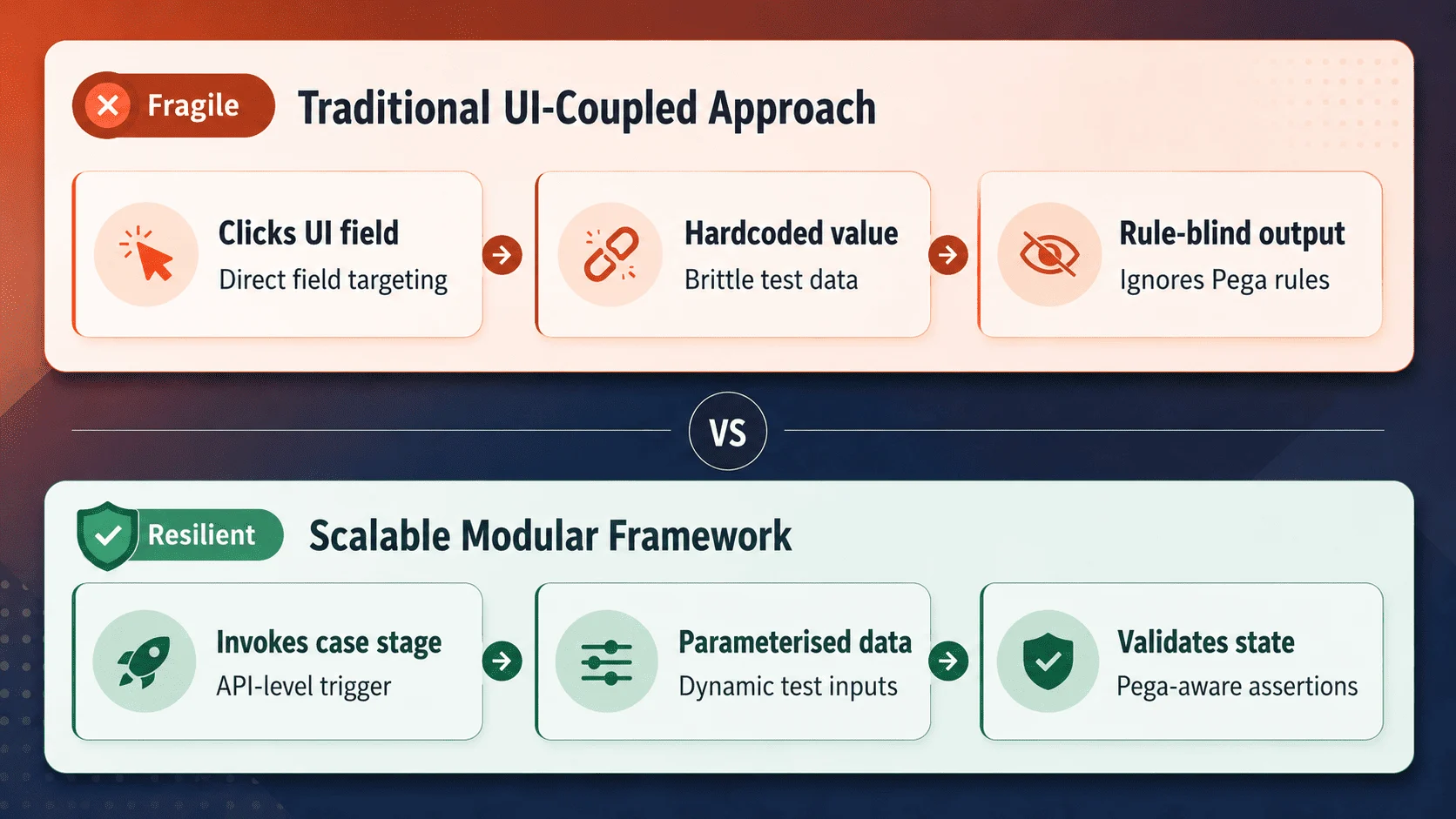
When automation merely mirrors screens instead of modeling core process logic, system changes become prohibitively expensive. This drag drops regression credibility and converts your test suite into a maintenance burden.
SUGGESTED READ - Mastering Pega Testing: How ACCELQ Simplifies Automation
How to Design Modular and Rule-Aware Test Components in Pega
True test reusability in Pega is not achieved by dumping shared scripts into a repository. It requires a structured framework of modular, rule-aware design.
A reusable framework that survives UI changes precisely because it aligns with business outcomes rather than interface layouts, making it immune to the locator churn that breaks screen-coupled scripts. A reusable component must represent a discrete, logical step in a case lifecycle, not a sequence of mechanical clicks. It must separate business intent from technical execution.
In practice, this means modeling your test automation framework around:
- Case Stages: Mapping tests to the structural phases of Pega case management.
- Decision Outcomes: Validating the conditional logic of decision trees and tables directly.
- Rule Triggers: Ensuring specific rules fire predictably across varying data environments.
These atomic components can then be composed across dozens of distinct test scenarios. They survive UI modifications because they do not rely on fragile locators, and they absorb rule changes because they validate the consistency of system states rather than field positioning.
A Diagnostic Matrix for High-Value Reuse Opportunities
Not every test scenario requires deep modularization. To maximize return on investment, engineering teams should prioritize five core functional areas for automation reuse:
| Functional Area | Target for Automation Reuse | Strategic Value |
|---|---|---|
| Core Case Lifecycles | Primary stages and resolution paths | Stabilizes end-to-end user journey validation |
| Shared Decision Logic | Centralized decision tables and business rules | Prevents duplication across multiple lines of business |
| Global UI Components | Reused layouts, sections, and harness structures | Minimizes locator maintenance when themes change |
| Integration Layers | Common API, service, and webhook flows | Isolates backend dependency validation from the UI |
| Compliance Workflows | Mandated validations across jurisdictions | Ensures regulatory consistency across localized apps |

Best Practices for Reducing Test Script Maintenance in Pega
To drastically reduce test maintenance, engineering teams must build for architectural volatility. This requires four explicit design patterns:
- Locator Abstraction: Decouple the functional test flow from the underlying HTML DOM structure. Use semantic, logical identifiers that remain stable across Pega updates.
- Data Parameterization (Data-Driven Testing): Remove hardcoded inputs from scripts. Externalize case data variations into configuration files or data sheets. A data-driven testing approach validates diverse business paths using a single reusable component.
- State-Transition Validation: Assert on business state changes and data model outputs rather than individual on-screen field values.
- Cross-Team Governance: Scale automation by centralizing these components in a shared library, enforcing unified modular design standards, and applying strict version control.

Integrating Reusable Pega Test Assets into Continuous Delivery Pipelines
Modular test assets deliver the highest operational impact when embedded into continuous delivery pipelines, enabling a shift-left approach where tests execute closer to development rather than waiting for a release gate.
Because modular tests isolate specific business flows, teams can trigger targeted regression suites based on the precise Pega rules or case types updated in a specific build. This eliminates the need to run massive, slow end-to-end suites for minor code changes, reduces regression time without losing coverage, because each modular component continues to validate its designated business flow regardless of pipeline scope. Pipeline noise drops because brittle, UI-coupled failures are eliminated, providing clean, actionable feedback loops for DevOps runners.
How ACCELQ Powers Reusable Pega Assets at Enterprise Scale
ACCELQ delivers native alignment with complex Pega environments through codeless, business-flow–driven modeling. Instead of forcing teams to manage script-heavy frameworks that break under the weight of dynamic Pega classes, ACCELQ allows teams to model application logic visually.
The platform automatically handles dynamic Pega IDs and complex UI patterns out of the box, abstracting locator complexity from the test creator. By treating test components as native business actions, it enables teams to build an automated step, such as an approval step or an eligibility check, just once and reuse it across multiple workflows, regions, and delivery pipelines. ACCELQ’s AI-driven coverage gap detection and risk-based test selection ensure the highest-impact scenarios are always prioritized, eliminating script maintenance, facilitating in-sprint testing, and providing a continuous validation layer that scales safely alongside enterprise Pega applications.
- 3x faster automation development
- 70% less test maintenance
- Covers Classic, Lightning & LWC
Frequently Asked Questions
Why do Pega test automation scripts break when rules are updated?
Pega test scripts break on rule updates when they’re written against volatile UI structures rather than stable business logic. Scripts that depend on static locators, hardcoded field values, or screen-level flows can’t absorb changes to presentation layers, decision tables, or case model configurations. The fix is modeling automation against case stages, rule outcomes, and state transitions elements that remain stable even when Pega’s UI evolves.
How do you build a Pega test automation framework that survives UI changes?
A reusable Pega test framework survives UI changes by anchoring automation to business behavior rather than interface layout. This means building modular components around case stages, decision logic, and rule triggers, not individual screens or field locators. When the UI shifts, the component doesn’t break because it’s validating what the case does, not how it looks.
How can Pega teams reduce regression cycle time without losing test coverage?
Modular test assets allow teams to trigger targeted regression suites scoped to the exact Pega rules or case types changed in a given build instead of running full end-to-end suites for every release. Because each reusable component independently validates its assigned business flow, coverage is maintained while execution time drops significantly. This is the core operational advantage of a modular Pega automation architecture over monolithic, screen-coupled scripts.



Chaithanya M N
Content Writer
A curious individual who is eager to learn and loves to share her knowledge using simple conversational writing skills. While her calling is technology and reading up on marketing updates, she also finds time to pursue her interests in philosophy, dance and music.

You Might Also Like:
 ACCELQ API Test Automation
ACCELQ API Test Automation
 API + UI Test Automation Together
API + UI Test Automation Together
 API Performance Monitoring: A Complete Guide with UI Insights