








Low-Code Automation: How Teams Move Faster in 2026?

Test automation is no longer optional. But how teams automate is becoming just as important as whether they automate at all.
Most organizations begin automation with the right intent. Reduce manual effort. Improve coverage. Speed up releases. Then reality sets in. Hiring skilled automation engineers takes time. Scripts grow fragile. Maintenance effort quietly increases. Momentum slows.
Here’s the thing. The problem is not automation. It’s the dependency on code-heavy approaches that do not scale across teams.
That is why the low-code automation platform category has gained serious attention at the decision-making level, not as a shortcut, but as a more sustainable way to scale quality without increasing complexity.
- What Is a Low-Code Automation Platform?
- Why Script-Heavy Automation Is Holding Teams Back?
- How Does Low-Code Automation Help Testers Who Don’t Know Coding?
- What Are the Real Benefits of Using a Low-Code Automation Platform?
- The Role of Self-Healing Automation in Long-Term ROI
- Where ACCELQ Autopilot Fits In?
- Why Enterprises Are Choosing Platforms Over Tools?
- What Is Low-Code Test Automation?
- Making the Decision: When Low-Code Automation Makes Sense?
- Conclusion
What Is a Low-Code Automation Platform?
A low-code automation platform allows teams to design, build, and maintain automated tests with minimal coding effort. The emphasis is on intent and behavior rather than scripts and syntax.
Instead of writing large volumes of test code, testers work with visual models, natural language steps, and reusable logic blocks. The platform handles execution mechanics, change management, and integration complexity behind the scenes.
What this really means is automation becomes accessible to more people without sacrificing depth or control.
Why Script-Heavy Automation Is Holding Teams Back?
Traditional automation frameworks assume a narrow operating model. Dedicated automation engineers. Heavy scripting. Constant manual maintenance.
That model struggles in enterprise environments where:
- Applications evolve continuously
- Teams are distributed
- Release cycles are short
- Business workflows span multiple systems
These constraints are especially visible in enterprise test automation, where scale magnifies rigidity.
Low-code platforms shift focus away from how tests are written and toward what they are meant to validate.
How Does Low-Code Automation Help Testers Who Don’t Know Coding?
This is often misunderstood.
Low-code automation does not remove engineering discipline. It removes unnecessary barriers.
Testers who understand application behavior, edge cases, and risk can contribute directly to automation, reinforcing the role of manual testers in test automation. They design scenarios using readable logic and reusable components.
Engineers still play a role. They extend capabilities, integrate systems, and optimize execution. But automation ownership is no longer bottlenecked by code expertise alone.
This shared ownership model is one of the biggest reasons enterprises are adopting AI-powered low-code automation platforms.
What Are the Real Benefits of Using a Low-Code Automation Platform?
At a decision level, benefits are measured in outcomes, not features.
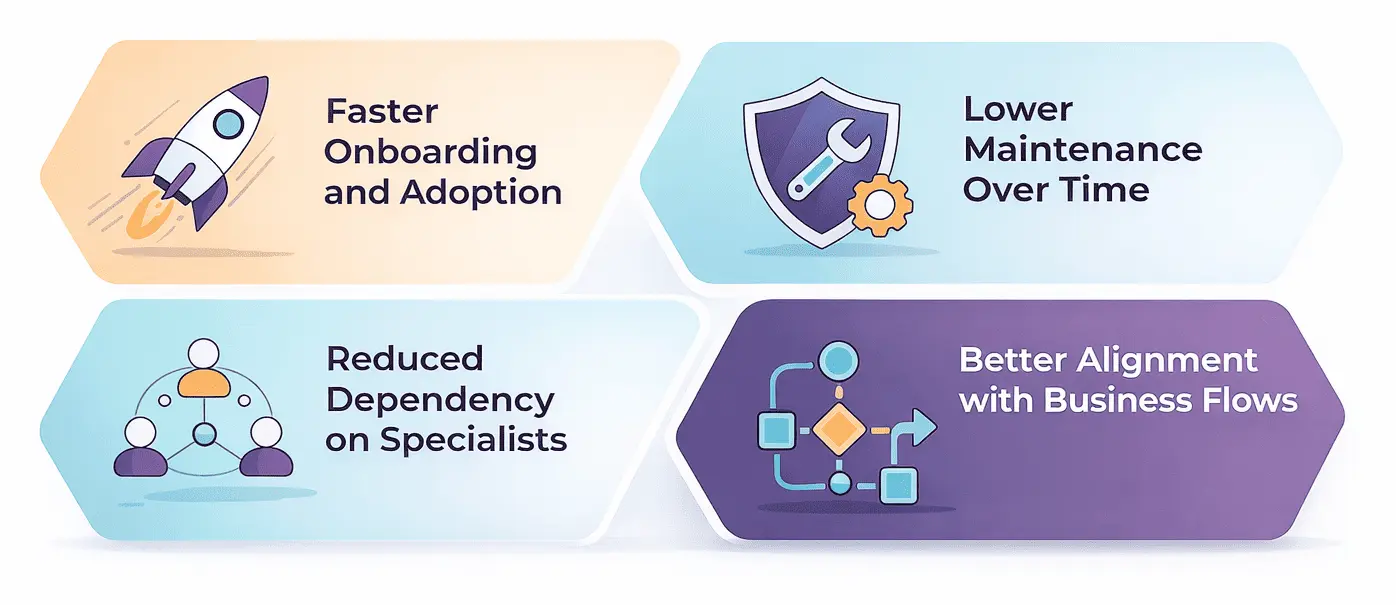
Faster Onboarding and Adoption
Teams ramp up in days instead of months. New testers contribute to automation early without long training cycles.
Lower Maintenance Over Time
Low-code platforms emphasize reuse and abstraction. When changes occur, automation adapts with far less rework. This is where AI-driven test maintenance becomes critical.
Reduced Dependency on Specialists
Automation no longer lives with a small group. Knowledge spreads. Risk decreases.
Better Alignment with Business Flows
Tests are built around workflows, not UI mechanics. This improves relevance and trust in results.
This approach aligns closely with sustainable test automation, where ownership and adaptability matter more than scripting speed.
The Role of Self-Healing Automation in Long-Term ROI
Maintenance is where most automation initiatives succeed or fail.
Modern low-code platforms use self-healing automation techniques rooted in AI in software testing to detect and reconcile change. When elements move or attributes change, tests do not immediately break.
This does not eliminate human review. It removes repetitive fixing.
Over time, this directly impacts cost, stability, and confidence in automation suites. This directly contributes to measurable test automation ROI.
Where ACCELQ Autopilot Fits In?
ACCELQ Autopilot builds on this foundation by applying AI to how automation is created and maintained over time.
Instead of relying on static scripts, Autopilot assists teams in generating automation from existing workflows, test intent, and application behavior. As applications evolve, Autopilot helps reduce ongoing maintenance effort by adapting automation logic rather than forcing teams to constantly rewrite tests.
What this really means is lower long-term automation cost without sacrificing coverage or control.
🤖 Agentic Automation That Learns and Innovates
Redefine Your Testing Game with AUTOPILOT
Why Enterprises Are Choosing Platforms Over Tools?
A tool solves a narrow problem. A platform supports an operating model.
Enterprises increasingly need automation that:
- Spans web, mobile, API, and backend in one flow
- Works across teams and geographies
- Integrates cleanly into CI pipelines
- Scales without exponential maintenance effort
This is where platforms such as ACCELQ stand out.
ACCELQ approaches automation as a system. Tests are modeled as business behavior. Assets are reusable. Change is managed centrally. Automation supports continuous delivery instead of slowing it down.
What Is Low-Code Test Automation?
Low-code test automation is an approach where automated tests are created using visual modeling, natural language logic, and reusable components instead of extensive scripting.
It allows teams to automate complex scenarios while keeping tests readable, maintainable, and aligned with real application behavior.
Making the Decision: When Low-Code Automation Makes Sense?
Low-code automation is not about replacing engineering expertise. It is about using it more effectively.
Organizations benefit most when:
- Automation needs to scale across teams
- Maintenance has become a pain point
- Testers are blocked by scripting requirements
- Release velocity demands stable CI integration
In these cases, a low-code automation platform is not a convenience. It is a strategic choice.
Do more with Test Automation
Discover more ways to add ‘low-code no-code‘ test automation in your workflows

Conclusion
Low-code automation platforms are not a trend. They are a response to how software is built and delivered today.
As systems grow more complex and release cycles shorten, automation must become easier to create, easier to maintain, and easier to trust. Script-heavy approaches struggle under that pressure.
Low-code automation, supported by AI-driven maintenance and intelligent assistance like Autopilot, offers a more sustainable path forward.
For teams evaluating how to scale quality without scaling complexity, the question is no longer whether to automate. It is whether the automation approach itself is built to last.



Geosley Andrades
Director, Product Evangelist at ACCELQ
Geosley is a Test Automation Evangelist and Community builder at ACCELQ. Being passionate about continuous learning, Geosley helps ACCELQ with innovative solutions to transform test automation to be simpler, more reliable, and sustainable for the real world.

You Might Also Like:
 Transforming Quality Assurance into Quality Assistance – 5 Essential Strategies
Transforming Quality Assurance into Quality Assistance – 5 Essential Strategies
 Challenges in Achieving In-Sprint Automation and Solutions
Challenges in Achieving In-Sprint Automation and Solutions
 Email Automation: Secure, Compliant & Reliable