







HLD vs LLD: Differences, When to Use Each

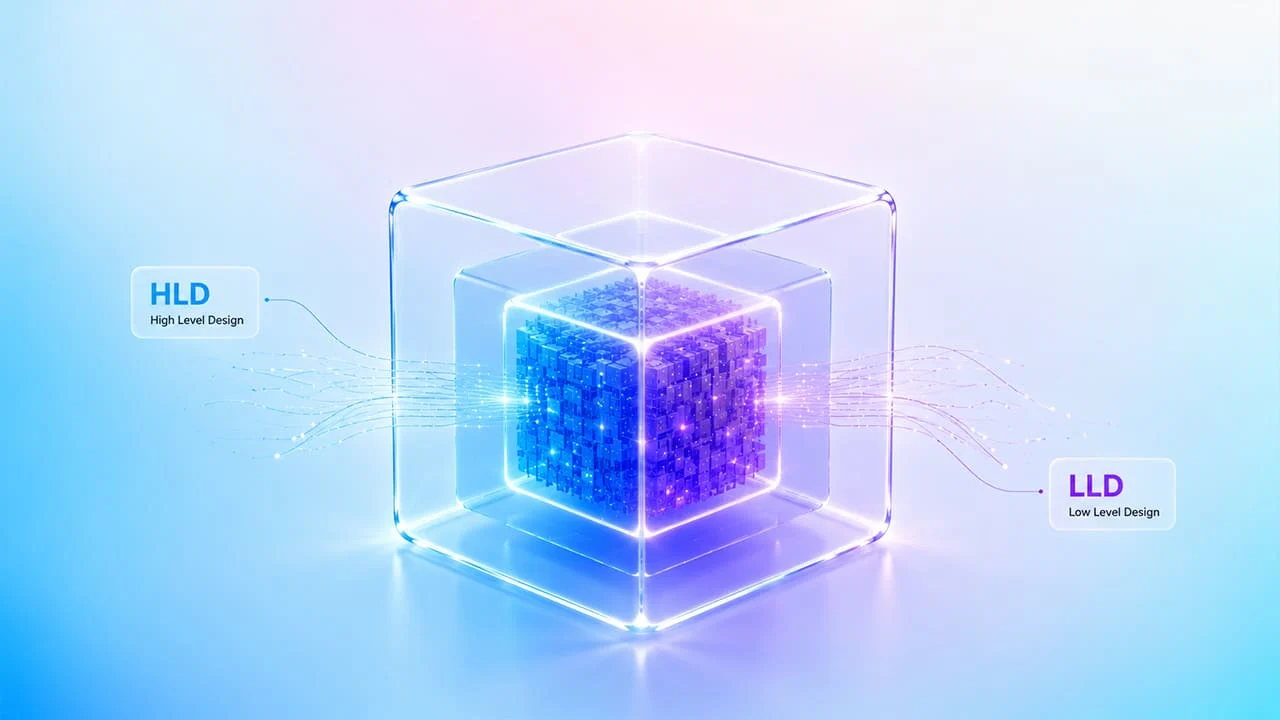
A system’s overall architecture is defined by High-Level Design (HLD), which finds the central parts, their connections, and the technology stack. Each module’s specifications, including algorithms, data structures, and logic, are translated from that architecture by Low-Level Design (LLD).
HLD is produced first and reviewed with stakeholders. LLD follows and guides developers during implementation. The software development lifecycle necessitates both stages.
- What is HLD vs. LLD?
- What is High-Level Design?
- What is Low-Level Design?
- HLD and LLD: A Side-by-Side Analysis
- A System Design Example of HLD vs. LLD
- How Does the SDLC Include HLD and LLD?
- When to Use HLD vs LLD in a Project?
- Who Makes LLD and HLD?
- HLD vs LLD in System Design Interviews
- Where Design Quality Meets Test Quality?
What is HLD vs. LLD?
Knowing where LLD begins and HLD ends can help avoid design gaps that eventually manifest as defects, irrespective of whether one is a solution architect making stack decisions, a developer getting ready for a system design interview, or a QA lead developing test coverage. In software system design, there are two successive stages: At the macro level, HLD establishes the general system architecture. Every component’s internal logic is specified at the micro level by LLD. In order, the two stages feed one another: HLD is always created and authorized before LLD starts.
What is High-Level Design?
Before any code is written, HLD helps review teams, architects, and clients understand the system collectively. It provides an overview of the general architecture of software without detailing the internal logic of each component.
HLD is created by solution architects following the completion of the Software Requirement Specification (SRS). An approved architecture document, which serves as the input for the LLD phase, is the result of the HLD phase.
HLD addresses interface definitions, software and hardware platform selections, system architecture, technology stack decisions, and data flow between modules.
What Does an HLD Document Include?
| HLD Document Component | Description |
|---|---|
| Diagram of the system architecture | A block diagram or component diagram that reflects the key elements of the system and their interactions. |
| Module breakdown | Each major functional module is identified and explained, and its place in the overall system is explained. |
| Overview of database architecture | Without table-level specifics, high-level schema choices, entity relationships, and data storage strategy are covered. |
| Technology stack choices | Hosting infrastructure, frameworks, platforms, and specific programming languages. |
| Interface definitions | APIs, UIs, and system component integration points are described. |
| Overview of the user process | Important user journeys associated with system elements. |
| Performance factors considered | High-level criteria for accessibility, scalability, and capability. |
What is Low-Level Design?
Each module’s specifications are translated from the approved HLD. It functions at the micro level and provides developers with a direct reference document while it is being implemented. LLD is sometimes referred to as micro-level design or detailed design.
After the HLD is examined and approved, senior developers, tech leads, and system designers create the LLD. A program specification and an outline of a unit test plan are the main results.
Where HLD answers “What does the system look like?” LLD answers “How does each component work internally?”
What Does an LLD Document Include?
| LLD Document Component | Description |
|---|---|
| Object models and class diagrams | Unified Modeling Language implements class diagrams that reflect the object techniques, properties, and connections of every single module. |
| Comprehensive module logic | Each function or method has its decision trees, pseudocode, and step-by-step processing logic. |
| Details of the data structure | Specific descriptions of each module’s field types, data structures, constraints, and validation rules. |
| Details of the algorithm | An explanation of each module’s sorting, processing, searching, and data transformation algorithms. |
| Overview of the unit test plan | Expected outputs, inputs, and edge cases are covered in test cases that are directly connected to module logic. |
| Managing errors and edge cases | Each component’s specified behavior for boundary conditions, failure modes, and exceptions. |
| Interface agreements | Exact definitions for return types, output/input parameters, and method signatures. |
HLD and LLD: A Side-by-Side Analysis
| Dimension | HLD | LLD |
|---|---|---|
| Level of abstraction | System-wide or macro-level | Micro or component-level |
| Principal goal | Describe the system architecture and key elements. | Specify the algorithms, logic, and data structures for each module. |
| Who produces it? | Business architects and solution architects. | Tech leads, senior developers, and system designers. |
| Main audience | Review team, stakeholders, and clients. | Implementation, development, and operations teams. |
| SDLC location | Before LLD, after requirements or SRS. | Following HLD evaluation and approval. |
| Input file | Software Requirements Specification (SRS). | Examined and authorized HLD. |
| Documents produced | Database design overview, architecture diagram, module breakdown, and interface definitions. | Error-handling specifications, class diagrams, comprehensive module logic, and unit test plans. |
| Scope | Complete system | Particular modules and parts |
| Also referred to as | Macro-level design or system design | Detailed design or micro-level design |
| Standard tools | ArchiMate, Lucidchart, and draw.io | UML tools, StarUML, and Visual Paradigm |
A System Design Example of HLD vs. LLD
When both LLD and HLD are applied to the same system, their distinctions become apparent. One of the most popular system design examples in interview preparation and technical discussions is a URL-shortening service, which the table below illustrates, showing what each covers: High level design vs Low level design.
| Area of Design | HLD Coverage (System Level) | LLD Coverage (Module Level) |
|---|---|---|
| Primary service | A stand-alone microservice, the URL shortening service communicates with a redirect service via a REST API. | ShortenerService class: string method, input validation logic, duplicate-check algorithm, and shorten(longUrl: string). |
| Storage of data | Redis cache layer for frequent redirects; relational database selected for URL mapping. | The urls table includes short_code (CHAR 7), long_url (VARCHAR 2048), id (UUID), created_at (TIMESTAMP), and an index on short_code. |
| Short code creation | Every URL has a distinct seven-character alphanumeric code generated by the system. | Base62 encoding of an automatically increasing integer ID, database unique constraint collision detection, and collision retry. |
| Reroute flow | After receiving a browser request, the redirect service queries the cache and database before returning HTTP 301. | RedirectController.redirect(shortCode) throws NotFoundException on missing code, writes to cache with TTL 86400s, retrieves a short cache key: {code}, and queries the database on cache miss. |
| Error handling | The system returns a 404 response for unknown short codes; rate limiting is applied at the API gateway level. | NotFoundException is mapped to HTTP 404 with body {error: ‘Short URL not found’}; rate limiter is applied per IP at 100 requests/minute. |
In architecture, one is a decision, and the other is an implementation instruction. For a developer to properly construct the feature without making haphazard design decisions at the keyboard, both are necessary.
How Does the SDLC Include HLD and LLD?
In the software development lifecycle, LLD and HLD are successive stages. It is impossible to combine or omit either phase without causing issues later on in the development, testing, and delivery processes. The normal order is:
- Requirements (SRS): Business analysts and stakeholders outline the tasks that the system must perform.
- High-Level Design: Solution architects specify how those requirements will be met by the system’s structure.
- Low-Level Design: Tech leads and developers specify in great detail how each element will be implemented.
- Development: Using LLD as the implementation reference, engineers write code.
- Testing: QA teams verify implementation against the initial SRS standards as well as the LLD specifications.
- Operation and deployment: The system is put into use and kept up to date.
In practice, teams that skip LLD don’t save time. They pay for it later, when it is much more costly to identify a design gap during production incidents and code assessments. This aligns with a long-standing pattern in software delivery. PMI’s Pulse of the Profession (2014), the most recent PMI data available on this specific finding, reported that 37% of organizations identified inaccurate requirements as the primary driver of project failure. Precise LLD documentation is the mechanism by which approved requirements are translated into unambiguous implementation instructions so that what gets built matches what was specified.

When to Use HLD vs LLD in a Project?
Each design document’s production and reference schedule is determined by the audience and project stage.
| Scenario | Use HLD | Use LLD |
|---|---|---|
| Initiating a fresh project | Yes, start by defining the system’s boundaries and architecture. | No, LLD can’t move forward without an HLD. |
| Giving a presentation to clients or stakeholders | Yes, HLD gives non-technical audiences the appropriate degree of abstraction. | No, stakeholder reviews cannot use LLD due to its granularity. |
| Starting a particular module’s implementation | No, there are no implementation details in HLD. | Yes, LLD describes data structures, logic, and algorithms. |
| Performing a design review before coding | Yes, architectural decisions are confirmed by HLD review. | Yes, LLD review validates logic at the module level. |
| Unit test writing | No, the HLD’s purview is too wide. | Yes, unit test plan outlines and logic specifications are included in LLD. |
| Organizing a sprint in Agile | Partially, epic or feature-level design is consistent with HLD scope. | Yes, design tasks at the sprint level correspond with the LLD scope. |
HLD vs LLD in Agile Projects
Though more iteratively than in waterfall delivery, both LLD and HLD are utilized in agile projects.
In Agile, HLD corresponds to the feature and epic levels. Architects create an HLD that outlines integration points, technology choices, and system boundaries at the beginning of a program increment. Before sprint planning starts, this HLD is reviewed with stakeholders and product owners.
In Agile, LLD corresponds to the sprint level. An LLD artifact specifies the pertinent module-level design before a developer starts a user story. The artifact accomplishes the same goal of providing developers with clear implementation guidance, but it is lighter than its waterfall equivalent, which is usually a class diagram or interface contract rather than a comprehensive specification document. For instance, a sprint developing an integration for a payment gateway might produce an LLD consisting of a single interface contract, a PaymentProcessor service class diagram, and a specified error-handling matrix for declined transactions.
Teams that skip LLD in Agile shift design decisions into code reviews and defect resolution, stages where discovering a design gap costs more than it would have at the sprint planning stage.
Who Makes LLD and HLD?
HLD for architects, LLD for developers – who creates what comes down to the level of abstraction each role owns. Each design document has a distinct role that reflects the different levels of expertise required for each phase.
- Solution architects, also known as enterprise architects, design HLD. These experts convert functional and business needs into a system architecture. HLD review and approval involve clients and business review teams.
- System designers, tech leads, and senior developers create LLD. These experts convert each component of the approved HLD into exact implementation specifications. The engineering team is the main audience.
The same individual may produce both HLD and LLD in smaller organizations. This is common in teams where a senior engineer or tech lead makes decisions regarding architecture and implementation. The documents differ even when the author is the same.
HLD visits customers, product managers, and other business stakeholders. LLD remains a member of the engineering team. Since the level of abstraction is unsuitable for non-tech stakeholders, sharing LLD-level detail with them usually confuses.
HLD vs LLD in System Design Interviews
The HLD and LLD distinction is a fundamental evaluation framework for engineers getting ready for technical interviews. Candidates must show proficiency at both levels during system design interviews at large and growth-stage technology companies. In order to determine whether a candidate can function at the proper level of abstraction for the problem under discussion, interviewers use this distinction.
What HLD Stage Interviewers Typically Expect
- A diagram of a component or service that displays the system’s primary building blocks.
- API, data flow, and service integration point identification.
- Standards and explanations of the technology stack, such as NoSQL versus SQL, synchronous versus asynchronous communication, etc.
- Capacity and scalability-related problems at the system level.
What Interviewers Commonly Expect at the LLD Stage
- Object models and class diagrams for the primary domain entities
- Contracts for methods and interfaces
- Design pattern selection with rationale (e.g., Observer, Factory, Strategy)
- Error management and handling of edge cases
Designing an e-commerce checkout flow, designing a URL shortener, designing a notification service, and designing a rate limiter are typical system design interview questions that call for fluency at both levels. A lack of design thinking is revealed to the interviewer by candidates who focus on execution details before building architecture or who maintain an abstract approach throughout.
Where Design Quality Meets Test Quality?
The accuracy of test cases created against LLD documentation is directly influenced by its quality. QA engineers can create test cases that align with implementation intent by using an LLD document that outlines precise algorithms, data structures, boundary conditions, and error-handling behavior. QA engineers can create unit and integration tests before the module’s construction when LLD specifies the expected behavior of a module at the method level.
The fundamental idea behind shift-left testing is that it lowers the cost of defect discovery by moving test design earlier in the SDLC. Test cases produced by an incomplete or ambiguous LLD are wide, overlapping, and likely to overlook the most important edge cases. When a system grows, a second issue arises.
Tracking which test cases match which LLD specifications and updating those tests becomes time-consuming and error-prone when module logic changes. The connection between test results and design artifacts is no longer present. When flaws that should have been discovered during unit testing appear in production, it is far more costly to identify and correct them.
The purpose of ACCELQ’s test management capability is to address this issue. When an LLD specification changes, the impacted tests are instantly visible because ACCELQ links each test case to the requirement or design artifact it was created against. Before a single line of code is changed, QA leads can see which tests need to be reviewed.
A large enterprise insurance platform saw what this looks like in practice: defect leakage dropped 87%, from roughly 8 defects per module per month to near-zero levels, once coverage gaps that had been surfacing after release were caught earlier instead.
See how ACCELQ keeps test coverage aligned to your LLD as it changes, talk to a specialist.
Stop HHD-LLD Gaps Before They Become Production Defects
Book a Demo
FAQs
What is the difference between HLD and LLD in system design?
At the macro level, HLD specifies the overall system architecture, key components, and how they interact. At the micro level, LLD describes each component’s internal logic, algorithms, data structures, and method-level details. Clients and other stakeholders review the HLD. LLD continues to work with the engineering team. The two documents are sequential: the reviewed HLD serves as the input document for the LLD phase, and the HLD is always created and approved before LLD starts.
Which comes first, HLD or LLD?
HLD is always prioritized. After HLD has been examined and approved, LLD is created. The input document for the LLD phase is the reviewed HLD. Starting LLD before HLD is finalized introduces risk to designing module-level logic for an architecture that has not yet been confirmed. In Agile projects, the same sequencing applies: HLD-level decisions are made at the feature and epic level before sprint-level LLD work begins.
Who is responsible for creating HLD and LLD?
HLD is produced by enterprise and solution architects. The design team, review team, and client are all involved in the HLD review. LLD is produced by system designers, tech leads, and senior developers. The design team, development team, operation teams, and implementers are all involved in LLD. The same individual may create both documents in smaller teams. Because they function at different levels of abstraction and serve diverse audiences, the documents stay unique regardless of who wrote them.
What does an HLD document include?
System architecture diagrams, module breakdowns, database design overviews, technology stack choices, interface definitions, user workflow overviews, and high-level performance considerations are included in an HLD document. Algorithm specifications, implementation logic, and code-level details are not included. They should be in the LLD. The HLD functions at a level of abstraction suitable for architecture sign-off rather than developer instruction because it is made to be readable and reviewable by non-technical stakeholders.
How do HLD and LLD work in Agile projects?
HLD corresponds to feature-level and epic planning at the beginning of a program increment in Agile. Before sprint planning starts, it establishes system or service boundaries, integration points, and technological choices. LLD corresponds to sprint-level design, which is created before a developer starts to implement a user story. Compared to their waterfall counterparts, both documents are lighter and more iterative. The logical distinction between system architecture, HLD, and module logic, LLD, does not change even if an Agile LLD consists of a single class diagram and interface contract instead of a thirty-page specification.
Can a project skip LLD and go directly to coding?
If LLD is skipped, design choices are moved to the development and code review phases, where they become more costly to fix. When developers implement from HLD alone, they have to translate architectural abstractions into implementation details on their own, which increases codebase inconsistency and defect rates. The reliability of unit tests as a quality signal is diminished because they are written against implementation assumptions rather than documented intent when there is no matching LLD specification. The document that transforms system design into clear implementation instructions is called LLD. Ignoring LLD advances design work to a more costly phase rather than eliminating it.



Prashanth Punnam
Sr. Technical Content Writer
With over 8 years of experience transforming complex technical concepts into engaging and accessible content. Skilled in creating high-impact articles, user manuals, whitepapers, and case studies, he builds brand authority and captivates diverse audiences while ensuring technical accuracy and clarity.


You Might Also Like:
 ACCELQ API Test Automation
ACCELQ API Test Automation
 Common API Testing Gaps and QA Blind Spots
Common API Testing Gaps and QA Blind Spots
 How to Test Message Queues, APIs, and Microservices Together?