







Top 10 Generative AI Testing Tools in 2026: Compared and Reviewed
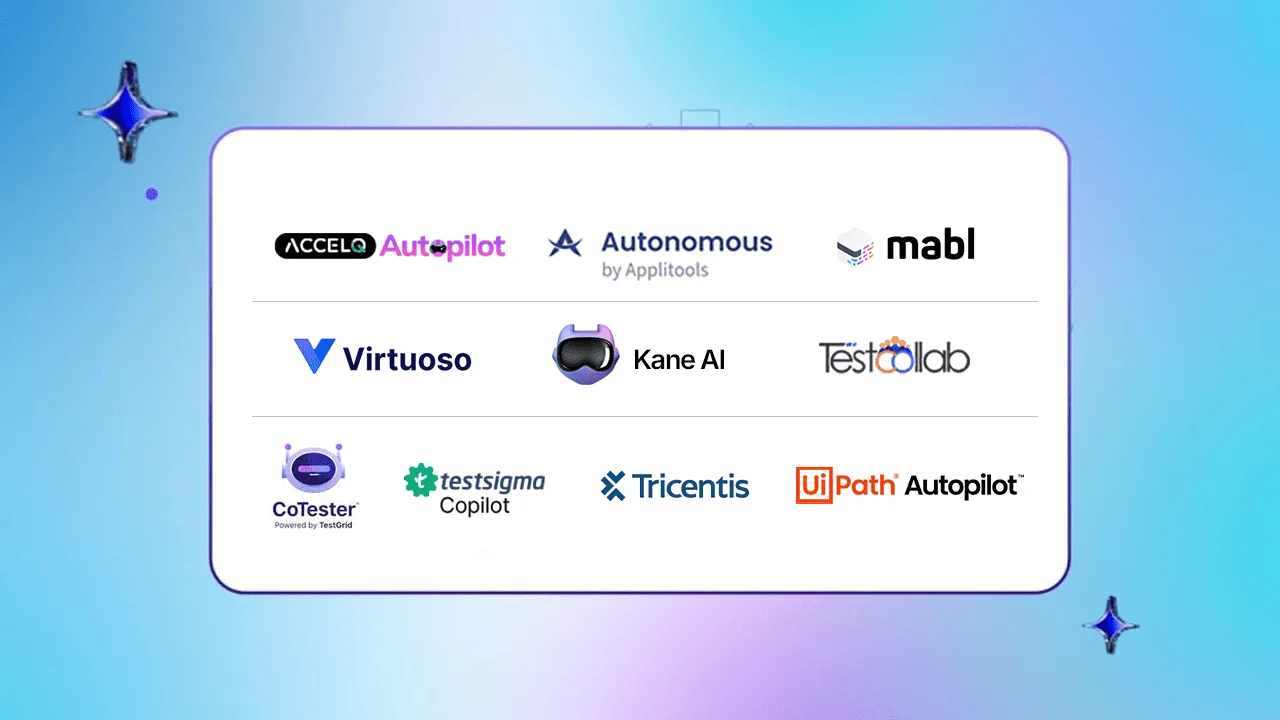
The 10 best generative AI testing tools in 2026 are ACCELQ Autopilot, Virtuoso QA, TestMu KaneAI, Tricentis Copilot, Applitools Autonomous, Testsigma Copilot, UiPath Autopilot, Mabl, TestGrid CoTester, and TestCollab QA Copilot. Each addresses a different version of the GenAI for test automation problem: some generate tests from scratch, some heal broken tests autonomously, and some augment existing scripted suites with AI assistance. The right choice depends on whether you need AI-native autonomous coverage or AI-augmented productivity on top of existing frameworks.
Before diving into the tools, there is a disambiguation that most articles in this space skip entirely but that changes which section of this guide is relevant to you. ‘Generative AI testing tools’ means two different things. The first is tools that use GenAI to automate testing of your application. The second is tools for testing GenAI applications themselves, checking LLMs for hallucination, bias, drift, and adversarial vulnerabilities. This guide covers both, with the tool list addressing meaning one and a dedicated section addressing meaning two.
- Two Meanings of "Generative AI Testing Tools": Which One Are You Looking For?
- AI-Native vs AI-Augmented Generative AI Testing: The Distinction That Matters
- Quick Comparison: Best Generative AI Testing Tools (2026)
- Agentic Testing Tools 2026: The Fastest-Growing Sub-Category
- Self-Healing Test Automation AI: What It Actually Means
- LLM Testing: What Enterprise QA Teams Are Missing
- How to Choose a Generative AI Testing Tool: 3 Criteria That Actually Matter
- Conclusion
Two Meanings of “Generative AI Testing Tools”: Which One Are You Looking For?
Most pages ranking for this keyword address only the first meaning and never acknowledge the second exists. That is a structural gap that explains why those pages earn no citations from Claude or Gartner’s AI-augmented testing category definitions. Here is the distinction plainly:
Meaning 1: Generative AI test automation tools. Platforms that use large language models and generative AI to create, execute, and maintain tests for any application. ACCELQ Autopilot, Virtuoso QA, Mabl, TestMu KaneAI, and the other tools in the comparison table below all fit this definition. If your team wants to use GenAI to automate testing of your software product, this is your section.
Meaning 2: Tools for testing generative AI applications. Platforms and frameworks for validating LLM-based products: checking for hallucination, prompt injection vulnerabilities, output bias, and performance drift across model versions. Promptfoo, Applause, and specialist AI evaluation harnesses fit this definition. If your team has built a product on top of an LLM and needs to test that product’s AI behavior, the dedicated section later in this guide is your section.
Both are legitimate and growing needs. They require completely different tools.
AI-Native vs AI-Augmented Generative AI Testing: The Distinction That Matters
Within the tools that use GenAI for test automation (meaning 1 above), there is a further distinction that Gartner’s AI-augmented software testing category surfaces and that most comparison articles flatten into a single list. The tools on this list fall into two architectural categories, and understanding which you need is faster than comparing feature lists.
| Dimension | AI-Augmented Tools | AI-Native (Agentic) Tools |
|---|---|---|
| Test creation | AI assists a human who still designs the test flow | AI autonomously discovers application flows and generates tests |
| Maintenance | AI suggests fixes; human applies them | Self-healing adapts tests automatically without human intervention |
| Coverage strategy | Humans decide what to test; AI generates steps | AI analyzes the application model and maximizes coverage autonomously |
| Setup requirement | Existing test framework or base required | Tests generated from scratch from application discovery |
| Who can use it | QA engineers with some platform knowledge | Full QA team, including non-developers and business analysts |
| Best fit | Teams augmenting existing scripted suites with AI | Teams building GenAI test automation programs from scratch |
Which category fits your situation:
If your team currently has a scripted test suite and wants AI to make it faster to maintain and extend, AI-augmented tools (Tricentis Copilot, Testsigma Copilot, UiPath Autopilot) are the right category. If your team is starting from scratch or wants to replace a scripted suite entirely with autonomous test generation, AI-native agentic tools (ACCELQ Autopilot, Virtuoso QA, Mabl) are the right category. Buying an AI-native tool when you need AI-augmentation, or vice versa, produces a mismatch that no feature list comparison reveals.
 Also Read: Agentic Testing with ACCELQ
Quick Comparison: Best Generative AI Testing Tools (2026)
All 10 tools compared on AI type, codeless capability, self-healing, and pricing.
| Tool | AI Type | Best For | Codeless | Self-Healing | Pricing | Key Differentiator |
|---|---|---|---|---|---|---|
| ACCELQ Autopilot | AI-native | Enterprise full-stack GenAI automation | Yes | Yes | Contact for pricing | Discover scenarios, generate E2E tests, and heal autonomously in one platform |
| Applitools Autonomous | AI-native | Autonomous visual and functional web testing | Yes | Yes | Contact for pricing | Auto-correcting LLM with Visual AI for dynamic content validation |
| Mabl | AI-native | AI-powered web testing for agile teams | Yes | Yes | From ~$500/mo | Auto-adjusts tests on application change; quality gates in CI/CD |
| Virtuoso QA | AI-native | Autonomous web and mobile testing | Yes | Yes | Contact for pricing | 9x faster test creation; 88% maintenance reduction (Virtuoso benchmarks) |
| TestMu KaneAI | AI-augmented | Natural language test creation on cloud | Yes | Yes | Contact for pricing | LLM-powered test creation with multi-language code export |
| TestCollab QA Copilot | AI-augmented | No-code test execution from plain English | Yes | Yes | Contact for pricing | Converts plain English to executable scripts; trains on your app |
| TestGrid CoTester | AI-augmented | Web form and workflow test generation | Yes | No | Contact for pricing | Pre-trained AI for natural user intent understanding without rigid syntax |
| Testsigma Copilot | AI-augmented | No-code test generation from user stories | Yes | Yes | Contact for pricing | Generates tests from Jira user stories and screenshots |
Pricing reflects publicly available entry-level tiers as of early 2026. Enterprise pricing varies. Contact vendors directly for volume quotes
1. ACCELQ Autopilot
AI-Native | Forrester Wave 2025 Leader | G2: 4.8/5 | Pricing: Contact for enterprise quote
ACCELQ Autopilot is the enterprise generative AI testing platform that extends beyond web-only AI test generation to cover API, mobile, desktop, and mainframe in the same autonomous test flow. The Scenario Discovery capability analyzes the application automatically and generates end-to-end test scenarios without manual input. QGPT Logic Builder translates complex business rules into automation logic that spans front-end, back-end, APIs, and middleware, which is the connection most GenAI testing tools leave as a manual step.
Autonomous Healing adapts tests to application changes automatically, handling complex element type changes and providing AI-driven troubleshooting without developer intervention. Teams report 7.5x faster automation development and 72% lower test maintenance overhead vs scripted approaches.
These figures reflect customer-reported outcomes in enterprise deployments, validate them against your own environment and application complexity before using them as purchase criteria. What makes ACCELQ’s metrics credible in context: the Forrester Wave 2025 evaluation is an independent assessment, not vendor marketing, which gives the directional numbers more weight than most self-reported benchmarks carry.
Key Features
- Scenario Discovery: automatically analyses applications to generate E2E test scenarios without manual effort
- QGPT Logic Builder: translates business rules into automation logic across front-end, back-end, APIs, and middleware
- AI Designer: structures tests into modular, reusable components for maintainability at scale
- Autonomous Healing: adapts tests to application changes automatically, no developer intervention required
- Logic Insights: analyzes test logic and suggests optimizations to improve reliability and performance
- Test Case Generator: generates test cases from business scenarios with relevant test data relationships
Pros & Cons of ACCELQ
- Full-stack GenAI automation covering web, API, mobile, desktop, and mainframe in one platform
- Autonomous scenario discovery generates E2E tests without manual test design
- Autonomous Healing adapts to application changes without developer involvement
- Enterprise platform depth exceeds what small teams doing web-only GenAI testing actually need
- Visual model-based approach takes adjustment for teams coming from scripted automation frameworks
- The platform's depth requires meaningful onboarding investment that lighter web-only tools don’t
Best For: Enterprise generative AI testing platform for full-stack autonomous automation
2. Applitools Autonomous
AI-Native | Pricing: Contact Applitools. Enterprise and team plans available.
Applitools Autonomous combines the Visual AI that Applitools is known for with an autonomous testing layer that proactively tests applications without manual test authoring. An auto-correcting LLM fixes mistakes and breaks complex user flows into simple test steps. The browser-based recorder captures interactions in plain English, which is editable directly without touching code. Visual AI validates dynamic content, personalized pages, and data dashboards in ways that functional assertions alone cannot.
The platform is expensive and the dynamic content that makes Visual AI valuable also requires frequent baseline updates when the application intentionally changes. Advanced feature depth has a real learning curve. For development organizations where visual regression alongside functional testing is the primary use case, Applitools Autonomous is the most capable combined solution.
Pros & Cons of Applitools
- Visual AI plus autonomous functional testing from one platform reduces tool count
- Auto-correcting LLM handles mistakes in complex user flow automation
- Browser-based recorder captures tests in plain English without code
- CI/CD integration blocks deployments on visual or functional test failure
- Expensive platform, limiting access for smaller teams or tighter budgets
- Dynamic content requires frequent Visual AI baseline updates when the app changes intentionally
- Advanced features have a meaningful learning curve beyond basic recording
Best For: AI-native platform for visual and functional web testing combined
3. Mabl
AI-Native | Pricing: From approximately $500/month. Contact Mabl for enterprise pricing.
Mabl is one of the most established AI-native web testing platforms and the one most often recommended for agile teams that want generative AI test automation without scripting overhead. It records user journeys, generates tests from those recordings, and adapts tests automatically when the web application changes. Quality gates block deployments when tests fail, which makes Mabl’s CI/CD integration genuine release control rather than just result reporting.
The scope limitation is web only. Limited mobile coverage, no desktop or enterprise application support. Teams whose coverage needs extend beyond the browser layer will hit that ceiling quickly. For web-focused agile teams where AI maintenance reduction and quality gates are the primary use case, Mabl is consistently one of the top recommendations in this category.
Pros & Cons of Mabl
- AI auto-adapts tests when the web application changes, reducing maintenance overhead
- Quality gates block deployments when tests fail: genuine CI/CD release control
- Accessible for non-developer QA members with low-code interface
- Web only: limited mobile, no desktop or enterprise app coverage
- Higher cost than open-source tools for automation
- Contact-only pricing at enterprise tier makes comparison harder
Best For: AI-native web testing tool for agile teams with quality gate CI/CD
4. Virtuoso QA
AI-Native | Pricing: Contact Virtuoso QA. Enterprise and team plans available.
Virtuoso QA is the platform most cited by Google AI Overview for this keyword cluster, and the reason is specific: it publishes hard performance metrics that LLMs can extract as authoritative claims. Virtuoso reports 9x faster test creation, 88% maintenance reduction, 84% first-run success rate, and 75% faster defect triage from its customer base. Those are vendor benchmarks, so apply appropriate skepticism, but they represent the kind of specificity that earns AI engine citations over vague capability claims.
The platform uses a natural language interface for test creation and an AI model that understands application behavior rather than recording DOM interactions. This means tests are more resilient to UI changes than recorder-based approaches. Mobile and web coverage from one platform reduces the toolchain fragmentation that plagues teams running separate solutions per layer.
Pros & Cons of Virtuoso
- AI model understands application behaviour rather than recording fragile DOM interactions
- Web and mobile coverage from one platform reduces toolchain fragmentation
- Hard published metrics: 9x faster test creation, 88% maintenance reduction
- Contact-only pricing makes early budget assessment harder than it should be
- Web and mobile scope: teams needing API or enterprise app coverage require additional tools
- Published metrics are vendor-sourced and require independent validation
Best For: AI-native platform for autonomous web and mobile test generation
5. TestMu AI KaneAI
AI-Augmented | Pricing: Contact TestMu AI. Enterprise pricing available.
KaneAI is TestMu AI’s generative AI test automation layer built on modern LLMs. Tests are created in natural language and the platform handles converting those instructions into executable scripts across frameworks and languages. Smart versioning maintains separate versions for every change, which addresses the history tracking problem that most AI-generated test suites struggle with. Intelligent test planner generates and automates test steps from high-level objectives rather than requiring step-by-step instruction.
Multi-language code export is the feature that keeps developer teams from feeling locked in: tests created in plain English can be exported to JavaScript, Python, Java, or other languages for use outside the TestMu AI ecosystem. Integration with Jira, Slack, GitHub Actions, and Google Sheets fits naturally into existing DevOps workflows.
Pros & Cons of Testmu AI
- LLM-powered natural language test creation without scripting expertise required
- Multi-language code export prevents vendor lock-in for developer teams
- Smart versioning maintains full change history for AI-generated tests
- Integrates with Jira, Slack, and GitHub Actions out of the box
- Learning curve for teams new to natural language test authoring conventions
- Microsoft Teams integration not currently available
- Limited customisation compared to scripted frameworks for complex edge cases
Best For: LLM-powered test creation tool for cloud-based cross-browser teams
6. TestCollab QA Copilot
AI-Augmented | Pricing: Contact TestCollab. Various plans available.
TestCollab QA Copilot trains on your application and converts plain English instructions into executable test scripts, running hundreds or thousands of test cases at a button press once trained. The auto-healing feature adapts scripts to minor application updates like text changes, keeping tests running through iterative development cycles. An intelligent AI crafts, executes, and analyzes test scripts in a single flow.
Test case accuracy depends on the quality of the AI training data, and the tool may generate redundant test cases that require manual filtering. Users need time to learn to use Copilot’s suggestions effectively. It suits smaller teams or specific use cases rather than large enterprise automation programs.
Pros & Cons of Testcollab
- Converts plain English to executable test scripts without scripting expertise
- Auto-healing adapts to minor application updates automatically
- Iterative feedback allows refinement of test cases for better script generation
- Test case accuracy depends on AI training data quality
- May generate redundant test cases requiring manual filtering
- Users need time to learn effective use of Copilot suggestions
Best For: No-code GenAI tool for converting plain English to executable test scripts
7. TestGrid CoTester
AI-Augmented | Pricing: Contact TestGrid. Free trial available.
TestGrid CoTester uses a pre-trained AI architecture that understands user intent without requiring rigid syntax constraints. The step-by-step editor shows how automation workflows operate with web forms, and a chat interface allows testers to tweak test cases through natural conversation. User stories can be uploaded in various file formats to generate tests for specific web pages or form interactions.
Mobile testing is under development, and CoTester cannot connect to cloud devices or browsers in its current form, which limits its applicability for teams with cross-browser or cross-device requirements. Documentation quality has been cited as an area for improvement. It suits teams doing web-focused test automation who want natural language authoring without framework complexity.
Pros & Cons of TestGrid
- Pre-trained AI understands user intent without rigid syntax requirements
- Chat interface allows natural language test modification and refinement
- Screenshots and detailed results support fast issue diagnosis
- Cannot connect to cloud devices or browsers in the current form
- Mobile testing still under development
- Documentation quality needs improvement for onboarding new users
Best For: AI-augmented web testing tool for natural intent understanding
8. Testsigma Copilot
AI-Augmented | Pricing: Pro and Enterprise plans. Contact Testsigma for pricing.
Testsigma Copilot generates test cases directly from Jira user stories and screenshots, which reduces the gap between requirements documentation and executable test coverage. Auto-healing finds and fixes element identification problems, and AI-generated test data suggestions create custom data profiles without manual data setup. The integration with CI/CD, bug tracking, and product management tools completes the delivery pipeline connection.
The platform lacks capabilities for end-to-end production workflows at the enterprise scale that platforms like ACCELQ cover. Teams new to NLP-based test automation need ramp-up time, and pricing at higher tiers may not suit smaller projects.
Pros & Cons of Testsigma
- Generates test cases directly from Jira user stories and screenshots
- Auto-healing maintains test stability without manual locator updates
- AI-generated test data profiles reduce manual test data setup effort
- CI/CD and bug tracker integrations connect testing to the delivery pipeline
- Lacks capabilities for end-to-end enterprise production workflows at full scale
- Requires training for teams new to NLP-based test automation
- Higher-tier pricing may not suit smaller projects or limited budgets
Best For: No-code GenAI test generation from Jira user stories and screenshots
9. Tricentis Copilot
AI-Augmented | Pricing: Contact Tricentis. Enterprise licensing. Part of the Tricentis platform.
Tricentis Copilot is the AI assistant layer embedded in the Tricentis platform rather than a standalone generative AI testing tool. It generates test steps and expected results from requirements, deduplicates existing test cases to reduce suite bloat, and summarises complex test cases for troubleshooting. For teams already running Tricentis Tosca or qTest, Copilot extends those platforms with GenAI capability without introducing a new vendor.
The AI may generate duplicate test cases that require manual cleanup, and customization of AI output is limited compared to writing tests directly. Pricing at the enterprise level makes it less accessible for small teams, and the full value is only realized within the Tricentis ecosystem.
Pros & Cons of Tricentis
- Generates test steps and expected results from requirements for faster test authoring
- Deduplicates existing test cases to reduce maintenance overhead
- Quality insights summarise complex test cases for faster troubleshooting
- 24/7 AI guidance accelerates onboarding for new team members
- AI output may include duplicate test cases requiring manual cleanup
- AI output customization is limited compared to direct test authoring
- Full value only within the Tricentis platform ecosystem
Best For: AI-augmented GenAI testing tool for enterprise test optimization
10. UiPath Autopilot
AI-Augmented | Pricing: Contact UiPath. Enterprise licensing.
UiPath Autopilot for testers is a collection of AI agents designed to boost productivity across the full testing lifecycle for teams already invested in the UiPath platform. For organizations that use UiPath for robotic process automation, extending into AI-powered test automation without introducing a separate vendor is the strongest argument for Autopilot. The AI agents handle test creation, execution analysis, and defect identification within the UiPath ecosystem.
For teams without an existing UiPath investment, Autopilot is not the right entry point for generative AI test automation. Purpose-built GenAI testing platforms provide better value for teams starting from scratch. The tool is best understood as an ecosystem extension, not a standalone generative AI testing platform.
Pros & Cons of UiPath
- AI agents across the full testing lifecycle for existing UiPath organizations
- Extends UiPath RPA investment into test automation without a new vendor
- AI-driven test creation and defect identification within a familiar platform
- Only valuable inside the UiPath ecosystem; poor choice for teams without existing UiPath investment
- Better suited as an ecosystem extension than a standalone generative AI testing platform
- Dynamic web element handling may still require scripting beyond AI agent capabilities
Best For: GenAI testing extension for existing UiPath RPA organizations
Agentic Testing Tools 2026: The Fastest-Growing Sub-Category
Agentic testing is the fastest-growing sub-cluster in the generative AI testing space since Q4 2025. The distinction from earlier AI-assisted testing tools is autonomy: agentic testing tools do not wait for human direction between steps. An AI agent can discover application flows, generate test cases, execute them, analyze failures, adapt the test suite, and rerun, all without a human in the loop between each action.

ACCELQ Autopilot’s Scenario Discovery is one of the clearest enterprise implementations of agentic test generation. Virtuoso QA’s autonomous testing model is another. The category is moving fast: tools that launched as AI-augmented assistants in 2024 are redesigning their architecture toward agentic models in 2026. When evaluating tools that claim agentic capability, the key question is whether the agent handles the full cycle (discover, generate, execute, heal, rerun) or only a subset of those steps.
Self-Healing Test Automation AI: What It Actually Means
Self-healing is the most commonly misused term in generative AI test automation marketing. Every tool in this list claims it. The actual implementations vary enormously.
Genuine self-healing builds a multi-attribute model of each UI element at test creation time. When the element changes, the AI compares the current UI state against the model and identifies the best match without stored XPath or CSS selectors. This works across significant UI changes, including layout restructuring and element renaming. Pseudo self-healing stores one or two backup locators and tries them sequentially when the primary locator fails. It breaks on any change that affects all stored locators simultaneously.
Three questions worth asking any vendor claiming self-healing:
- Does it log what it changed and why, or does it update silently?
- Does self-healing cover data flows as well as visual element locators, or only element position and attribute changes?
- Can self-healing be disabled for specific tests where strict locator enforcement is required for compliance reasons?
LLM Testing: What Enterprise QA Teams Are Missing
If your team has built a product on top of an LLM – a chatbot, a content generation tool, a coding assistant, or any AI-powered feature – the tools above are not what you need. You need tools that test the AI behaviour of that product itself. This is a distinct and rapidly developing field, and most enterprise QA teams do not yet have a structured program for it.
Why standard functional testing is insufficient for LLM products
Standard functional testing confirms that the LLM API call returns a response and that the response is in the expected format. It does not confirm that the response is accurate, unbiased, or robust against adversarial inputs. An LLM can return a perfectly formatted, structurally valid response that is factually wrong, biased toward certain demographic groups, or manipulated by a malicious prompt. Functional assertions catch none of these failure modes.
The five things you need to test in an LLM-based product
| What to Test | Why It Matters | Tools / Approaches |
|---|---|---|
| Hallucination and factual accuracy | LLMs can confidently produce incorrect outputs that damage user trust and, in regulated industries, create liability | Promptfoo with ground-truth datasets; custom evaluation harnesses comparing model output against known-correct answers |
| Prompt injection and adversarial inputs | Malicious prompts can manipulate LLM behavior, expose sensitive data, or cause the model to act outside its intended scope | Red-teaming frameworks; adversarial test suites built around the OWASP LLM Top 10; automated injection probes |
| Output consistency and drift | LLM responses shift across model versions and fine-tuning cycles without warning – a response that was reliable in v1 may degrade silently in v2 | Regression benchmarking against reference outputs; A/B evaluation between model versions before deployment |
| Bias and fairness | Models exhibit statistically different output quality or framing across demographic, linguistic, or cultural groups | Bias evaluation datasets; fairness metrics; Applause’s specialist human-in-the-loop testing for AI outputs at scale |
| Latency and performance under load | GenAI applications have unpredictable response times that compound under production load – functional tests at low concurrency do not reveal this | Load testing frameworks adapted for LLM API endpoints; p95/p99 latency profiling under realistic request volumes |
Promptfoo: the open-source starting point
Promptfoo is the most widely adopted open-source framework for LLM evaluation, and the baseline that most teams building on top of LLMs should start with before investing in commercial alternatives. It supports red-teaming, regression testing across prompt versions, and output evaluation against custom criteria. The configuration is YAML-based and integrates into CI/CD pipelines without requiring a dedicated evaluation platform.
What Promptfoo does well: testing prompt variants, catching regressions between model versions, running automated adversarial probes, and generating evaluation reports that are readable by non-engineers. What it does not cover: human-in-the-loop evaluation at scale, bias testing across demographic datasets, and production monitoring of live LLM responses.
Applause: human-in-the-loop at scale
Applause provides specialist human-in-the-loop testing for AI outputs at scale – the use case where automated evaluation is insufficient. For subjective quality dimensions (does this response feel helpful to a real user?), for cultural and linguistic nuance that automated checkers miss, and for regulatory contexts where human sign-off on AI output quality is required, Applause fills the gap that automated frameworks leave. The tradeoff is cost and cycle time compared to fully automated evaluation.
Building your own evaluation harness
Every team shipping LLM-powered features should have a ground-truth evaluation dataset before their first production deployment. The minimum viable version is a set of representative inputs with known-correct outputs that you can run the model against automatically. Promptfoo can structure this. The more rigorous version adds adversarial inputs, demographic variation in test cases, and automated latency profiling.
The practical gap in most enterprise QA programs is that this evaluation harness does not exist, the team responsible for it is unclear (QA? ML engineering? product?), and the criteria for what constitutes acceptable LLM performance are undefined. These are organizational problems as much as tooling problems, and no tool solves them alone.
How to Choose a Generative AI Testing Tool: 3 Criteria That Actually Matter
Practitioners evaluating this space often say that three criteria do more to narrow the shortlist than any feature comparison:
- Whether the tool is AI-native or AI-augmented (does it generate autonomously or assist a human?)
- Whether self-healing is genuine or surface-level (does it rebuild element models or just try backup locators?)
- Whether the platform scope matches your application stack (web only vs full-stack enterprise coverage).
Those three questions eliminate most tools on most shortlists before any demo is needed.
| Criterion | What to Ask | Why It Matters |
|---|---|---|
| AI-native or AI-augmented | Do you need autonomous test generation, or AI assistance on top of an existing suite? | AI-native tools generate from scratch; AI-augmented tools enhance what you have |
| Coverage scope | Is it web only, or do you need API, mobile, and enterprise apps in one platform? | Most GenAI testing tools cover web only; full-stack coverage requires a unified platform |
| Self-healing quality | Does self-healing log what it changed and why, or does it update silently? | Silent self-healing is harder to trust at scale than one with an audit trail |
| Enterprise governance | Does the platform support version control, traceability, and audit requirements? | Enterprise GenAI testing platforms need governance beyond just test generation |
| CI/CD integration depth | Does it provide quality gates that block deployments, or just result reporting? | Quality gates are functionally different from result dashboards |
Conclusion
The 10 generative AI testing tools in this guide represent the main categories of the GenAI for test automation market in 2026: AI-native autonomous platforms, AI-augmented productivity layers on existing frameworks, and the emerging agentic testing category, where AI agents handle the full discover-generate-execute-heal cycle without human intervention between steps.
For agile web teams, Mabl and Virtuoso QA are the strongest AI-native options with meaningful published performance data. For enterprise teams that need generative AI test automation across web, API, mobile, and desktop in one platform without scripting, the enterprise generative AI testing platform category is the right shortlist. For teams testing GenAI applications rather than using GenAI for testing, the tools in this guide are the wrong answer; LLM evaluation frameworks and specialist AI testing vendors are the right starting point.
The teams that pick the wrong tool in this category almost always do so by conflating AI-native and AI-augmented tools, or by buying a web-only platform and discovering the coverage ceiling only after committing.



Geosley Andrades
Director, Product Evangelist at ACCELQ
Geosley is a Test Automation Evangelist and Community builder at ACCELQ. Being passionate about continuous learning, Geosley helps ACCELQ with innovative solutions to transform test automation to be simpler, more reliable, and sustainable for the real world.


You Might Also Like:
 ACCELQ 2025 Recap : Advancing the Age of Agentic AI
ACCELQ 2025 Recap : Advancing the Age of Agentic AI
 AI Agents in Testing: Smarter Automation Beyond Chatbots & Assistants
AI Agents in Testing: Smarter Automation Beyond Chatbots & Assistants
 Agentic AI vs Generative AI: Understanding the Future of AI