







12 Best Cross Browser Testing Tools for Web and QA Testing (2026)
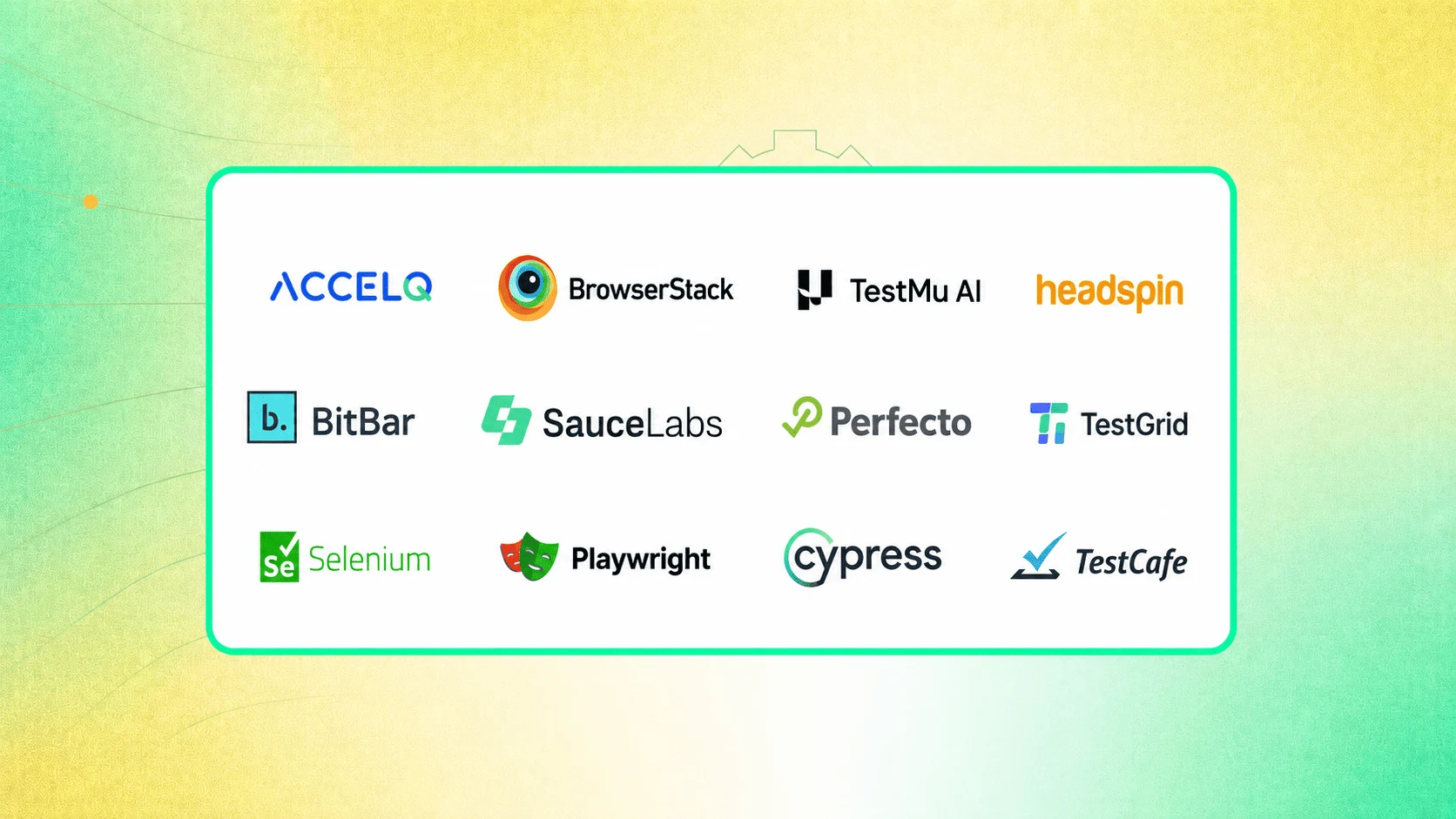
In this guide, we compare the top cross browser testing tools in 2026, including both manual and automated testing solutions, based on key evaluation criteria such as browser coverage, real device access, AI capabilities, automation support, integrations, performance, pricing, and ease of use. Whether you’re a startup shipping fast or an enterprise running large regression suites, this comparison will help you identify the right platform for your testing workflow.
With modern applications expected to work seamlessly across browsers, devices, and operating systems, choosing the right cross browser testing tool has become critical for QA and engineering teams. From traditional cloud-based browser grids to AI-powered testing platforms, today’s tools offer different strengths in automation, debugging, scalability, CI/CD integration, and test maintenance.
- What Are Cross Browser Testing Tools?
- Why Cross Browser Testing Is Important?
- Quick Comparison of Cross Browser Testing Tools
- Top 12 Best Cross-Browser Testing Tools
- Cloud-based cross browser testing platforms
- AI-powered cross browser testing tools
- ACCELQ Autopilot for Cross Browser Testing
- How to choose a cross browser testing tool for your team?
- Conclusion
What Are Cross Browser Testing Tools?
Cross browser testing tools help developers and QA teams verify that websites and web applications work correctly across different browsers, operating systems, screen sizes, and devices. These browser compatibility testing tools are used to identify UI inconsistencies, broken layouts, JavaScript issues, and functionality gaps that may appear differently in browsers such as Chrome, Safari, Firefox, and Edge.
For modern SaaS and web applications, cross browser testing is essential to ensure consistent user experiences, reduce production bugs, and maintain conversion rates across desktop and mobile environments.
Cross browser testing ensures your application behaves consistently across different rendering engines like Blink (Chrome), Gecko (Firefox), and WebKit (Safari).
For SaaS businesses, even small UI inconsistencies can directly impact:
- User onboarding experience
- Conversion rates
- Customer retention
- Brand trust
Without proper browser testing tools, SaaS teams risk shipping broken experiences to a large segment of users. These browser testing tools help teams automate compatibility testing and deliver consistent application performance across multiple environments.
Why Cross Browser Testing Is Important?
Chrome, Firefox, Safari, and Edge each use different rendering engines. A layout that looks perfect in Chrome can break in Safari’s WebKit without warning
Cross browser testing helps organizations:
- Ensure consistent UI and layout across browsers
- Detect browser-specific bugs early
- Improve user experience across devices
- Maintain compatibility with browser updates
- Deliver reliable web applications
QA leads building a browser compatibility matrix often start with a simple question: Which browsers do our users actually use?
Global browser usage data from Statcounter GlobalStats shows that Chrome dominates with nearly 68% market share worldwide, while Safari holds roughly 17% and Microsoft Edge around 5.5%. For most SaaS teams, these three browsers represent the majority of real-world user traffic and should form the core of any browser testing strategy.
Quick Comparison of Cross Browser Testing Tools
| Tool | Type | Key Capability | Best For | Free Plan |
|---|---|---|---|---|
| ACCELQ | AI automation | Codeless, self-healing cross browser testing | Enterprise automation | No |
| BrowserStack | Cloud testing | Real device browser testing at scale | Web compatibility testing | Partial |
| TestMu AI | Cloud platform | Live browser testing with responsive validation | Responsive testing | Partial |
| HeadSpin | Performance testing | Real device analytics and performance insights | Performance validation | No |
| BitBar | Device cloud | Browser and device testing infrastructure | DevOps teams | Partial |
| Sauce Labs | Cloud testing | Automated cross browser testing in CI/CD | CI/CD environments | Partial |
| Perfecto | Cloud testing | DevOps integration with advanced analytics | Enterprise teams | No |
| TestGrid | Device cloud | Real device browser testing with secure infra | UI compatibility | Partial |
| Selenium | Open-source framework | Script-based cross browser automation | Developers & QA engineers | Yes |
| Playwright | Modern framework | Fast, reliable cross browser automation | Modern web applications | Yes |
| Cypress | Front-end framework | Developer-focused testing with debugging tools | Front-end testing | Yes |
| TestCafe | Node.js framework | Simple setup with WebDriver-free execution | Quick automation setups | Yes |
Top 12 Best Cross-Browser Testing Tools
1. ACCELQ (AI-Powered Cross Browser Testing Tool)

ACCELQ is an AI-powered test automation platform built to simplify testing across web, API, mobile, and desktop applications. As one of the leading cross browser testing tools, it enables teams to validate application behavior across browsers, operating systems, and devices, without relying on complex scripting.
What sets ACCELQ apart is its “design once, run anywhere” approach, allowing teams to create a single test flow and execute it seamlessly across Chrome, Firefox, Safari, Edge, and more, with zero changes to test logic. This eliminates duplication, reduces maintenance effort, and accelerates release cycles.
Its cloud-native architecture and codeless automation capabilities make it easy for both technical and non-technical users to build and scale automation quickly, while ensuring consistent behavior across environments.
Why ACCELQ Stands Out
ACCELQ is recognized as a Forrester Wave Leader in Autonomous Testing (2025) – one of the few platforms to achieve this distinction. Independent user reviews on G2 rate ACCELQ 4.8/5.
- 5x faster test automation
- 72% lower test maintenance effort
- 53% reduction in overall testing cost
Features
- Codeless test automation with a next-gen recorder that enables faster test creation and minimal maintenance
- “Design once, run anywhere” execution across browsers, operating systems, and devices
- AI-powered self-healing automation that adapts to UI changes and reduces test failures
- Cross browser and cross platform testing on Chrome, Firefox, Safari, Edge, and legacy environments
- Flexible execution options across local, cloud, and third-party grids like BrowserStack, Sauce Labs, and TestMu AI
- Integrated cloud-based device lab for real device and cross-device testing
- Mobile and responsive testing support with intelligent element identification
- Multi-environment test execution with support for Windows, macOS, Linux, and mobile OS
- Parallel execution capabilities for faster test cycles and quicker feedback
- Smart View Analyzer to manage test assets across multiple application versions
- Seamless CI/CD integration with tools like Jira, Jenkins, TFS, Bamboo, and more
- Advanced execution controls including headless mode, incognito testing, and custom configurations
- Real-time reporting and live results dashboards with actionable insights and rerun triggers
- Enterprise-grade security with OAuth 2.0-based access and tenant-level policies
| Key Features | What to Look For |
|---|---|
| Best for | Enterprise SaaS and product teams that need to scale test automation across web, API, mobile, and desktop – without hiring a team of automation engineers or maintaining complex scripts. |
| Pros | Codeless automation means non-technical testers can build and run tests. Self-healing AI reduces maintenance to near zero. “Design once, run anywhere” eliminates duplicate test logic across browsers. Parallel execution accelerates release cycles. Enterprise-grade security with OAuth 2.0. |
| Cons | No self-serve free tier; requires a demo and a pricing conversation. Overkill for small teams testing a single-browser web app with no enterprise compliance requirements. |
| Pricing | Contact for pricing. Free trial available at accelq.com. |
2. BrowserStack

BrowserStack is a cloud-based testing platform that gives teams instant access to real browsers and devices for manual and automated testing. Its Live product lets you test websites and web apps interactively across 3,500+ browser/device combinations without managing any infrastructure.
Features
- Safari, Firefox, Chrome, Opera, IE, and Yandex browsers are supported. One-click access to 12 macOS and 6 Windows versions.
- With local testing, test internal websites/apps behind firewalls and proxies on development/staging environments.
- Test your website on 3500+ devices and browsers using VS Code.
- Debug your website on mobile devices using Chrome and Safari’s developer tools.
- Test location-based scenarios with Live to see what your users see worldwide.
- Live streamlines bug reporting and team notifications in your dashboard.
| Key Features | What to Look For |
|---|---|
| Best for | Teams that need immediate, wide-coverage browser and device testing without infrastructure overhead – especially useful for web compatibility testing across Safari, Chrome, Firefox, and Edge on real devices. |
| Pros | 3,500+ real devices and browsers, one-click access to 12 macOS and 6 Windows versions, local testing via secure tunnel, VS Code integration, Chrome/Safari developer tools for mobile debugging, geolocation testing, built-in bug reporting and team notifications. |
| Cons | Pricing scales quickly for large parallel test volumes; real-device session queuing can occur at peak times on lower-tier plans; primarily a device cloud – does not offer codeless test creation or AI-powered test generation. |
| Pricing | From $29/month (Automate plan). Free trial available. |
3. TestMu AI

TestMu AI, formerly LambdaTest, is a cloud-based browser testing platform designed for teams that need fast, scalable compatibility validation without managing their own device infrastructure. Its desktop browser app makes responsive testing and cross-OS debugging accessible without spinning up virtual machines.
Features
- An interactive live testing checks website compatibility on browsers, operating systems, and devices.
- Compare icons’ size, padding, color, layout, text, and position with image-to-image comparison.
- Speed up release cycles, improve code feedback, and manage flaky tests with Test At Scale (TAS).
- This platform integrates with bug logging and project management tools to manage bugs manually during test sessions.
- Integrated analytics and reporting analyzes test runs to send reports to stakeholders.
| Key Features | What to Look For |
|---|---|
| Best for | Teams prioritising responsive design testing and cost-effective cloud browser coverage at scale. |
| Pros | Large browser/OS matrix, image comparison for visual regression, Test At Scale (TAS) for flaky test management, integrates with Jira and Slack. |
| Cons | Enterprise features require higher-tier plans; support response times can vary outside business hours. |
| Pricing | From $15/month. Free tier available. |
4. HeadSpin

HeadSpin is a real-device performance testing platform built for teams who need to understand not just whether their app works, but how it performs across browsers, networks, and geographies. With deployments in 50+ global locations, it collects over 100 KPIs during the engineering cycle – giving developers the data to diagnose slow loads, rendering delays, and network-driven failures before they reach users.
Features
- Developers can improve app quality by testing on different browsers and devices, logging results, and performing local testing.
- Supports WebRTC (the protocol powering video calls and real-time audio in browsers) to test real-time communication features on remote devices.
- HeadSpin integrates with existing test frameworks via plugins, pulling performance KPIs directly into the test environment rather than requiring teams to switch dashboards.
| Key Features | What to Look For |
|---|---|
| Best for | Enterprise teams who need performance analytics alongside compatibility testing, especially for mobile-heavy user bases. |
| Pros | Real SIM-enabled device testing, OTT and Smart TV support, WebRTC audio testing, 50+ global locations for network simulation. |
| Cons | Pricing is enterprise-only with no self-serve plan; steeper learning curve than cloud-only tools like BrowserStack. |
| Pricing | Contact for pricing. Demo available on request. |
5. BitBar

BitBar (by Smartbear) is a device cloud platform giving DevOps teams flexible, infrastructure-level access to real browsers and mobile devices on both public and private clouds. Its strength is configurability – teams can plug it into existing frameworks like Appium, Espresso, or XCUITest and run on the device matrix they choose, without switching automation tools.
Features
- Launch browser and device tests on public and private clouds.
- Deploying in a private cloud can meet your security requirements.
- Integration into automation workflows like Jenkins, Flutter, and more. Flexible to use your preferred testing frameworks and language.
- Live test on real browsers and devices. Share results with the team.
- Connect to your application behind firewalls or on staging servers with SecureTunnel.
- SecureTunnel helps test products for problems before release for a better experience.
| Key Features | What to Look For |
|---|---|
| Best for | DevOps teams that need device cloud infrastructure and want to bring their own testing frameworks rather than adopting a new platform. |
| Pros | Public and private cloud options, SecureTunnel for firewall testing, framework-agnostic, integrates with Jenkins and Flutter CI. |
| Cons | Less suited to non-technical testers; no codeless or low-code test creation; pricing requires direct contact. |
| Pricing | Contact for pricing. Free trial via smartbear.com. |
6. Sauce Labs

Sauce Labs streamlines the product testing phase with one do-it-all service. Sauce Cross browser can test the apps and websites on every browser to find and fix errors.
Features
- Test real-time features on many devices simultaneously, including emulators, simulators, and different browser/OS configurations.
- Diagnose and debug quicker using Chrome DevTools and Safari Web Inspector.
- Access your test results by video recording the entire test or browsing through screenshots on this platform.
| Key Features | What to Look For |
|---|---|
| Best for | Engineering teams running automated cross-browser regression suites in CI/CD pipelines who need parallel test execution across a broad device and browser matrix. |
| Pros | Simultaneous testing on real devices, emulators, and simulators; Chrome DevTools and Safari Web Inspector integration for faster debugging; full video recording and screenshot access for every test run; strong CI/CD ecosystem integrations. |
| Cons | Higher entry pricing than some competitors; interface can feel complex for teams new to cloud testing; does not offer codeless test creation – scripting knowledge is required. |
| Pricing | From $49/month (Automate plan). Free trial available. |
7. Perfecto

Perfecto simplifies testing by combining creation, execution, and analysis. DevOps teams can release quality web apps faster by using this platform. Over 50 integrations with leading DevOps tools and automation frameworks are supported.
Features
- This platform integrates with any browser testing tools in your CI/CD pipeline to improve testing efficiency.
- You can connect with cloud-based browsers to debug from your IDE without recreating test environments.
- Uses a robust and built-in analytics solution to analyze test failure, providing detailed test reports and a CI dashboard.
| Key Features | What to Look For |
|---|---|
| Best for | Enterprise DevOps teams running high-frequency release pipelines who need deep analytics and CI/CD-native test orchestration. |
| Pros | 50+ CI/CD integrations, cloud-based IDE debugging without environment recreation, built-in CI dashboard, advanced failure analytics. |
| Cons | Premium pricing with no transparent self-serve tiers; overkill for small teams or projects with limited browser coverage needs. |
| Pricing | Contact for pricing. Free trial available. |
8. TestGrid

TestGrid offers secure & scalable test infrastructure by hosting on real mobile devices and browsers. With TestGrid, you can find browser compatibility issues and deliver flawless UI/UX. Pick and test from hundreds of real browsers running on real devices.
Features
- Perform cross browser testing on 1000+ real devices and browsers.
- Web and mobile app automation frameworks are supported.
- Find mistakes in your code on desktop and browsers – Safari, Chrome, and Samsung Internet.
- This platform can run tests from different IP locations to confirm browser compatibility.
- After usage, TestGrid wipes every public device to store sensitive information.
| Key Features | What to Look For |
|---|---|
| Best for | Teams that need real-device browser testing with strict data security requirements, or those validating UI/UX across a wide range of desktop and mobile browser combinations. |
| Pros | 1,000+ real devices and browsers, IP-location-based testing to validate geo-specific compatibility, post-session device wipe for data security, supports web and mobile app automation frameworks, covers Samsung Internet alongside Chrome and Safari. |
| Cons | Smaller ecosystem and community than BrowserStack or Sauce Labs; fewer third-party integrations; less established in enterprise CI/CD tool chains. |
| Pricing | From $49/month. Free trial available. |
9. Selenium

Selenium is a widely used open-source framework for automated cross browser testing across multiple browsers and platforms. It provides flexibility and control for developers to build custom automation frameworks, making it a popular choice for scalable testing solutions.
Features
- Supports multiple programming languages like Java, Python, and C# for flexible automation
- Works seamlessly across all major browsers including Chrome, Firefox, Safari, and Edge
- Backed by a large global community with extensive plugins and resources
- Integrates easily with CI/CD pipelines for continuous testing and delivery
| Key Features | What to Look For |
|---|---|
| Best for | Development and QA teams that need maximum flexibility and language choice for building custom automation frameworks, particularly where the team already has scripting expertise and wants full control over test architecture. |
| Pros | Free and open source, supports Java/Python/C#/Ruby/JavaScript, works across all major browsers, massive global community, integrates with every major CI/CD tool, highly extensible via plugins. |
| Cons | No built-in test runner or reporting (requires third-party libraries); WebDriver setup and maintenance adds overhead; no self-healing – brittle locators require manual upkeep; not suitable for non-technical testers. |
| Pricing | Free and open source (Apache 2.0 licence). |
SUGGESTED READ - Top 5 Selenium Alternatives for Automation Testing in 2026
10. Playwright

Playwright is a modern automation framework built for reliable cross browser testing across Chromium, Firefox, and WebKit.
Features
- Automatically waits for elements to be ready, reducing flaky tests
- Enables parallel execution to speed up test runs significantly
- Provides built-in network mocking for advanced testing scenarios
- Supports headless execution for faster and scalable test automation
| Key Features | What to Look For |
|---|---|
| Best for | Modern web application teams who need fast, reliable cross-browser automation with minimal flakiness and built-in network mocking. |
| Pros | Auto-waiting eliminates most flaky tests, parallel execution is built-in, supports Chromium/Firefox/WebKit, headless mode for CI, active Microsoft-backed development. |
| Cons | JavaScript/TypeScript-first (Python and Java bindings exist but are secondary); steeper learning curve than Cypress for frontend-only teams. |
| Pricing | Free and open source (Apache 2.0 licence). |
 Also Read: Playwright Cross-Browser Testing
11. Cypress

Cypress is a developer-friendly testing framework designed for cross browser testing of modern web applications. It runs directly in the browser, enabling real-time debugging, automatic waiting, and seamless end-to-end test execution.
Features
- Offers real-time reloads to instantly reflect changes during test execution
- Simplifies debugging with built-in tools and clear error messages
- Supported by a strong developer ecosystem and active community
- Has limited cross-browser support compared to Selenium and Playwright
| Key Features | What to Look For |
|---|---|
| Best for | Front-end developers testing modern JavaScript/TypeScript web applications who prioritize fast feedback, in-browser debugging, and ease of setup over broad cross-browser coverage. |
| Pros | Runs directly in the browser for real-time test feedback, automatic waiting without explicit waits, excellent developer experience with clear error messages, strong component testing support, active community and ecosystem. |
| Cons | Limited cross-browser support compared to Selenium and Playwright – no Safari support in open-source version; not designed for multi-tab or multi-origin testing; Cypress Cloud (for parallelization and test analytics) requires a paid plan. |
| Pricing | Free open-source core. Cypress Cloud from $67/month (for parallelization, test analytics, and flakiness detection). |
12. TestCafe

TestCafe is an open-source framework designed for cross browser testing without requiring browser plugins or WebDriver setup. It enables fast test execution with built-in waiting mechanisms and supports testing across multiple browsers with minimal configuration.
Features
- Eliminates the need for WebDriver, simplifying setup and execution
- Supports testing across all major browsers without additional configuration
- Provides quick and easy test setup with minimal learning curve
| Key Features | What to Look For |
|---|---|
| Best for | Teams that want quick cross-browser automation without WebDriver complexity – particularly useful for smaller teams or projects with fast setup requirements. |
| Pros | Zero WebDriver dependency, fast setup, built-in waiting mechanisms, works across all major browsers without plugins, low learning curve. |
| Cons | Smaller community than Selenium or Playwright; fewer integrations; TestCafe Studio (GUI) is paid-only. |
| Pricing | Free and open source. TestCafe Studio (commercial IDE) is available separately. |
Cloud-based cross browser testing platforms
Cross browser testing cloud platforms allow teams to run tests on real devices and browsers without maintaining infrastructure.
Top cloud-based platforms include:
- ACCELQ – AI-powered cloud automation with codeless capabilities
- BrowserStack – Real device testing at scale
- TestMu AI – Cost-effective cloud testing
- Sauce Labs – Enterprise CI/CD integrations
AI-powered cross browser testing tools
AI cross browser testing tools are transforming how teams automate and maintain tests.
Key capabilities include:
- Self healing cross browser testing (auto-fixes broken locators)
- Visual AI validation (UI regression detection)
- NLP-based test creation (plain English automation)
ACCELQ stands out as a leading AI-powered platform offering:
- Codeless cross browser testing
- Self-healing automation
- AI-driven test generation
These capabilities can reduce test maintenance effort by up to 70%.
ACCELQ Autopilot for Cross Browser Testing
ACCELQ Autopilot brings an AI-driven approach to cross browser testing by removing the need for manual script maintenance. It intelligently adapts to UI changes, ensuring tests remain stable across browsers like Chrome, Firefox, and Edge without constant updates.
With its codeless automation and self-healing capabilities, Autopilot enables teams to validate user journeys across multiple browsers faster and with significantly less effort. This makes it easier to scale cross browser testing while maintaining consistency and reliability.

How to choose a cross browser testing tool for your team?
Choosing the right cross browser testing tool depends on your workflow, release speed, and team skills. Here are five things to evaluate:
1. CI/CD Integration
The tool should fit easily into your existing pipeline, whether you use Jenkins, GitHub Actions, or other CI/CD platforms. Good integrations make it easy to run automated tests on every build and catch issues early.
2. Real Devices vs Emulators
Emulators are faster and cheaper, but real devices provide more accurate results. If user experience is critical, real device testing is usually the better choice.
3. Parallel Execution
Running tests in parallel helps reduce execution time and speeds up releases. This becomes especially important for large regression suites and fast-moving teams.
4. Test Maintenance Cost
Automation can become expensive if tests constantly break. Tools with self-healing capabilities help reduce maintenance effort by automatically handling small UI changes.
5. Scripted vs Codeless Testing
Scripted tools offer more flexibility for technical teams, while codeless platforms help QA teams create tests faster with less coding. The right choice depends on your team’s skill set and testing goals.
Conclusion
Cross browser testing tools play a critical role in delivering consistent user experiences across browsers, devices, and operating systems. As web applications become more complex, modern testing platforms are evolving beyond basic compatibility checks to include automation, real device testing, AI-powered maintenance, and faster CI/CD workflows.
The right tool depends on your team’s needs, technical expertise, and release process. Some platforms focus on large-scale cloud testing, while others prioritize codeless automation, AI capabilities, or developer-focused integrations. Evaluating factors like real device coverage, parallel execution, ease of maintenance, and pipeline integration can help teams choose a solution that improves both software quality and release speed.
By adopting the right cross browser testing strategy, organizations can reduce production issues, improve application reliability, and deliver a more seamless experience to users across every browser and device.
Book your personalized demo to see how ACCELQ simplifies cross browser testing and accelerates test automation.
FAQs
1. What are the best cross browser testing tools in 2026?
The best cross browser testing tools in 2026 include ACCELQ, BrowserStack, TestMu AI, Selenium, Playwright, and Sauce Labs. ACCELQ stands out for its AI-powered codeless automation, while Selenium remains popular for flexibility. Cloud platforms like BrowserStack simplify real device testing.
2. Which free cross browser testing tools are available?
Popular free tools include Selenium, Playwright, Chrome DevTools, and BrowserStack’s free tier. These tools are ideal for teams starting with cross browser testing online free solutions.
3. How do I choose a cross browser testing tool for my team?
Choose based on CI/CD integration, real device support, execution speed, maintenance effort, and whether you need codeless cross browser testing or scripting flexibility.
4. What is the best cloud-based cross browser testing platform?
Top platforms include BrowserStack, TestMu AI, Sauce Labs, and ACCELQ. ACCELQ adds AI-driven automation, while others focus on device cloud infrastructure.
5. Can AI improve cross browser testing efficiency?
Yes. AI improves efficiency through self-healing locators, visual validation, and NLP-based automation. It can reduce maintenance effort by up to 70% while improving test reliability.
6. What is the difference between Selenium, Playwright, and Cypress for cross browser testing?
- Selenium: Broad support, legacy-friendly
- Playwright: Modern, fast, recommended for new projects
- Cypress: Developer-centric, limited browser support



Geosley Andrades
Director, Product Evangelist at ACCELQ
Geosley is a Test Automation Evangelist and Community builder at ACCELQ. Being passionate about continuous learning, Geosley helps ACCELQ with innovative solutions to transform test automation to be simpler, more reliable, and sustainable for the real world.


You Might Also Like:
 Want a Flawless Website? Follow this Website QA Checklist!
Want a Flawless Website? Follow this Website QA Checklist!
 5 Common Cross Browser Compatibility Testing Issues
5 Common Cross Browser Compatibility Testing Issues
 10 GUI Testing Tools for Enterprise QA Architects