








What, Why, and How to Create an Effective API Testing Strategy?

As software systems grow in complexity and speed, API testing is a crucial part to ensure stability, security, and reliability. Knowing how to test is not the problem. But knowing what to test, and in what order, is often where teams struggle. Here is where API testing strategies do not test everything at once. Instead, the strategies focus on where they are most likely to prevent bugs, compliance risks, and customer-facing disruptions. The blog presents what, why, and how to create an API testing strategy that is effective for your team.
What is an API Testing Strategy?
An API testing strategy is an action plan used by QA teams to test and ensure they meet expected results. It consists of defining test entry and exit criteria, designing test cases, developing test cases, finding the test data, and executing the tests. The strategy involves testing data inputs, testing each API endpoint separately, validating the XML/JSON responses, error messages, and testing integrations with other services.
Why is an API Testing Strategy Important?
Without a proper API testing strategy, coverage gaps and production risks can increase. Test coverage may rise toward what is easy to automate or what developers might be working on, rather than what the business truly depends on without a strategy. So, a good strategy for API testing helps teams:
- To prioritize test coverage based on risk, usage, and value.
- To choose which types of testing to automate first.
- To avoid wasting time on redundant or low-value scenarios.
- Should align test efforts across QA, development, security, and compliance teams.
Benefits of an API Testing Strategy
It’s rarely possible to test each scenario in every environment. As such, APIs often power critical connections between systems, and each one can expose hundreds or thousands of potential interaction points. The benefits of an API testing strategy are:
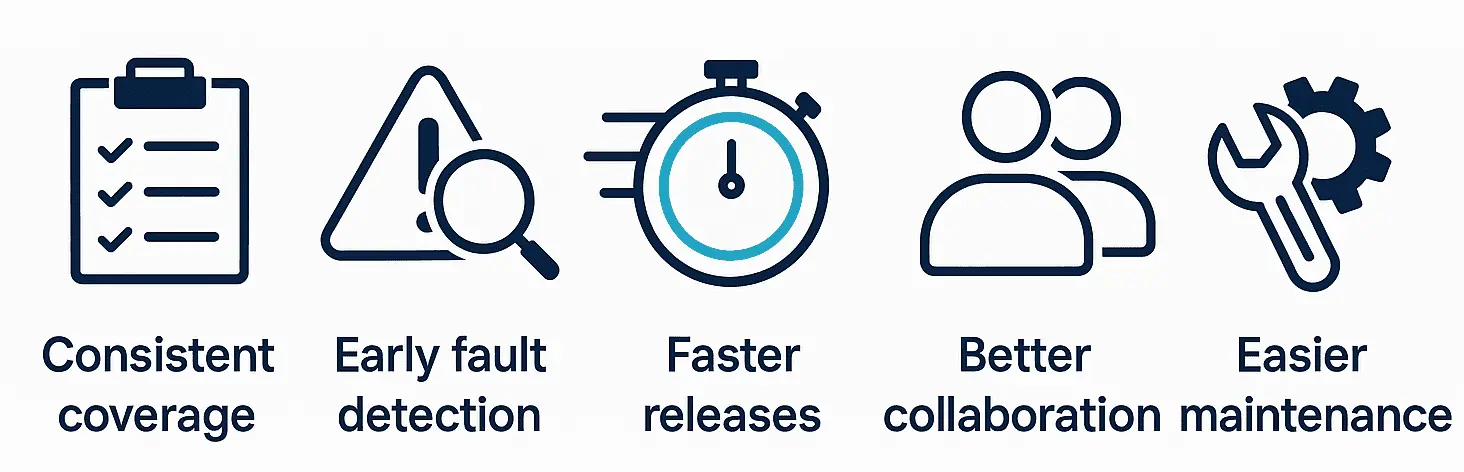
- Consistent coverage: Ensures each API aspect is tested systematically, leaving no gaps.
- Early fault detection: Identify faults before they occur, reducing failures in production.
- Faster releases: Easier to add or change tests as APIs evolve for rapid releases.
- Better collaboration: By organizing API tests with a strategy, teams can maintain control and clarity even in complicated test environments.
- Easier maintenance: Streamlines the software testing process to save time and resources for easy maintenance.
How to create an API Testing Strategy?
Wondering: How do you create a good API testing strategy? Here are the steps for modern API testing strategies to ensure consistent test coverage across services.
- Requirements: Clearly define functional vs non-functional testing needs, and understand the API’s expected behavior.
- Test design: Find and design test scenarios for positive and negative cases, considering various data inputs and usage patterns.
- Test environment: Build a test environment like a production setup, including the necessary tools for API testing.
- Test data management: Develop and manage test data for consistent and repeatable test execution.
- Automation testing: Use automation tools to deliver thorough testing and quick feedback loops.
Designing an API Testing Framework that scales
An API testing framework serves as the foundation for scalable test execution. It defines how to structure test cases, manage, and integrate them into your delivery pipelines. An ideal framework for APIs combines data-driven testing, CI/CD integration, and service virtualization to ensure smooth automation across environments.
Modern frameworks go beyond simple request and response validation. They centralize reusable components like authentication handlers, environment variables, and payload templates to make tests more maintainable. Combining your framework with version control and CI tools such as Jenkins or GitHub Actions ensures continuous validation after each code commit.
A codeless test automation platform like ACCELQ eases this even further by allowing teams to design and execute tests in a model-driven interface without much scripting. It helps testers and business analysts collaborate while maintaining the rigor of a code-based framework.
API test automation strategy
An effective API test automation strategy aligns testing goals with quality. It identifies which test scenarios to automate, integrates automation into the CI/CD process, and determines success metrics. This involves highlighting API endpoints that change frequently and establishing automation layers for extensive coverage. In a CI environment, your API test automation strategy should trigger automated runs upon each deployment or commit, ensuring that service-level dependencies are verified continuously.
An automated API testing approach focuses on execution efficiency and speed. Automation eliminates the need for manual testing by validating core functionality, data integrity, and API performance in real time. By integrating automated scripts into development pipelines, teams can achieve faster regression testing and minimize human error. This approach offers earlier feedback, better coverage, and consistent quality across builds.
 Also Read: API Automation Testing
Codeless API testing strategy with ACCELQ
A key change in quality assurance is the adoption of codeless API automation, as APIs become essential to digital ecosystems. ACCELQ allows you to implement a codeless API testing strategy that promotes collaboration among developers, testers, and business analysts. Automating API tests early in the development lifecycle accelerates feedback and helps identify defects sooner. ACCELQ’s platform is built to enable CI-driven execution of API test suites, allowing them to fit into sprint workflows rather than being a post-release activity.
Conclusion
API testing is required to ensure the quality, reliability, performance, and security of software. A strong API testing strategy helps you to identify issues early in your development cycle, reducing risks and improving overall product quality. AI-driven platforms like ACCELQ improve predictive test selection and enable self-healing automation. Hence, a solid testing strategy paired with the right tools allows your API testing efforts to evolve alongside your development needs.



Geosley Andrades
Director, Product Evangelist at ACCELQ
Geosley is a Test Automation Evangelist and Community builder at ACCELQ. Being passionate about continuous learning, Geosley helps ACCELQ with innovative solutions to transform test automation to be simpler, more reliable, and sustainable for the real world.

You Might Also Like:
 API Performance Monitoring: A Complete Guide with UI Insights
API Performance Monitoring: A Complete Guide with UI Insights
 Top API Testing Examples You Need To Try Today
Top API Testing Examples You Need To Try Today
 Understanding API Virtualization: A Beginner’s Guide