







Tracing the Journey of AI and Its Impact on Test Automation

Artificial Intelligence (AI) has transformed industries worldwide, and software testing is no exception. As organizations embrace agility and digital transformation, AI test automation has become the driving force behind faster releases, higher accuracy, and scalable quality assurance. Before diving into the evolution of AI, consider a curious story that mirrors how innovation often unfolds, through adaptation rather than force.
Just after the First World War and during the Great Depression, war veterans returned home to take up farming amid the economic slowdown. Around this time, a proliferation of gigantic Emu birds began waging war against these skilled military men on their farmlands.
They destroyed crops and livelihoods, forcing the ex-militia and the government to intervene with all their might. Yet, despite advanced weaponry, the soldiers failed. Much to everyone’s shock, the birds won by sheer persistence and adaptability.
This episode, known as the “Emu War,” perfectly symbolizes the current shift in technology. For years, brute-force methods of test automation dominated, but adaptability, powered by AI test automation, is what now drives real progress.
So, is AI the silver bullet? Does it hold the power to transform how we approach testing and technology itself? To answer that, let’s explore how AI evolved and how it continues to redefine innovation in quality assurance.
- The Evolution of AI Traced Through 5 Phases
- Why Modern Testing Needs AI Automation?
- AI vs Traditional Test Automation: Which Is Better?
- What Is AI Test Automation?
- How AI Can Help in Automation Testing?
- Selecting the Right AI Test Automation Platform
- Why Enterprises Choose ACCELQ?
- Identifying the Accurate Tool in the Age of Generative AI
- Automation in Testing - Basics
- How Can AI Enable Innovation and Efficiency in Testing?
- What Challenges Exist in AI Test Automation?
- How to Implement AI in Test Automation?
- The Power of AI in Testing
- Why Choose ACCELQ for AI-Driven Testing?
- Conclusion
The Evolution of AI is Traced Through 5 Phases.
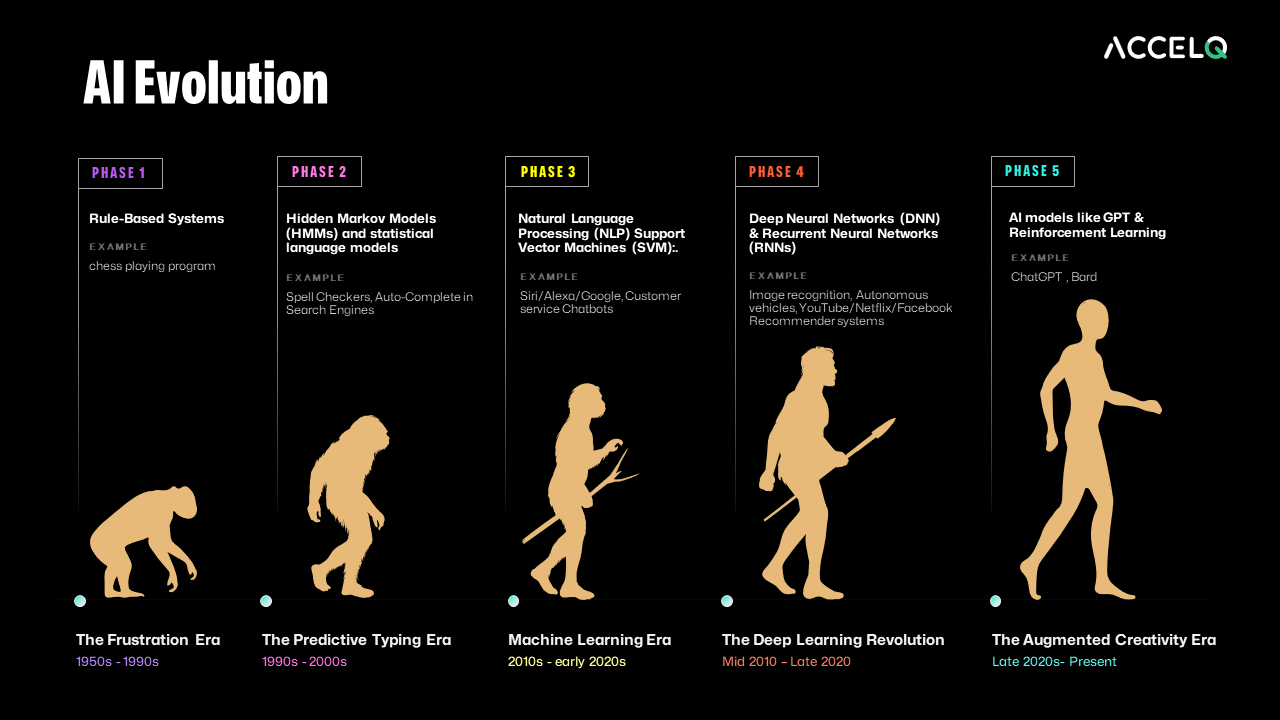
Phase 1: “The Frustration Era”
- The infancy phase was the largest, relying on rule-based systems to understand user input.
- It glorified if-then-else functioning and used hand-crafted rules to handle data.
- It also used patterns to handle data; complexities and ambiguity could not be handled.
- Examples include chess-playing programs, credit scoring systems, or early spam-detecting filters.
Phase 2: Predictive Typing Era
- More technological maturity heralded the phase of early speech that helped with recognition models and transition between speech sounds.
- Primary models of algorithms, such as hidden macro models or flagship models, are statistical models that help improve the accuracy of understanding data.
- Predictive uses and probabilistic models were used to answer likelihood questions, translate using keyboards, and convert handwritten text to a digital format.
Phase 3: Machine Learning Era
- More robust algorithms also include NLP, the natural language processing era or virtual assistant era.
- The nascent era responded to queries using NLP test automation techniques, tokenization, tagging, and entity recognition to understand text and ML algorithms.
- Machine learning in test automation also emerged as systems began predicting outcomes, identifying data patterns, and making context-driven decisions.
- Decision trees and random forests were used to help categorize user inputs for specific actions and commands, such as wave classifiers, gradient boosting, and named entity recognition models.
- The outcome of all these developments includes the dawn of more mature models, such as Facebook automated translators, Twitter sentiment analysis, and Facebook spam filters, all of which help make predictions.
These lead to the next phase, with the signs of deep learning set in from the Machine Learning phase.
Phase 4: Deep Learning Revolution
Here is a quick foreword for this phase, understanding the difference between Deep Learning and Machine Learning.
- ML = shallow learning for a moderate amount of labeled data, primarily manually engineered.
- DL = uses unstructured data that is not yet dominant but was born out of phase 3 offset from ML.
- Technology evolution played a role here, both software and hardware demanded more computational power to handle large volumes of unstructured data.
- This gave birth to the deep learning revolution in the last decade, where more complex algorithms were deployed.
- Models like RNN models, which have long and short memory, revolutionized sequence handling tasks like language translation and dialogue generation. While they played a role in sequence modeling, they also suffered from gradient challenges, leading to the next phase, the Generative AI era.
- ML= shallow learning for a moderate amount of labeled data, primarily manually engineered
- DL= uses unstructured data that is not yet dominant but was born out of phase 3 offset from ML
- Technology evolution played a role here—of both software and hardware that demanded more computational power to handle large volumes of unstructured data.
- This gave birth to the DP revolution in the last decade, where more complex algorithms were deployed.
- Models like RNL models, which have long and short memory, revolutionized sequence handling tasks like language translation and dialogue generation. While they played a role in sequence modeling, they also suffered from gradient challenges, leading to the next phase—the generative AI era.
Phase 5: Generative AI Era – Our Present
- The hallmark developments here include the birth of transformer architecture, which led to the self-attention mechanism that turned around NLP born in phase 3.
- This has enabled the development of GPT, large language models, and BERT, which have helped machines understand context.
- Phase 4 saw monitoring systems like music generation, virtual reality, etc., but with phase 5, the creativity era is just getting started.
Artificial Intelligence (AI) has revolutionized many industries, and AI test automation is not far behind. AI isn’t just beneficial for software testing but also redefines the entire QA automation process. When trained algorithms can analyze data, adjust to new issues, and forecast results, AI automation testing brings accuracy, efficiency, and scalability to the forefront.
Whether it’s automating tasks or detecting hidden issues before they reach production, AI-based test automation is transforming software quality across the development lifecycle.
Why Modern Testing Needs AI Automation?
Today’s software development demands speed, quality, and agility. Manual testing simply cannot match the pace of continuous integration and deployment. While traditional automation helped, it still faces challenges like maintenance overhead and lack of adaptability. This is where AI bridges the gap, enabling predictive, self-healing, and adaptive testing.
AI vs Traditional Test Automation: Which Is Better?
Traditional test automation depends heavily on scripts and frameworks that require manual updates whenever applications change. In contrast, AI test automation uses intelligent algorithms that automatically adapt to changes through self-healing and predictive analysis. This makes AI-driven testing faster, more scalable, and more resilient in agile environments.
Verdict: AI-based testing delivers higher accuracy, lower maintenance, and greater ROI.
What Is AI Test Automation?
AI test automation utilizes machine learning algorithms, NLP, and advanced data analysis to automate testing intelligently. Instead of relying on predefined scripts, AI continuously learns from data to monitor application changes, create and update test cases, and identify potential problem areas.
Key Characteristics:
- Self-healing test scripts
- Predictive defect analysis
- Intelligent test case generation
- Visual and UI-based recognition
Compared to traditional automation, AI-powered test automation reduces maintenance, optimizes test coverage, generates contextual data, and allows no-code or auto-generated test authoring.
How AI Can Help in Automation Testing?
AI is reshaping the way teams approach software testing by bringing intelligence, adaptability, and speed into every stage of the QA lifecycle.
- Autonomous Test Case Generation: AI creates and manages test cases based on user behavior and system changes.
- Intelligent Test Data Creation: Generates realistic, dynamic data to simulate diverse scenarios.
- Enhanced Visual Testing: Detects layout and UX changes through pattern recognition.
- Predictive Failure Analysis: Learns from past results to forecast probable failures.
Real-World Benefits
The true value of AI test automation lies in its ability to deliver tangible business outcomes beyond speed and accuracy.
- Faster release cycles through automation and AI-assisted regression testing.
- Higher test coverage via AI-suggested untested paths.
- Reduced costs with fewer false positives and minimal rework.
- Simplified cross-platform testing across web, API, and mobile.
Selecting the Right AI Test Automation Platform
Selecting the right AI test automation platform is crucial for long-term scalability and integration success. Businesses should evaluate tools based on accuracy, CI/CD compatibility, and ease of maintenance before investing.
Build, test, and release Ionic apps with confidence using AI-driven automation. → Dive Into the Blog
Why Enterprises Choose ACCELQ?
ACCELQ AI automation uses AI to automate web, API, mobile, and packaged apps in one unified platform.
With no-code logic building, auto-discovery of test flows, and CI/CD integration, ACCELQ enables enterprises to increase speed and reduce maintenance costs.
Why? Now, let us circle back to our earlier World War story, the emphasis is on the challenge of identifying the right tool for the right job.
We are nowhere near the end of the possibilities of what AI can do to technology, and all this while AI is evolving along with us. There is a lot left to be discovered.
Identifying the Accurate Tool in the Age of Generative AI
Here is a quick recap of some facts before discussing the advent of copilots. Let us recall the following:
- Testers began with codes in notepads, followed by EditPlus and smart text editors, the early stage of IDEs for coding.
- IntelliSense further eased this task by suggesting completions as users typed, reducing manual effort.
- This evolution aligns with phase three of AI, where advancements in NLP introduced intelligent code assistants capable of context-aware analysis, intent classification, and auto-completion.
- These capabilities eventually led to the creation of AI copilots, such as GitHub Copilot and similar assistants, which marked a major leap in developer productivity.
- However, solutions like ACCELQ Autopilot go beyond generic copilots, bringing AI-powered automation intelligence tailored specifically for testing and quality engineering.
We are just beginning to explore what can be achieved when Generative AI meets test automation, and platforms like ACCELQ Autopilot are leading the way in redefining how automation is designed, executed, and optimized.
Automation in Testing – Basics
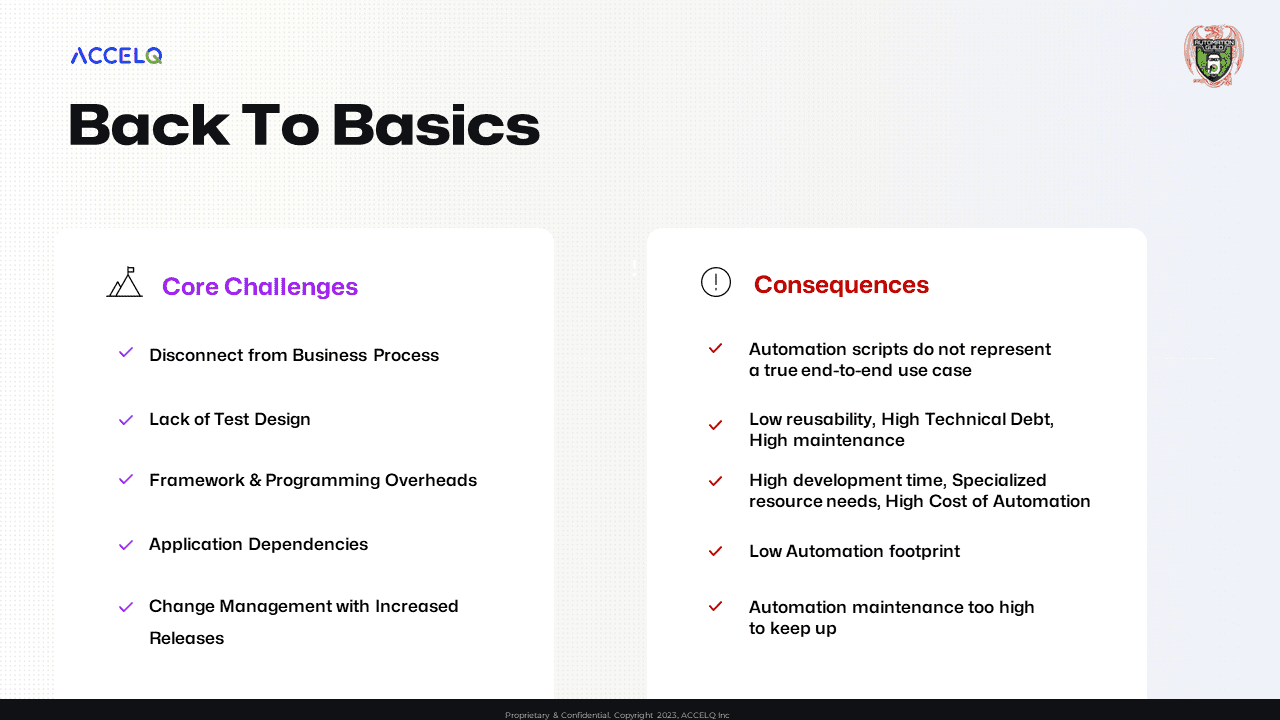
Let us brush this up a little. Where and what should we apply to solve issues:
- Disconnect from business processes since both testing and workflows are primarily disparate. Automation testing still needs to represent an accurate end-to-end omnichannel business process.
- Another impediment is the need for open-source test design. This was initially expected to address the core frustration of needing a sound test design at the foundation. However, this leads to low code reusability, high-tech debt, and high maintenance.
- Frameworks and programming overheads due to high development time. All of this defeats the purpose of achieving end-to-end validation.
- App dependencies for change management. Automation maintenance is undoubtedly an ROI killer. Add to this higher release velocities and AI entry.
Accelerate your test cycles and boost quality with effective automated testing strategies.
How Can AI Enable Innovation and Efficiency in Testing?
Lack of transparency between testing and validating business processes requires building an intuitive automation test design that flows across systems and has reusability and modularity. All of these need a sound test design without any additional cost and dependencies.
A lean, mean automation must be the motto. AI automation testing helps with the following in the automation life cycle:
- No overheads, frameworks programming, and technical debt.
- Automation logic is generated across channels.
- Virtualization is everywhere, not just in API but also in the functional world.
- Getting started with automation objectives without dependencies in the agile world, no waiting game for executing regression testing.
- Maximize test coverage and validate all test use cases.
- Troubleshooting for change maintenance, be it element handling or changed end-to-end flows.
What Challenges Exist in AI Test Automation?
While AI test automation delivers efficiency, it comes with challenges such as model drift, data sensitivity, and false positives due to dynamic learning models. Addressing these requires continuous data validation, retraining algorithms, and balancing automation with human oversight for accuracy and trust.
- Model Drift: Continuous changes in AI models can reduce accuracy over time, requiring frequent retraining.
- Data Sensitivity: AI relies on large datasets, increasing the risk of privacy and compliance issues.
- False Positives and Negatives: Dynamic learning models may misclassify results without consistent validation.
- High Initial Setup Effort: Training AI models and integrating them into existing test frameworks can be resource-intensive.
- Interpretability: Understanding how AI makes testing decisions remains a challenge for transparent QA processes.
- Human Oversight: Striking the right balance between automation and manual judgment is essential for maintaining quality and trust.
Tired of chasing inconsistent test results? Learn how to make your automation rock solid. → Fix Flaky Tests Now
How to Implement AI in Test Automation?
Implementing AI test automation requires a structured approach to ensure seamless adoption and measurable ROI.
- Assess: Identify repetitive, data-heavy test cases best suited for AI.
- Pilot: Start with small, high-value workflows to measure ROI.
- Integrate: Align AI testing tools with CI/CD pipelines and agile processes.
- Scale: Expand coverage across web, API, and enterprise platforms for maximum impact.
The Power of AI in Testing
AI and ML enhance the testing process by simulating human intelligence and enabling systems to learn and adapt without intervention.
Key foundational elements include:
AI and ML enhance the testing process by simulating human intelligence and enabling systems to learn and adapt without intervention.
- Machine Learning (ML): Classifies and predicts outcomes using data-driven insights.
- Neural Networks: Emulate human brain patterns to identify anomalies and correlations.
These enable testing tools to interpret user-like actions, classify results, and predict defect likelihoods based on historical patterns.
Why Choose ACCELQ for AI-Driven Testing?
See how AI-driven testing enables continuous quality and smarter decision-making. As the SDLC evolves, ACCELQ AI automation stands out with:
- Cloud-based agility integrated with DevOps pipelines.
- Codeless automation that accelerates testing.
- Self-healing capabilities to minimize script maintenance.
- Business logic integration for enterprise-grade quality.
- Unified coverage across web, mobile, desktop, API, and backend systems.
Conclusion
At ACCELQ, we have embraced the evolution of AI in the testing realm. Our cloud-native platform introduces layers of AI infusion to resolve core efficiency issues in the automation lifecycle. With collaborative test asset management, reusable test assets, and live-release alignment with ERPs, we ensure maximum test coverage and valid end-to-end AI test automation.
Stay tuned to our resources section for more buzz on our advanced no-code test automation powered by Generative AI. You may also get started with a personalized demo.


Guljeet Nagpaul
Chief Product Officer at ACCELQ
Guljeet, an experienced leader, served as North America's head for ALM at Mercury Interactive, leading to its acquisition by HP. He played a key role in expanding the ALM portfolio with significant acquisitions. Now at ACCELQ, he sees it as a game-changer in Continuous Testing. As Carnegie Mellon graduate, he oversees ACCELQ's Product Strategy and Marketing.

You Might Also Like:
 AI-Powered Root Cause Analysis for Better Testing Outcomes
AI-Powered Root Cause Analysis for Better Testing Outcomes
 AI Test Automation for nCino | Powering Fintech Innovation
AI Test Automation for nCino | Powering Fintech Innovation
 Supercharge Testing with AI: Automate & Accelerate Efficiency