







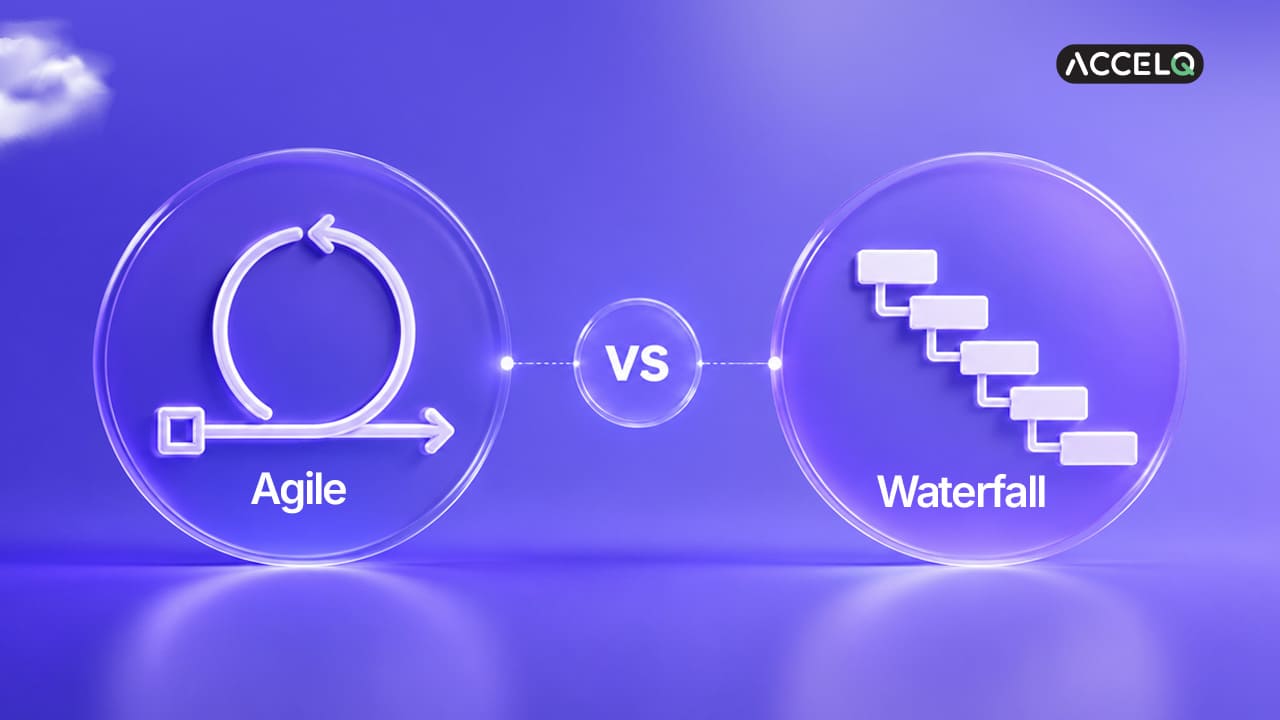
Agile vs Waterfall: What Actually Breaks Your Testing Layer in Hybrid Delivery

Agile and Waterfall differ in when testing happens and how many requirements are allowed to move. Waterfall tests once, at the end, after requirements are locked. Agile tests continuously, in every sprint, while requirements keep changing. Most enterprises don’t run one or the other; they run Agile sprints for delivery under Waterfall-style stage gates for governance, and that combination is what breaks testing, not the methodology choice.
That’s the part most comparisons skip. Here’s where it goes wrong, and what to do about it.
- Agile vs Waterfall in Software Development: The Main Differences
- When to Use Agile, Waterfall, and When You Need Both?
- Why Hybrid Delivery Breaks Testing, Not Methodology?
- Metrics To Know Whether Your Hybrid Delivery Is Actually Working
- How to Shift from Waterfall to Agile Without Breaching Testing?
- Conclusion
Agile and Waterfall manage change in diverse ways. Waterfall locks requirements early and tests at the end, and Agile keeps testing inside each sprint as requirements continue to evolve.
Most enterprises now use both: Agile for delivery and Waterfall-style gates for governance. The issue is that testing often is between these two speeds. A test suite may look ok during a sprint but fail at the release gate because traceability, ownership, documentation, and regression coverage have not kept pace.
Hybrid delivery works better when teams track more than velocity. Escaped defects, traceability coverage, test maintenance lag, and clear ownership show whether the product is genuinely ready for release.
The fix is to rebuild the testing layer around both cadences. Testing should happen inside the sprint, traceability should be captured as tests are created, and ownership should remain tied to roles or systems rather than temporary sprint teams.
ACCELQ supports this model by helping teams maintain continuous testing, shared visibility, and built-in traceability across fast-moving delivery and governance requirements.
Agile vs Waterfall in Software Development: The Main Differences
Waterfall is a linear and sequential approach: the requirements, design, build, test, and release each finish before the next phase starts. Agile methodology replaces that sequence with short, repeating cycles, so your team can test, learn, and adjust requirements inside the same cycle rather than at the end of the project.
| Dimension | Waterfall | Agile |
|---|---|---|
| Structure | Linear and sequential; one phase finishes before the next begins | Iterative, short cycles that repeat and adapt |
| Requirements | Fixed before work starts | Revisited every cycle |
| Testing | A separate stage after the build is complete | Built into each sprint alongside development |
| Release | One release at the end of the project | Working software delivered every 1–4 weeks |
| Documentation | Formal, extensive, tied to sign-off | Lightweight, evolving documents that change with the product |
| Change | Handled through formal change control | Absorbed directly into the next sprint |
Neither approach is a worse version of the other. A waterfall methodology vs agile methodology choice is really a choice about which kind of risk you’d rather manage: schedule and scope risk, or adaptability risk.
When to Use Agile, When to Use Waterfall, When You Need Both?
The right call depends less on company size and more on how much the requirements are likely to move and how strict the audit trail needs to be.
| Project Type | Better Fit | Why | What It Means for Testing |
|---|---|---|---|
| SaaS product, consumer app | Agile project management | Requirements are shaped by user feedback you don’t have yet | Tests need to change as quickly as the product does |
| HIPAA-governed healthcare system | Waterfall project management | Regulatory sign-off requires locked, traceable requirements | Every test needs a direct link back to a documented requirement |
| Audited financial services platform | Waterfall | Change control and audit trails are mandatory | Testing must produce sign-off-ready evidence, not just passing runs |
| Fixed-price contract | Waterfall | Scope changes have direct cost and legal consequences | Tests double as proof that the delivered scope matches the contract |
| Infrastructure program with hardware dependencies | Waterfall | Some steps are genuinely sequential; hardware cannot be installed before the software layer exists | Testing follows the same fixed sequence as the build |
| Large enterprise running both | Hybrid (Agile execution, Waterfall governance) | Delivery speed matters, but so does the audit trail | The testing layer must satisfy both cadences simultaneously—this is where most teams struggle |
The Agile Advantages Over Waterfall
The agile advantages over waterfall are faster feedback, lower cost of changing direction, and working software in weeks instead of months. What gets traded away is the built-in audit trail. Waterfall’s heavy documentation is annoying until the day an auditor asks for it, at which point Agile’s lighter paper trail becomes the actual bottleneck.
Agile vs Waterfall vs Scrum: Where Scrum Actually Sits
A frequent question is the difference between waterfall vs agile vs Scrum, and the framing is off as it is not a three-way comparison. Scrum is one way of doing Agile: it adds defined roles, a backlog, and sprint planning on top of the Agile philosophy. Kanban and SAFe are other ways of doing the same thing. Waterfall stands apart as a sequential, phase-gated model. So the real comparison stays Waterfall vs Agile; Scrum is just the most common implementation of the Agile side.
 Also Read: Why Agile Test Automation Approach?
Why Hybrid Delivery Breaks Testing, Not Methodology?
Once sprints handle delivery and stage gates handle release, the testing layer is what absorbs the mismatch between the two cadences. It shows up the same way in most organizations:
| What You Notice | What’s Actually Broken | How to Check It Yourself | Direction of the Fix |
|---|---|---|---|
| Test suite is green at sprint review but red at the release gate | Regression coverage was built for Waterfall’s slower cadence and can’t keep up with sprint-speed change | Compare the number of new test cases added per sprint against the number of new stories shipped | Coverage growth must track story throughput instead of lagging behind it |
| Every release gate involves manually rebuilding documentation | Sprint-team test artifacts and gate-level traceability requirements were never designed to map to each other | Pick one test at random and measure how long it takes to trace it back to its requirement | Traceability should be captured when the test is created, not reconstructed before sign-off |
| Tests get skipped under deadline pressure, then rerun in a panic before the gate | One suite is trying to satisfy both sprint goals and governance goals, achieving neither well | Ask whether flaky tests get fixed in the same sprint they are found or simply deferred | Split or redesign the suite so speed and stability are no longer competing inside the same test run |
| Nobody knows who owns a given test six months after it shipped | Ownership was assigned by sprint staffing instead of by role or business area, so it disappears as teams change | Ask “Who owns this test?” about five random tests and see how many receive a confident answer | Assign ownership by role or system area instead of by the individual who originally created the test |
SUGGESTED READ - Building a Future-Proof Test Automation Architecture
Metrics To Know Whether Your Hybrid Delivery is Actually Working
Sprint teams already track velocity, burndown, and cycle time, but those describe delivery speed, not release readiness. Agile workflow and metrics like these are necessary but not sufficient in hybrid delivery. Pair velocity and cycle time with software testing metrics that measure release readiness, or the quality gap will stay invisible until the release gate.
| Metric | What It Tells You | Blind Spot if You Skip It |
|---|---|---|
| Escaped defect rate | How many bugs are caught after the sprint instead of during it | Rising numbers mean sprint-speed testing is thinning without anyone noticing |
| Traceability coverage | Share of tests mapped to a requirement without manual lookup | This is the metric release gates actually check—velocity doesn’t substitute for it |
| Test maintenance lag | Time between a story shipping and its tests being confirmed stable, not just passing once | A test that passed once but was never re-verified isn’t stable—it’s effectively untested |
| Ownership coverage | Share of tests with a named owner beyond the sprint that created them | Without ownership, coverage depends on whoever is still around rather than on the system itself |
Some codeless test automation platforms, ACCELQ among them, are built around keeping traceability attached to a test at the moment it’s created rather than reconstructing it later, which speaks directly to the traceability row above. That’s a tooling decision, though; the four metrics matter whether or not you change tools.
How to Shift from Waterfall to Agile Without Breaching Testing?
Teams that shift from a waterfall lifecycle toward agile software development rarely fail because they opted for the incorrect framework. They fail because testing and documentation moved to Agile speed before anyone rebuilt them for it. In practice, the best practices for a smooth waterfall to agile transition all come down to rebuilding the testing layer before you change anything else. A few moves make the transition hold:
- Move testing inside the sprint first, before changing anything else. If quality assurance still runs as a separate stage after the sprint closes, the calendar changed but the risk didn’t.
- Capture traceability as tests are written, not as a report assembled later. Retrofitting it at each gate is where most transition pain comes from.
- Assign test ownership by role or system, not by sprint roster. Ownership tied to staffing disappears the moment the team changes.
- Keep a single source of test truth for sprint teams and release governance. Running two parallel testing efforts, one for velocity, one for audits, doubles the workload for no extra safety.
- Migrate one product at a time. A phased shift lets you identify and solve testing gaps on a smaller surface before they spread across the complete portfolio.
Conclusion
The Agile vs Waterfall debate is settled at the strategy level, as most organizations already run by blending them. What isn’t settled, and what causes the missed compliance deadlines and last-minute audit scrambles, is whether the testing layer under that blend was really developed for both cadences at once. Fix that layer ownership, traceability, and shared documentation, and the methodology question doesn’t bother.
FAQs
Which methodology is better for software development: waterfall or agile
Agile fits products shaped by continuous user feedback. Waterfall fits work where scope changes carry actual cost or regulatory risk, such as fixed-price contracts or audited platforms. Enterprises running both need the testing layer to support each cadence rather than picking a side.
Why do sprints look healthy while compliance deadlines still get missed?
A sprint review only reflects sprint-speed testing. A release audit checks for traceability and stability that sprint-cadence tests were not designed to carry, so the shortfall stays hidden until the gate.
What is Water-Scrum-Fall?
It’s the common hybrid pattern of running Scrum sprints for execution while keeping Waterfall-style stage gates for release sign-off. The strain lands on testing specifically, since one suite ends up trying to satisfy fast sprint teams and slow, audit-ready governance at the same time.
What is the difference between waterfall vs agile vs scrum?
Waterfall is a step-wise, phase-gated model. Agile is the broader iterative philosophy. Scrum is one framework to run Agile, with its own roles and ceremonies, so it sits inside the Agile side to compare rather than a third choice.



Chaithanya M N
Content Writer
A curious individual who is eager to learn and loves to share her knowledge using simple conversational writing skills. While her calling is technology and reading up on marketing updates, she also finds time to pursue her interests in philosophy, dance and music.


You Might Also Like:
 How Automated Visual Testing Boosts QA Accuracy and User Experience?
How Automated Visual Testing Boosts QA Accuracy and User Experience?
 How ACCELQ Simplifies Middleware Testing for Modern Enterprises?
How ACCELQ Simplifies Middleware Testing for Modern Enterprises?
 Verification vs Validation Guide