








Unlock the Power of API Automation Testing with ACCELQ

Automated API testing offers advantages, from early bug detection to increased reusability of test cases and reduced human errors. In the long run, API test automation saves your time and resources by allowing faster development of strong API products. According to Global Industry Analytics Inc., the API testing market is projected to reach $2 billion market value by the end of 2026. This growth is attributed to the higher dependency on APIs and their ubiquity in the digital world. As such, the role of API in software testing is non-negotiable.
Application programming interface testing is a type of software testing that focuses on individual API methods and the interactions between different APIs. This type of testing is usually performed at the integration level, after unit testing is complete, and before user interface testing starts. It is used to verify that the API behaves correctly and meets the system’s requirements.
Let us get into what API automation testing is, its benefits, challenges, best practices, how to automate API testing, and why ACCELQ is the best choice for API testing.


What is API Automation?
APIs are the mission-critical connective tissue that ties systems. Automating the API lifecycle is central to maximizing ROI on cloud native investments. API automation consists of automating the testing, deployment, and management of APIs.
API automation testing consists of automating the verification of APIs’ behavior and functionality. This process includes sending requests to the API, analyzing the responses, and comparing them to the expected results.
Using codeless tools, automated API tests can verify consistent request-response, enable better integration, and continuous delivery. Hence, developers can eliminate most manual efforts, reduce human errors, and speed up the API development cycle.
Benefits and Challenges of API Testing
API testing plays a vital role in validating business logic, integrations, and performance at the service layer. While it provides faster, reliable validation, teams often face implementation challenges that require proactive mitigation.
| Benefits | Challenges |
|---|---|
| Automation enables API testing to integrate easily into CI/CD pipelines, resulting in faster releases. | Setting up an API testing environment is time-consuming and often requires manual configuration of databases and servers. |
| APIs are platform-independent, allowing testing across various technologies and ensuring compatibility with different environments. | Parameter combinations can become complex. Teams must validate data types, ranges, and all required parameters. |
| Early defect detection reduces the time and cost associated with fixing issues later in the development lifecycle. | Some APIs require calls to be executed in a specific order. Testers must validate correct API sequencing, especially for multi-threaded systems. |
| Penetration, fuzz, and security testing help uncover vulnerabilities before APIs go live. | API schemas change frequently. Teams must update tests to match new contracts to ensure accuracy. |
| API testing uncovers defects across interfaces, databases, and services, improving overall quality and user experience. | Maintaining API specifications under version control and ensuring backward compatibility can be challenging. |
| API tests help detect issues early in backend interactions, reducing downstream failures and improving performance. | Teams may need to adopt no-code or low-code API testing tools to reduce heavy coding and speed up test creation. |
 Also Read: Top API testing mistakes
Best Practices for API Testing
API testing is a crucial step to ensure application programming interface (API) functionality, security, and performance. Implementing the best practices below can help you conduct comprehensive testing of the API, minimizing potential threats and ensuring seamless integration in your software development lifecycle.
- Familiar with API: Before anything gets written down, start by reading the documentation. Look at all the inputs and outputs, authentication, and how the API is meant to behave.
- Dedicated test environment: Executing tests in a staging setup prevents test data from interfering with live environments. Starting with this setup also mirrors production closely, giving teams more reliable results.
- Test Data: APIs need to do more than return the correct test data. So, test cases should have performance metrics, security rules, error handling, and edge cases for a complete picture of how the API behaves under stress.
- Authentication: APIs regularly restrict access using API keys, and should be tested against authentication methods such as Basic Auth, OAuth 1.0, and 2.0.
- Negative API testing: Trying to break the API on purpose. Attempting to send malformed requests. These tests show how the API handles unexpected input and whether it returns meaningful error codes (e.g.,
400 Bad Request). - Integrate into CI/CD: API testing can be added as an automated process to CI/CD pipelines so they run whenever code is deployed. The pipelines help validate the API with every code change and indicate failures.
- Early testing: Testing early helps to find issues in business logic, data handling, or integrations more easily, rather than at the end of development.
- Automate using tools: API testing with ACCELQ supports codeless automation, CI/CD, and self-healing to automate tests and reduce repetitive tasks. Once the tests are built, they can be reused and expanded into new pipelines without starting from scratch.
How to automate API testing?
Any successful API automation testing project is thoroughly planned and follows a particular set of steps designed by your automation team. Here are the steps:
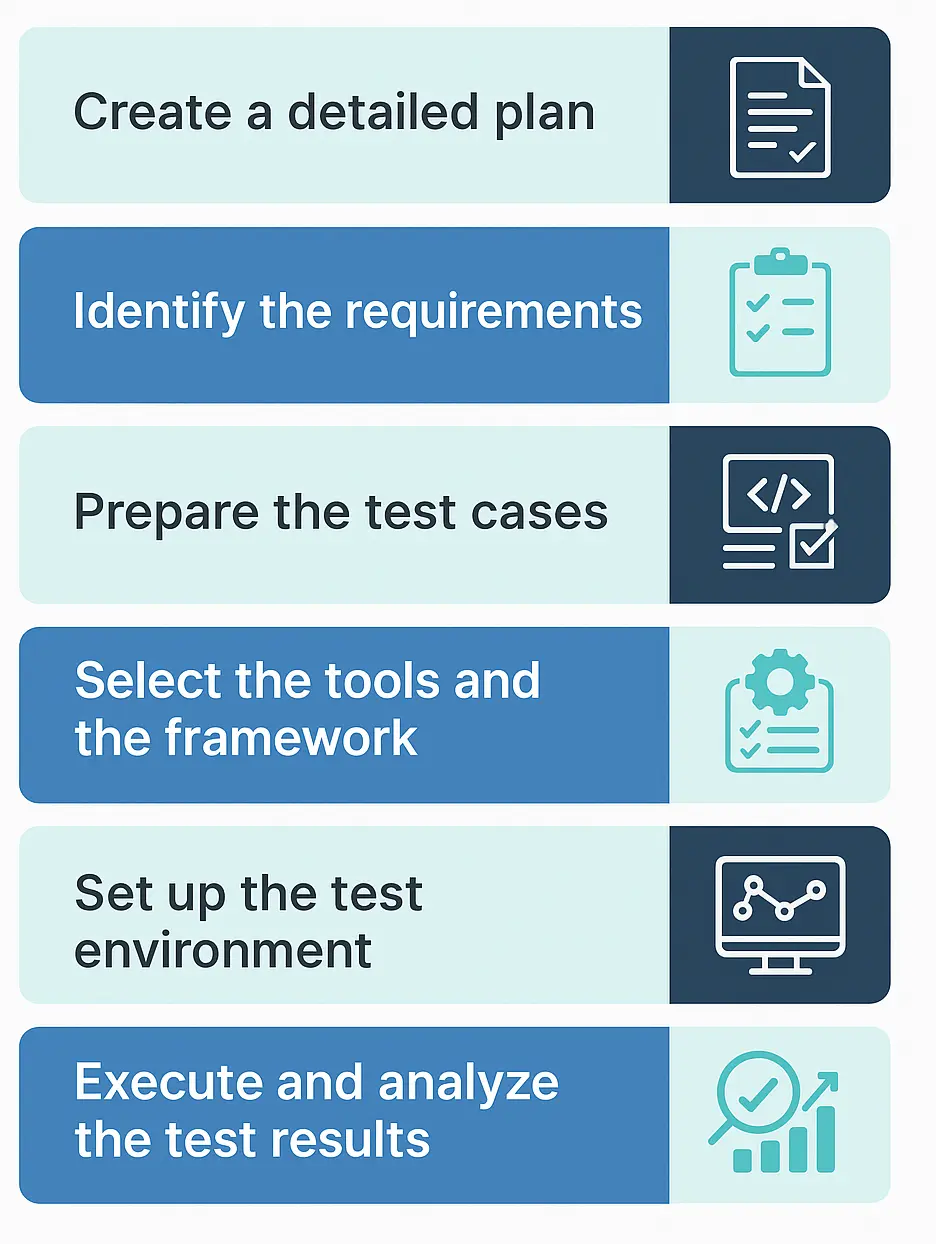
1. Create a detailed plan
Creating a plan is a critical step for automating API testing. A well-structured test plan will help you gain a clearer understanding of the tasks and prepare your team for further steps. Planning the project allows you to assess available resources and helps you keep the project budget under control.
2. Identify the requirements
A clear list of requirements guides an API automation testing project and helps the team focus on key objectives. While specific needs will differ, the most important ones are:
- Who is the API for, and what will it do?
- Primary and secondary functionality of the API.
- How does it interact with other APIs?
- What is the team looking for with testing?
- The definition of passed and failed tests.
3. Prepare the test cases
Whether you already have an API test case written by the manual team or plan to write the cases from scratch and have them done by the automation team, the number and variety of test cases directly impact the project results. Two popular approaches for designing test cases include behavior-driven and data-driven testing.
4. Select the tools and the framework
A standardized testing framework for the QA team enhances efficiency and improves testing quality. Teams can select from existing frameworks or develop their own, which needs senior-level skills and expertise. As for the tools, the choice is usually between open-source and paid.
5. Set up the test environment
The project should be assigned to the DevOps team or skilled engineers. Test environment setup for an API project requires configuring servers, databases, and other components the API will use.
6. Execute and analyze the test results
This stage evaluates the API’s quality and stability, as well as the success of earlier project planning steps. To improve testing efficiency and reduce dependencies, consider running tests in parallel. When analyzing testing results, you can rely on one or more API testing tools.
Examples of API automation in testing
- Testing an API checks that it handles user login properly, resists brute-force attacks, and protects sensitive data.
- Verifying the correct retrieval of data from the server ensures consistency with the database.
- Testing an API that calculates totals in the cart to ensure it returns the valid price based on inputs.
Conclusion
In the interconnected software landscape, API automation testing is essential. It speeds up software development, reduces bugs, and ensures high-quality releases. ACCELQ is the best choice for your API testing needs as it offers AI-powered codeless automation that unites API and UI testing. The platform makes easy test creation and maintenance for non-technical users. It links business processes with corresponding APIs for better traceability. Tests API chains for detailed coverage. ACCELQ facilitates continuous improvement through built-in regression testing capabilities.



Yuvarani Elankumaran
Technical Consultant at ACCELQ
Yuvarani Elankumaran is a highly skilled technical consultant at ACCELQ. With over a decade of experience in the field of Test Automation, Yuvarani is a seasoned professional who is well-versed in a variety of programming languages and automation frameworks.

You Might Also Like:
 Understanding API Virtualization: A Beginner’s Guide
Understanding API Virtualization: A Beginner’s Guide
 Extending Test Coverage for Mobile and API
Extending Test Coverage for Mobile and API
 What are Mocking and Stubbing in API Testing? A Beginner’s Guide