








Email Testing for Enterprise QA Teams: Building Transactional Email Into Your CI/CD Pipeline

A VP of Product pings you on Slack mid-sprint. A major client just hit the onboarding flow, clicked “verify your email,” and landed on a broken link. The backend team shipped a change to the user object yesterday. Nobody flagged the email template. Now production is sending a dead link to every new signup, and you’re the one explaining how it got past QA.
This isn’t a content problem. It’s a pipeline gap. The email layer had no automated gate, so a dynamic variable failure shipped straight through to a live onboarding sequence. Transactional email needs to be tested like any other functional dependency in the user journey, not spot-checked like a marketing asset before a send. Teams that treat email testing as a functional pipeline gate, not an afterthought, stop having that Slack conversation entirely, because the pipeline catches broken links before any client does.
- Why Email Testing Breaks Down at Enterprise Scale
- Testing by Email Type: Why Transactional Can't Use a Marketing Checklist
- CI/CD Email Testing: The Shift from Superficial Checkpoints to Asynchronous Functional Gates
- The Three Scale Killers in CI/CD Cadences (And the DIY Engineering Trap)
- The Strategic Evaluation: Custom Frameworks vs. Model-Based Abstraction
- Operational Accountability: Who Owns the Build Failure?
- The Takeaway: Architecture Over Faster Scripts
Why Email Testing Breaks Down at Enterprise Scale
Most enterprise email testing guidance is fundamentally useless for QA architects because it focuses on cosmetic rendering rather than functional logic.
Marketing QA evaluates dark-mode padding and subject-line emojis. Transactional email QA treats email as a critical, release-blocking backend system dependency. If a password reset link fails to resolve or an order confirmation payload drops a dynamic variable, your entire core user flow is broken, regardless of how perfectly the HTML template renders in Outlook.
The current enterprise crisis is architectural. Teams attempt to run high-concurrency continuous integration (CI/CD) pipelines while routing transactional traffic through static dummy mailboxes built years ago, or manual staging checks. This approach collapses under continuous deployment cadences. Treating an email notification as a post-release afterthought instead of an automated pipeline gate introduces significant functional risk to your production environment.
Testing by Email Type: Why Transactional Can’t Use a Marketing Checklist
Marketing, lifecycle, and transactional emails fail in different ways, and a single checklist tends to default toward whichever category is loudest, which is usually marketing.
Marketing email failures are mostly cosmetic. A clipped image or a misaligned CTA hurts engagement, not function. Lifecycle emails sit in between. A drip sequence firing a day late is a timing bug, not a functional break.
Transactional email has zero tolerance. A verify-email link, a password reset, an order confirmation. Each one carries a dynamic variable pulled from a live backend state, fires on a trigger that has to sequence correctly with the rest of the user journey, and blocks the user from moving forward if it fails. There’s no “engagement impact” framing here. There’s only “did the user get blocked or not.”
That’s the case for treating transactional email as a functional gate in software testing rather than a QA checklist item: the cost of failure is binary, not graded.
CI/CD Email Testing: The Shift from Superficial Checkpoints to Asynchronous Functional Gates
When email verification stalls a release pipeline, the baseline instinct is to throw manual labor or superficial script patches at the problem. This is a technical dead-end. The core bottleneck is not script execution speed; it is architectural isolation. Checking an email as a disconnected, standalone entity fails to validate how it interfaces with live backend application states.
Enterprise maturity requires converting email validation into an automated email validation gate within your continuous delivery pipeline. The email event must function as a native assertion inside your end-to-end user journey test suite. If the system fails to fire the communication, or if the extracted token payload fails validation, the build must fail automatically. This aligns email validation with standard API and database assertion protocols within your deployment pipeline.
The Three Scale Killers in CI/CD Cadences (And the DIY Engineering Trap)
Running transactional email checks at pipeline speed exposes three systematic infrastructure failures. Most engineering teams attempt to patch these manually, creating a massive custom-code maintenance tax.
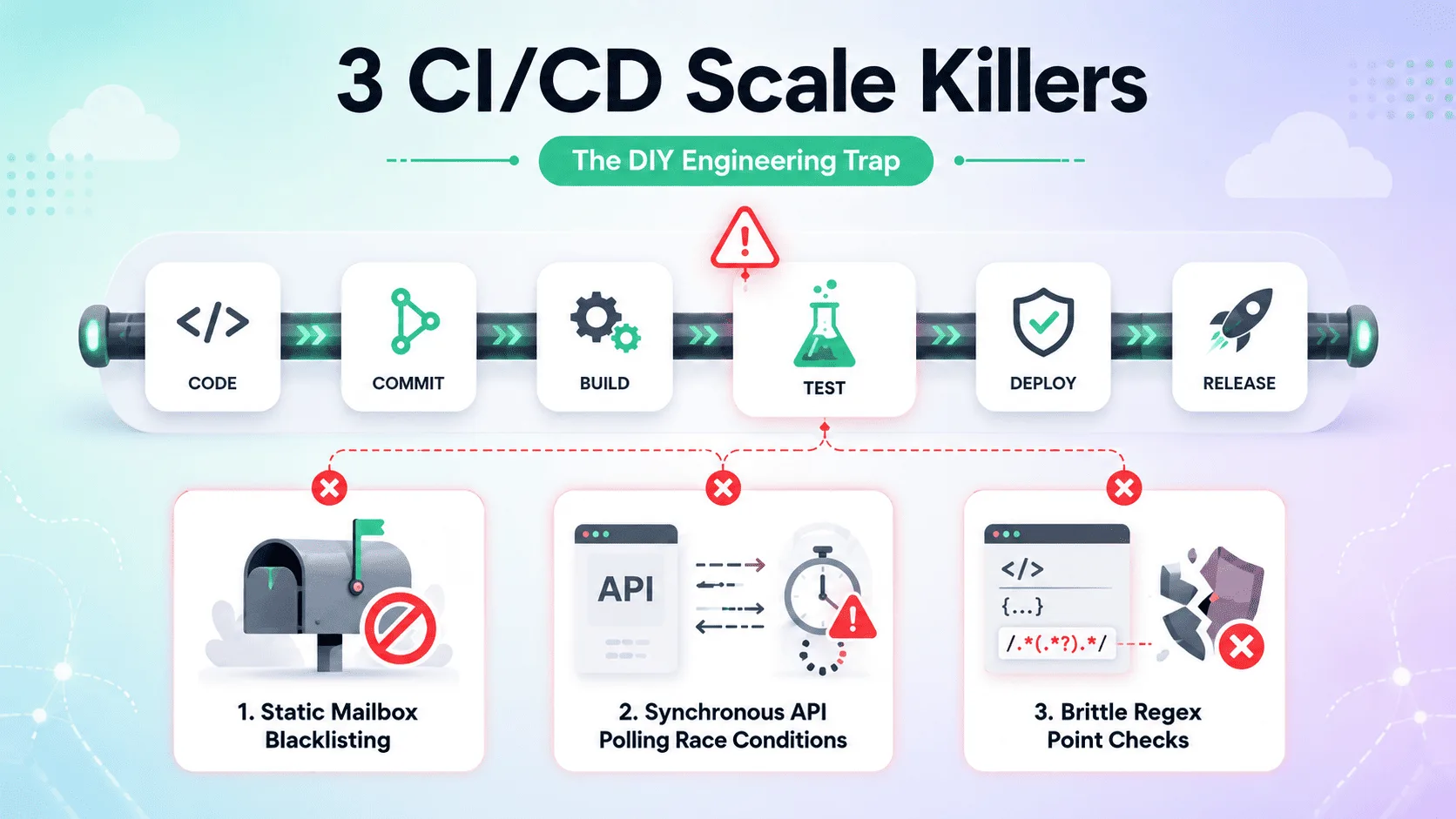
1. Static Mailbox Blacklisting
- The Hardship: Directing automated pipeline traffic to permanent staging inboxes causes major mail providers to flag the domain as a bot network. Deliverability degrades, triggering false-positive test failures that have nothing to do with the application code.
- The Solution: Implement programmatic, ephemeral API-driven mail environments. Every individual pipeline execution run must dynamically provision and destroy its own isolated SMTP sink or disposable mailbox route (using services like Mailtrap).
2. Synchronous API Polling Race Conditions
- The Hardship: Traditional scripts use a synchronous wait(10s); checkInbox() loop. If network latency delays delivery by 11 seconds, the build drops. To fix this, teams write custom programmatic retry loops with exponential backoff. This is a developer anti-pattern; if upstream delivery queues spike during high-load periods, your hardcoded backoff ceilings still flake out, stalling the entire engineering team’s deployment.
- The Solution: Decouple the linear execution thread. The testing architecture must utilize an asynchronous event listener that intercepts the inbound mail payload via an API webhook, handling delivery latency completely independent of your frontend UI automation state.
3. Brittle Regex Point Checks
- The Hardship: Standalone point checks that merely assert “an email was generated” offer no validation of runtime logic. Teams write custom scripts using raw regular expressions (Regex) to parse text strings out of complex HTML objects. If a developer shifts a single <div> tag in the template layout, the Regex breaks, forcing a maintenance sprint.
- The Solution: Embed your email validation directly into the end-to-end data model. The automated testing tool must parse the multi-layered HTML object tree semantically, extracting verification links and context-aware tokens to immediately pipe them into the next step of the active user journey.
The Strategic Evaluation: Custom Frameworks vs. Model-Based Abstraction
When addressing these failure points, enterprise QA leadership faces a direct choice between custom framework development and platform orchestration:
- The High-Maintenance Custom Path: Your engineers write, debug, and maintain hundreds of lines of raw Playwright or Selenium code, custom IMAP client configurations, and fragile Regex parsers to scrape text from email headers. The team spends substantial sprint time maintaining the test infrastructure rather than expanding enterprise email automation testing coverage.
- The Model-Based Abstraction Path (ACCELQ): Instead of forcing developers to write custom code hooks for external mail routing, ACCELQ abstracts the transactional email layer completely. It treats inbound notifications as a native system-level interface. The platform maps out the incoming transactional data model codelessly, automatically listens for the delivery payload via secure webhooks, isolates dynamic variables natively, and feeds them into the next UI or API workflow step. The infrastructure overhead is entirely absorbed by the platform.
What Does the Gate Check
Once the integration pattern is in place, automated email validation needs a defined scope. Not a checklist, but a set of assertions the pipeline evaluates on every run:
- Dynamic variable resolution: Confirming the exact field that broke in the opening scenario populates correctly across account states, including new, returning, and edge-case users.
- Trigger timing and sequencing: Verifying the email fires at the correct point in the journey, not just eventually.
- Link validity and destination: Confirming links resolve to production URLs, not staging environments left over from testing.
- Clipping risk: Checking transactional templates stay under Gmail’s roughly 102KB clipping threshold (Source: Stripo), since a clipped confirmation email can hide critical text below the cut.
- Dark mode and accessibility: Lower priority for transactional templates than marketing ones, but still worth a baseline check given how often these templates get reused.
Pre-Deploy and Post-Deploy: One Gate, Two Checkpoints
This isn’t two separate maturity stages. It’s one integration strategy applied at two points. Pre-deploy, the synthetic journey test described above runs as part of the release pipeline, catching the exact class of bug from the opening scenario before it ships. Post-deploy, lightweight production monitoring watches for delivery failures, bounce spikes, or silent trigger failures that only surface at real send volume, the kind of failure a synthetic test at staging scale won’t always catch.
Most teams have one of these and assume it covers the other. It doesn’t. The pre-deploy gate catches logic bugs. The post-deploy gate catches scale and infrastructure bugs. Both are needed.

Operational Accountability: Who Owns the Build Failure?
Because transactional email functions as a core application dependency, ownership belongs entirely to the engineering and core QA organizations, not marketing.
When a transactional email test fails within the release pipeline, it must be treated with the same severity as a database exception or an expired SSL certificate. The operational boundaries should be divided cleanly:
- The Core QA Team owns the functional assertion data models (e.g., verifying that data strings map correctly to end-to-end customer journeys).
- The DevOps/Platform Team owns the routing infrastructure (e.g., ensuring API webhooks, SMTP sinks, and execution runtimes maintain high availability within the CI pipeline).
By decoupling cosmetic marketing reviews from automated functional validation, enterprise teams can stop treating email as an unmanageable edge case and transform it into a reliable, automated email testing metric within the delivery pipeline.
The Takeaway: Architecture Over Faster Scripts
The teams that stop having incidents like the one in the opening scenario aren’t the ones who check email faster. They’re the ones who made email a structural part of the pipeline, with the same gating logic applied to a checkout flow or a payment API. Speed was never the constraint. The constraint was treating transactional email tests as a manual afterthought instead of a functional dependency.
ACCELQ, a Forrester Wave 2025 Leader in Autonomous Testing Platforms (G2: 4.8/5) is built for end-to-end, codeless test automation, making this shift easier to execute: journey-based tests that already span backend and frontend can verify emails as one more step rather than a separate tool to maintain.
FAQs
How do you approach CI/CD email testing for transactional flows?
Treat email as a single assertion in an end-to-end test, not a standalone check. Use API-based or rotating test mailboxes to prevent blacklisting, asynchronous polling with backoff rather than waiting for delivery lag, and fold the email assertion into the surrounding user journey so it inherits the required context. Gate this into the pipeline pre-deploy, and combine it with lightweight post-deploy monitoring for failures that only appear while scaling.
What causes transactional emails to pass QA testing but break in production?
Most failures go back to point checks that confirm an email was sent, without verifying what really matters, like whether a dynamic variable populated correctly, a link resolves to production rather than a leftover staging URL, or whether the trigger fired at the correct point. A test built this way can pass cleanly while still delivering a broken link to every user.
What is Gmail email clipping limit, and how does it affect transactional email testing?
Gmail clips messages around 102 kilobytes; content beyond that threshold is behind a “view complete message” link. For transactional email, this is a functional risk, not just a design one: a clipped confirmation or verification email can bury critical text or links below the cut. Testing for clipping risk should be part of the gate’s defined scope, not an afterthought handled by marketing QA alone.
Should transactional email testing be owned by QA or marketing?
QA and engineering, not marketing. Transactional email sits inside the release pipeline as a release-blocking check, the same category as a broken checkout flow or failed API call, so it should be owned by whoever owns the rest of the deployment gate. Marketing email QA rendering, subject lines, and campaign quality can remain a separate, lower-stakes workflow with different ownership entirely.
What does email testing in QA actually cover beyond rendering checks?
Email testing in QA covers three functional layers that rendering tools don’t touch: dynamic variable resolution across account states, trigger timing and sequencing within the user journey, and link validity and destination to confirm links resolve to production rather than a leftover staging URL. Rendering is a marketing QA concern. Functional email testing belongs in the release pipeline alongside API and checkout validations.
How do you approach email automation testing without slowing down the pipeline?
Speed comes from architecture, not shorter waits. A pipeline that folds email verification into an existing journey test with rotating mailboxes and backoff-based polling already in place adds no separate runtime; it inherits the journey test’s pace rather than running as an extra sequential step. The latency problem most teams hit isn’t the email check itself. It’s running email as a standalone script that has to wait for its own delivery confirmation before the pipeline can move on.



Nishan Joseph
VP Sales Engineering
Nishan is a tech strategist with expertise in Test Automation and roles at giants like TCS, Microfocus, and Parasoft. At ACCELQ, he champions Strategic Alliances, cultivating global tech partnerships. Educated at Leeds University and Symbiosis Pune, he also possesses an engineering background from Bangalore.


You Might Also Like:
 Top Sauce Labs Alternatives QA Teams Are Actually Switching To in 2026
Top Sauce Labs Alternatives QA Teams Are Actually Switching To in 2026
 Boost Test Automation ROI in 2026
Boost Test Automation ROI in 2026
 NLP Test Automation: Shaping the Future of Software Testing