







Shift-Right Testing: Synthetics, Traces, and Real-User Journeys

Traditional testing has always leaned left. Teams focused on unit tests, integration tests, and functional checks before release, then handed everything over to production. But here’s the reality: no matter how much you prepare, true quality is only tested when real users interact with your software.
That’s why shift-right testing matters. It extends QA practices into production, where performance, reliability, and usability are validated continuously. Think about it this way: your users are already testing your software, the question is, are you watching?
If you’ve been exploring continuous testing practices, this is the natural evolution.
What Is Shift-Right Testing?
So, what is shift-right testing? At its core, it’s the practice of running tests and quality checks in live production environments. Instead of stopping at pre-release validation (shift-left), shift-right focuses on post-release monitoring, validation, and feedback loops.
It helps detect problems that only appear under real-world conditions. Pre-release testing is like a pre-flight checklist: making sure everything looks safe before takeoff. Shift-right is in-flight monitoring: ensuring the plane continues to operate safely while airborne. Both are critical, but one without the other leaves blind spots.
This concept connects closely to functional vs non-functional testing. Functional checks verify correctness, while shift-right emphasizes real-world performance and resilience.
You’ll also hear people call it right shift testing, same idea, just a different phrasing.
 Also Read: Shift Left Testing
The Three Pillars of Shift-Right
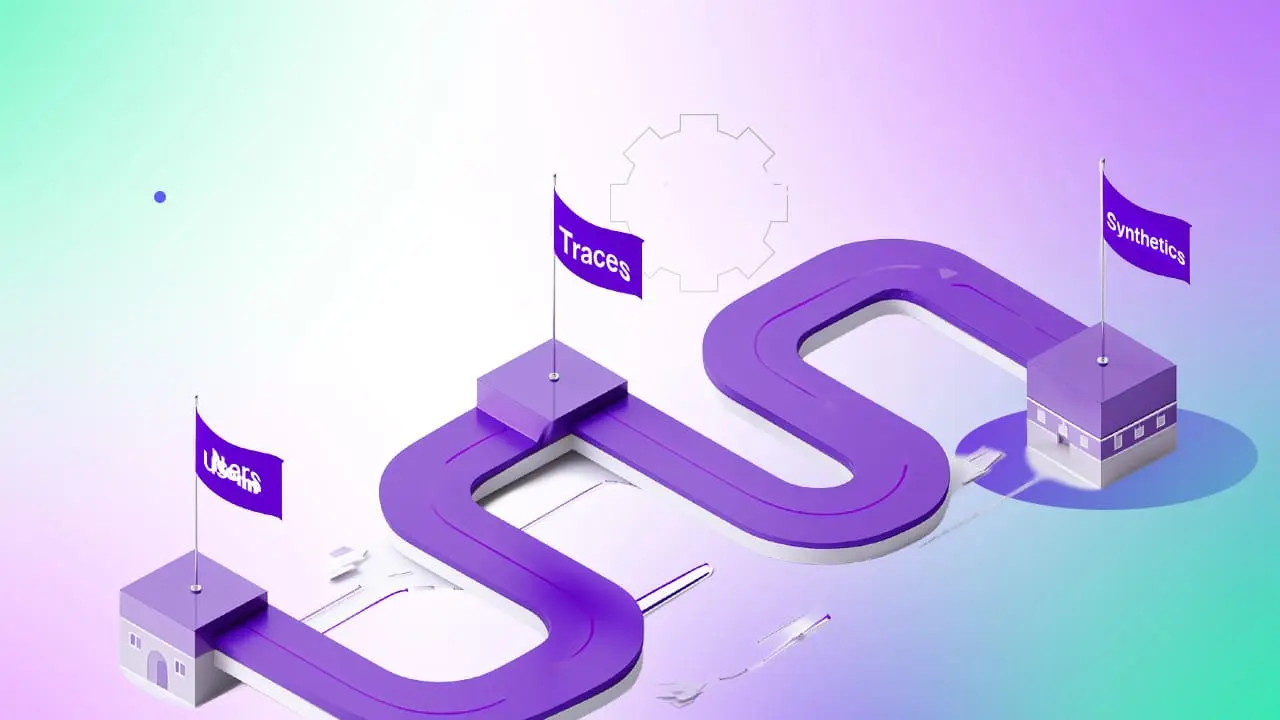
The foundations of shift-right practices usually lie in synthetics, traces, and real-user journeys.
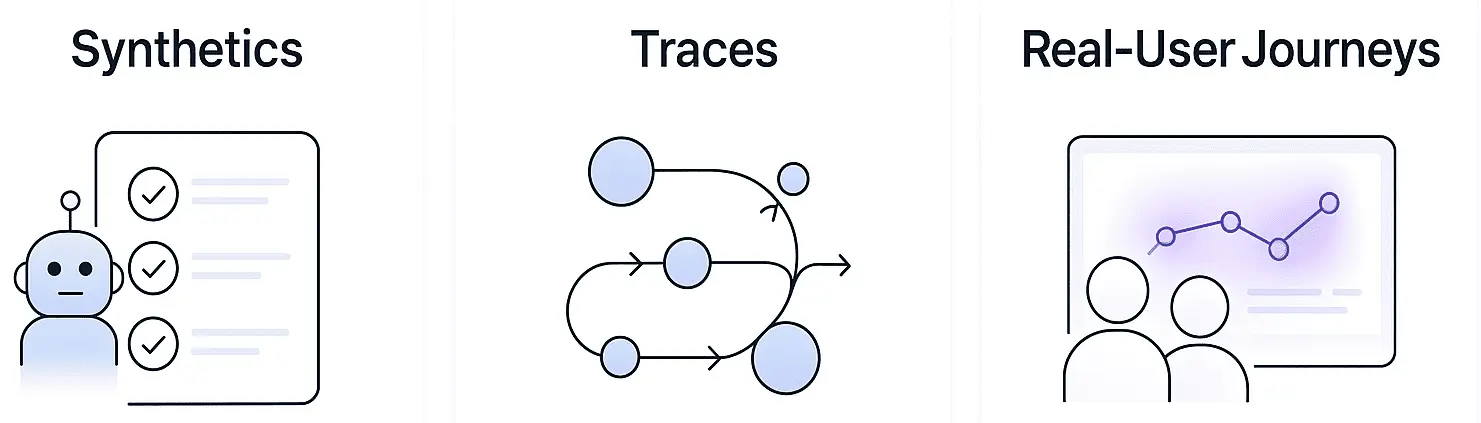
Synthetics: These are scripted checks of key business processes you want to monitor including login, search, or checkout. Simulating user actions even while there is no one in Playhouse Online, they run 24/7. Synthetics alert you of a login latency spike before your customers do.
Traces: Distributed tracing traces the path of requests as they traverse the various microservices. If checkout is slow, traces could tell you if the slow part is a payment service, an exploration of such a type of API, or the database layer.
Real-User Journeys: Gathered at scale, this where you see folks using your physical product. Journey mapping reveals patterns that you will never see in pre-release testing, such as mobile users abandoning at payment screens – because of a script that takes time to load.
Just as exploratory testing surfaces surprises ahead of release, these three techniques underpin the use of visual and behavioral monitoring in production.
Why Shift-Right Matters in 2026?
Let’s break it down. Why is shift-right testing important in DevOps today?
- Always-on expectations: Users don’t tolerate downtime. A few minutes of failure can mean thousands in lost revenue.
- Microservices complexity: With dozens of interconnected services, bottlenecks often emerge only in live environments.
- Real user experience: Pre-release metrics don’t always capture what matters most, smooth, frustration-free journeys in production.
The advantages of the shift-right concept in testing go beyond catching bugs. It builds confidence, reduces firefighting, and aligns teams around delivering reliable digital experiences. That’s why more QA leaders are exploring test automation for enterprise apps that span both shift-left and shift-right strategies.
In addition to technical benefits, shift-right also aids compliance-heavy industries. For instance, a hyperscale banking app can never afford latency in fund transfers going unnoticed, while a healthcare portal can never risk slow access to patient data. SLAs are met due to constant monitoring, and tracking quality metrics live helps make regulatory audits seamless. This, for DevOps teams, turns QA into a shared responsibility and not a handoff. Everyone from devs to operations gets visibility into real-time software health.
Examples in Action
Examples make this clearer. Here’s how shift-right testing examples play out in practice:
- Synthetic monitoring: Detecting a login slowdown at 2 a.m. before any customer notices, triggering an alert for the DevOps team.
- Traces: Identifying that checkout slowness isn’t the whole system, it’s the payment service timeout. Developers fix the right thing faster.
- Real-user journeys: Discovering a 20% drop-off in mobile checkout because images weren’t optimized.
But the scenarios don’t stop at e-commerce. Imagine a streaming platform where synthetic checks run nightly playback tests. Before customers complain about buffering, engineers already know which CDN node failed. Or picture an airline booking system: tracing shows exactly which microservice is delaying seat reservations, so fixes are immediate instead of firefighting blind.
These stories show why right-shift testing is becoming non-negotiable. It’s not just about catching bugs; it’s about protecting the end-to-end user experience, something ACCELQ emphasizes in its end-to-end automation approach.
Common Challenges Without Shift-Right
Skipping shift-right creates real gaps. Here are some challenges in shift-right testing (or rather, in its absence):
- Blind spots: Without production monitoring, issues slip through unnoticed until customers complain.
- Reactive firefighting: Teams spend more time scrambling after failures than preventing them.
- Siloed workflows: Dev, QA, and Ops misalign when they don’t share a common view of live quality.
A subtler challenge is cultural. Many teams still see QA as “done” at release, so they lack ownership of live quality. Ops teams monitor uptime, but without QA context, they miss user experience gaps. Bridging this divide isn’t easy, but it’s the only way to catch invisible problems before they erode customer trust.
This lesson is similar to black box vs white box testing: one perspective isn’t enough, you need both.
How to Get Started with Shift-Right
So, how do you implement shift-right testing if your team is new to it? Start simple.
- Begin with synthetics: Script a few top flows like login and checkout. Make sure they run continuously.
- Add tracing gradually: Instrument your most critical microservices to capture latency and error propagation.
- Layer in real-user monitoring: Start with basic analytics, page loads, drop-offs, then expand into deeper journey mapping.
The key is not to overwhelm teams with too much at once. Shift-right complements, not replaces, pre-release checks. ACCELQ customers often begin with left-shift practices, then evolve toward a shift-left + shift-right convergence, creating a continuous quality loop. If you want to see parallels, the blog on CI/CD pipelines with Jenkins explains how testing fits across stages.
Think of it as a crawl-walk-run journey. Crawl with simple synthetics on critical flows. Walk by adding distributed tracing to top-tier services. Run by layering real-user journey analytics and feeding those insights back into pre-release testing. This staged maturity path makes adoption realistic, avoids burnout, and ensures that shift-right testing grows with your team’s confidence.
The Future of Shift-Right Testing
Looking ahead, shift-right testing will only get smarter. Expect:
- AI-driven anomaly detection that reduces alert fatigue.
- Automated feedback loops where production insights flow back into pre-release pipelines.
- Unified dashboards giving Dev, QA, and Ops the same real-time view of quality.
The convergence of shift-left and shift-right will shape the next era of continuous quality engineering, something ACCELQ is already enabling with its AI-powered platform. For a broader lens, see how AI Agents in testing are redefining QA.
Conclusion
Shift-right testing is a mindset shift, not just another buzzword, to extend the pledge of quality beyond deployment. So, by incorporating synthetics, traces, and actual user journeys into your overall QA strategy, you create a dynamic safety net that is always learning from production.
Benefits of the shift-right principle in testing are not just about catching problems sooner. It builds user trust, keeps money rolling in, and allows teams to ship faster without fear. When paired with shift-left, it completes the circle, making testing a continuous, end-to-end solution.
Takeaway: if your users are already testing your software, you can either sit tight and let them discover the issues, or you can adopt shift-right testing and find them before they do.
Join the ACCELQ Community
Connect with fellow testers, share knowledge, and grow together.
🤝 Join Now



Balbodh Jha
Associate Director Product Engineering
Balbodh is a passionate enthusiast of Test Automation, constantly seeking opportunities to tackle real-world challenges in this field. He possesses an insatiable curiosity for engaging in discussions on testing-related topics and crafting solutions to address them. He has a wealth of experience in establishing Test Centers of Excellence (TCoE) for a diverse range of clients he has collaborated with.

You Might Also Like:
 What Is Regression Testing In Agile?
What Is Regression Testing In Agile?
 Top 10 Salesforce DevOps Tools
Top 10 Salesforce DevOps Tools
 Elevate TDD with End-to-End Testing