







End-to-End Email Flow Validation: Secure, Compliant, and Observable

Email automation sits at the center of how enterprises communicate, notify, and transact. Whether it is a password reset, a ServiceNow approval, a Salesforce alert, or an invoice generated by Oracle, automated email workflows must work reliably every single time. The challenge is that today’s email ecosystem is far more complex than a simple send-and-receive path. Messages pass through APIs, SMTP relays, encryption layers, spam filters, data-loss prevention engines, and compliance gateways before reaching the inbox.
If any part of this chain breaks, your automated emails break with it. That is why enterprises need structured, end-to-end email automation testing that validates not just delivery, but security, compliance, observability, and full workflow logic.
This article explains how email automation works across modern systems, the core pillars you need to validate, and how intelligent automation makes these workflows both testable and reliable.
- What Is End-to-End Email Flow Validation?
- How Email Automation Works?
- Understanding the Modern Email Ecosystem
- Core Pillars of Email Flow Validation
- Challenges in Email Automation Testing
- Automating Email Flow Validation
- Security and Compliance as Built-In, Not Bolt-On
- Real-World Scenarios
- How ACCELQ Automates at Enterprise Scale?
- AI and the Future of Email Validation
- Email Automation Best Practices
- Conclusion
What Is End-to-End Email Flow Validation?
End-to-end email flow validation is a structured form of end-to-end testing that verifies every stage an automated email touches, from send initiation all the way to the recipient inbox. It covers functional behavior, security enforcement, compliance checks, and message traceability.
The validation scope includes:
- Trigger accuracy: does the automated email fire at the right time
- SMTP relay checks
- Header and metadata integrity
- TLS encryption and certificate validation
- Deliverability through filters and gateways
- Content and link correctness
- Compliance requirements for regulated data
Email automation examples you might recognize:
- A Salesforce workflow sends a contract approval request
- ServiceNow generates incident-closure notifications
- Oracle or SAP sends invoices as attachments
- A healthcare system emails encrypted lab reports
These automated email workflows must behave consistently across environments, volumes, and integration paths.
How Email Automation Works?
Automated email workflows typically follow this chain:
Application trigger → Email service or API → SMTP relay → Security gateway → Spam/DLP filters → Inbox
Each layer adds logic or enforcement:
- CRM systems generate event-based triggers
- SMTP servers format and forward messages
- Security gateways apply DKIM, SPF, and DMARC
- DLP modules scan for sensitive data
- Spam filters evaluate reputation, content, and structure
This is why email automation testing must be holistic. If you validate only part of the chain, you miss the real issues that occur in production.
Since many automated emails originate from backend or integration events, robust API testing ensures application triggers fire correctly before an email is ever generated.
Understanding the Modern Email Ecosystem
Enterprise email delivery is no longer a straight line. It is a web of interconnected systems.
Key components involved:
- SMTP infrastructure (Exchange, Office 365, Postfix, custom relays)
- API gateways (AWS SES, SendGrid, Mailgun)
- Security enforcement tools (Proofpoint, Mimecast)
- Spam and phishing filters
- Encryption modules
- Compliance engines
- User inboxes across devices
Where things commonly break:
- Misconfigured SMTP relays
- Dropped MIME headers
- Incorrect DKIM signatures
- TLS downgrade failures
- DLP blocks due to content
- Spam filters rejecting automated transactional emails
- Wrong routing rules in security gateways
Email testing must catch these early, before customers or employees call support.
Core Pillars of Email Flow Validation
End-to-end validation spans three major pillars: security, compliance, and observability.
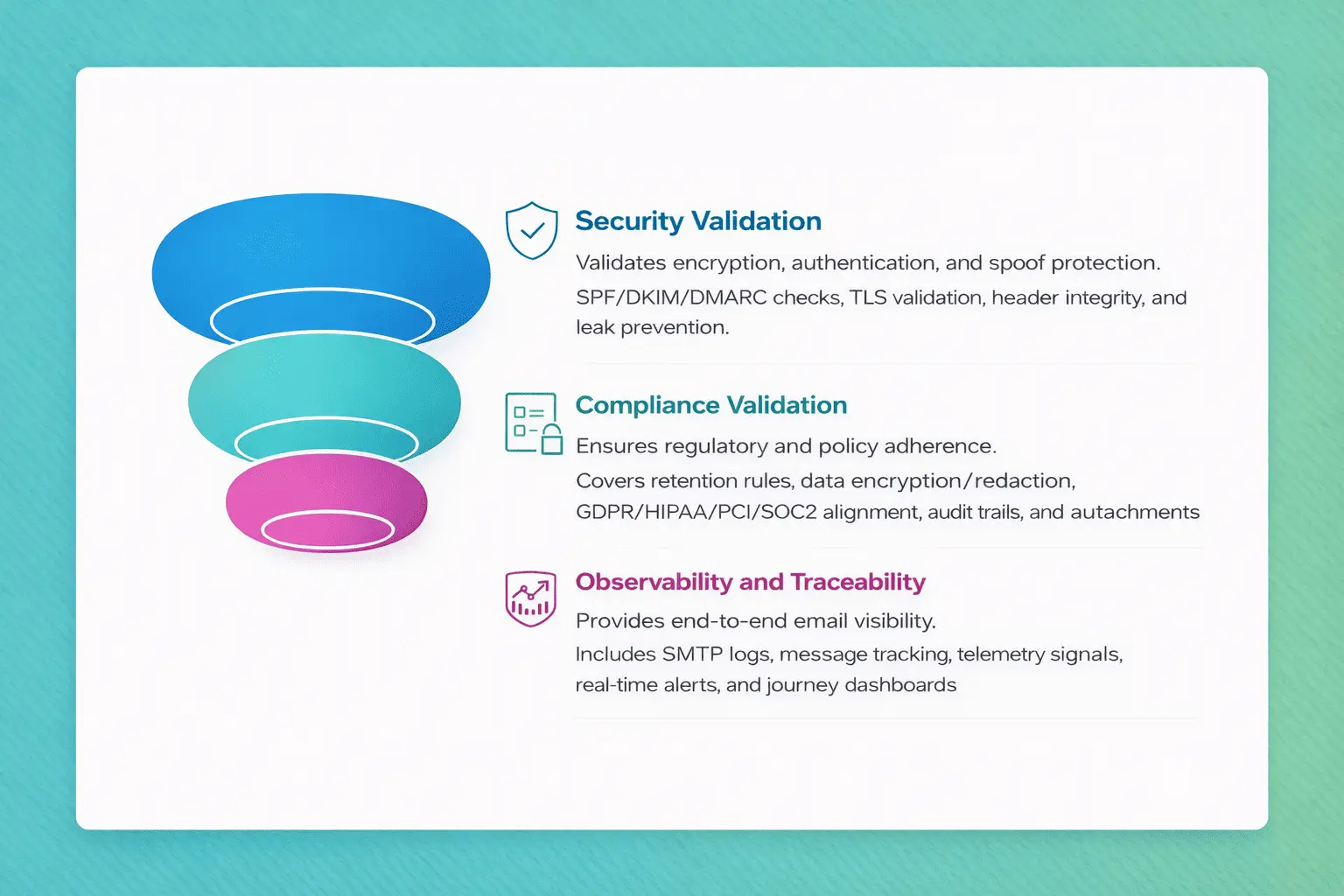
1. Security Validation
Security checks ensure automated email workflows remain safe, encrypted, and trustworthy. This includes:
- SPF, DKIM, and DMARC validation
- TLS negotiation checks
- Header authenticity and integrity checks
- Detecting spoofing or impersonation in automated emails
- Ensuring no sensitive content leaks through misconfigured workflows
Given the rise of phishing and spoofing, validating security signals is now a mandatory part of email testing.
2. Compliance Validation
Email automation intersects with regulatory requirements. Your validation must confirm:
- Retention policies are applied correctly
- Sensitive data is encrypted or redacted
- Content meets GDPR, HIPAA, PCI, or SOC2 standards
- Automated emails leave auditable trails
- Attachments follow corporate security rules
Compliance is not something you bolt on later. It must be part of email automation from the start.
3. Observability and Traceability
Email testing without traceability is guesswork. Enterprises need:
- Logs for send initiation, SMTP hops, and delivery checks
- Message tracking in tools like Splunk or ELK
- Telemetry signals across security gateways
- Real-time alerts on failures or anomalies
- Dashboards that show full message journeys
Without visibility, teams cannot diagnose failures or prove compliance.
📧 Make Email Workflows Fully Observable
Understand how modern QA teams move beyond basic monitoring to full workflow visibility across logs, signals, and trace paths.
Challenges in Email Automation Testing
Email testing is uniquely difficult because of how distributed the ecosystem is.
Typical challenges include:
- Third-party relays and gateways you do not fully control
- Different SMTP configurations across QA, staging, and production
- Manual validation that slows feedback loops
- Difficulty testing attachments, encrypted payloads, and dynamic content
- Non-reproducible bugs due to asynchronous processing
- Lack of an automation framework that simulates secure end-to-end flows
These challenges make manual email testing unreliable and expensive.
Automating Email Flow Validation: A Smarter Approach
Automation brings structure and repeatability to complex email workflows, and modern test automation practices make it possible to validate these flows consistently across environments.
1. Model-based automation for business-critical email journeys
Map workflows end-to-end:
trigger → processing → security → delivery → inbox → confirmation
2. Reusable test assets across environments
Automated email workflows must run across dev, QA, UAT, and prod-like environments.
3. Deep integration with enterprise systems
- Salesforce
- ServiceNow
- Oracle
- SAP
- HR and finance systems
4. Full validation in a single automated flow
- Email body content
- Headers and metadata
- Links and attachments
- Encryption and compliance
- Deliverability across security layers
5. Observability with dashboards
Teams need to trace where an email went, how long each hop took, and where it failed.
Security and Compliance as Built-In, Not Bolt-On
Most organizations still treat email security and compliance as later checks. The smarter way is to embed them in the CI/CD workflow enables predictable, policy-driven continuous testing across environments.
What this enables:
- Policy-driven testing
- Automated encryption validation
- Pre-production spam-classification tests
- Real-time compliance alerts
- Standardized workflows across teams
This creates automated email workflows that are secure by design.
Real-World Scenarios
Scenario 1: Financial approval alerts
A banking application triggers automated emails when a loan request crosses specific thresholds. Validation ensures:
- The right stakeholders receive notifications
- Headers follow financial compliance rules
- No sensitive data leaks
Scenario 2: Encrypted healthcare reports
A healthcare provider emails encrypted lab results. Validation includes:
- Secure encryption enforcement
- HIPAA-compliant redaction
- End-to-end traceability for audits
Scenario 3: Retail CRM campaigns
A retail company sends personalized campaigns. Testing ensures:
- Deliverability across geographies
- Dynamic content accuracy
- CAN-SPAM and consent compliance
These email automation examples show how validation protects both the business and the recipient.
How ACCELQ Automates End-to-End Email Flow Validation at Enterprise Scale?
ACCELQ brings intelligence, automation, and observability to workflows where email is a core part of the business process. It allows teams to automate emails across triggers, systems, and validation layers without writing code.
1. Model-based automation for email journeys
ACCELQ Autopilot models each automated email workflow so teams can validate:
- Trigger accuracy
- SMTP flow
- Security signals
- Inbox delivery
- Downstream workflow impacts
This removes guesswork and creates repeatable, audit-ready test flows.
✨Bring Intelligence to Email Workflow Validation
ACCELQ Autopilot models automated email journeys end-to-end, from trigger validation to security enforcement and inbox confirmation, without writing code.
🪐Explore ACCELQ Autopilot
2. Deep content, header, and security validation
ACCELQ validates:
- Email body text and dynamic values
- Attachments and MIME structure
- DKIM, SPF, and DMARC signatures
- TLS enforcement and metadata integrity
- Embedded links and workflow transitions
All in a single automated run.
3. Cross-system integration testing
ACCELQ connects directly to systems that fire automated emails:
- Salesforce workflow events
- ServiceNow incidents and approvals
- Oracle and SAP invoice workflows
This makes end-to-end email automation testing part of the larger business flow.
Email triggers often originate from CRM systems, making Salesforce test automation essential for validating approval flows, alerts, and workflow-driven notifications.
4. Compliance-ready traceability
ACCELQ offers observability dashboards that help teams:
- Trace message journeys
- Capture email evidence for audits
- Analyze issues across security or spam filters
- Monitor delivery performance in real time
5. No-code automation for rapid scaling
ACCELQ’s no-code approach allows QA, security, and compliance teams to automate without depending on developers. This speeds up validation cycles and reduces maintenance.
ACCELQ essentially provides a unified method to test automated email workflows with accuracy, depth, and governance.
AI and the Future of Email Validation
AI is beginning to reshape email automation testing in several ways:
- NLP models detect anomalies in subject lines, content, and tone
- AI validates spam classification before production
- Predictive insights identify delivery bottlenecks
- Intelligent analysis of complex headers and metadata
- Automated compliance checks across large email volumes
AI in email assurance is part of a broader shift in AI test automation, where intelligence helps teams detect anomalies, validate content quality, and predict delivery failures before they impact users.
Email Automation Best Practices
A few principles make automated email workflows far more reliable:
- Validate the full workflow, not just the inbox
- Build observability into the automation strategy
- Keep compliance checks in the CI pipeline
- Use synthetic test accounts for repeatability
- Automate encryption, header, and content checks
- Track message trace across hops
- Test high-risk emails first (notifications, invoices, resets)
To ensure repeatability across environments and high-volume scenarios, teams increasingly use parallel testing to validate email behavior under load and across multiple workflow variations.
Conclusion
Email automation is more than scheduled messages or triggered notifications. It is a mission-critical workflow that must be validated end-to-end across triggers, relays, security layers, and compliance rules. Treating email as a testable, measurable, observable workflow is the only way enterprises can guarantee reliability.
ACCELQ helps unify email automation testing by bringing model-based validation, observability, and compliance assurance into one intelligent platform. Whether your emails originate from Salesforce, ServiceNow, Oracle, or custom applications, automated validation keeps every message secure, compliant, and predictable.



Balbodh Jha
Associate Director Product Engineering
Balbodh is a passionate enthusiast of Test Automation, constantly seeking opportunities to tackle real-world challenges in this field. He possesses an insatiable curiosity for engaging in discussions on testing-related topics and crafting solutions to address them. He has a wealth of experience in establishing Test Centers of Excellence (TCoE) for a diverse range of clients he has collaborated with.

You Might Also Like:
 Building a Future-Proof Test Automation Architecture!
Building a Future-Proof Test Automation Architecture!
 Improving Test Automation Quality Through Code Reviews
Improving Test Automation Quality Through Code Reviews
 Top 8 PDF Testing Tools In 2026