







What is Chatbot Testing?

Quick Answer: What Is Chatbot Testing?
Chatbot testing is the process of validating a chatbot’s functional behavior and the quality of its AI-generated responses across single turns and full conversations.
This is also called bot testing or bot test automation, though ‘chatbot testing’ is the more precise term.
Traditional chatbot testing checks if the bot does the right thing: does it load? Does it route to the right intent? Does it call the right API? AI chatbot behavioral testing checks whether the bot says the right thing: is the response accurate, relevant, and consistent across a conversation. Most teams are still only running the first type of test.
- When Chatbot Testing Passes But the Bot Still Fails
- Why Chatbot Testing Needs to Change for AI Chatbots
- The Send-and-Match Model Breaks With No Single Right Answer
- Chatbot Testing vs GenAI Testing: Same Family, Different Focus
- Chatbot Testing Scenarios and Frameworks
- AI Chatbot Behavioral Testing: Moving From Assertions to Metrics
- Best Approach to Test AI Chatbots: Three Questions to Start With
- Enterprise Chatbot Testing Is Becoming a Governance Question
- FAQs
Send-and-match testing only checks whether the bot responded, not if the response was true. That works fine on a rule-based bot with one correct answer per input. But an LLM has a range of valid phrasings, so a confidently wrong answer passes the same check as a correct one.
- Know What Send-and-Match Can’t Catch: Chatbots can pass QA while hallucinating, losing context by turn five, or drifting after a model update. Exact-match assertions cannot check accuracy; they only check that a response appears.
- Replace Assertions With Scored Metrics: Measure faithfulness and hallucination to catch factual drift. Measure role adherence and knowledge retention to catch context loss across turns. Trigger scheduled re-runs after every model or prompt change to catch what a one-time launch suite would miss.
- Assign the Threshold to an Owner: When you set an acceptable score instead of a pass or fail, someone has to be accountable for that number. ACCELQ’s LLM Testing framework runs these metrics as no-code commands inside a standard automation pipeline, useful for teams integrating chatbot tests on top of what they already run.
When Chatbot Testing Passes But the Bot Still Fails
A customer asks your chatbot about a refund policy. The bot answers with the right tone, formatted cleanly, with no errors thrown. The answer is wrong, but delivered with the same confidence as a correct one.
This chatbot almost certainly passed QA. Every test case ran green. The widget loaded. The API calls moved correctly. The conversation flow was intact.
The test suite was not wrong, but the testing model was.
Why Chatbot Testing Needs to Change for AI Chatbots
You cannot assert your way to a good chatbot. You have to measure it.
The chatbot underneath most customer-facing widgets has changed. It used to be a decision tree, i.e., an if-this-then-that structure with a fixed set of responses; it is now an LLM generating a fresh answer every time.
The test suites didn’t get updated to match this.
A rule-based bot has exactly one correct answer to a given input. If the input and output are fixed, checking for an exact match works.
An LLM-based bot has a range of acceptable answers, all worded differently and equally valid. Ask it the same question twice, and you might get two different phrasings, both correct.
Exact match testing against a moving target fails by giving you a “pass” on a response that hasn’t been verified for accuracy.
The Send-and-Match Model Breaks With No Single Right Answer
The send-and-match model in chatbot test automation was: send a string, get a string back, check it against an expected string. It’s been the default chatbot testing method and still works fine for confirming that a widget renders, an API call returns data, and a button click routes correctly.
It breaks when there’s no single right answer to check against, which is what an LLM produces every time.
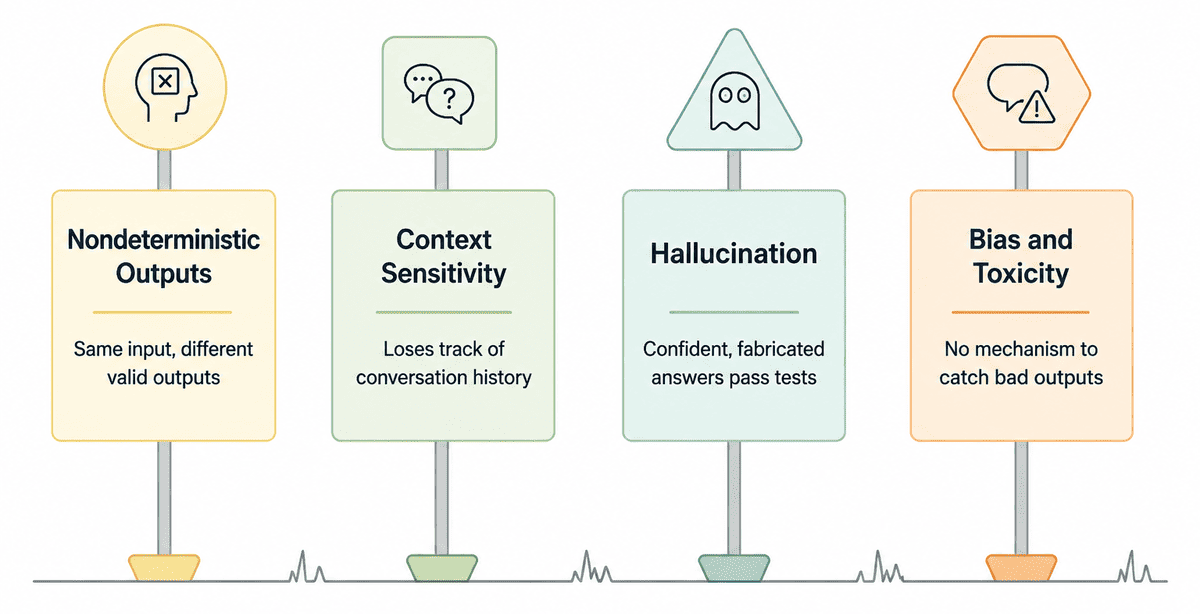
Four ways this shows up:
- Nondeterministic outputs: The same input can produce different, equally valid outputs. Exact match testing cannot handle that, so it either produces false failures on correct answers or gets loosened until it stops catching anything.
- Context sensitivity: A response can be perfectly correct on turn one and wrong by turn five, if the bot loses track of what the customer already told it. Send-and-match tests a single exchange in isolation. It doesn’t understand conversations.
- Hallucination: A confident, fabricated answer looks identical to a correct one to a test that only checks “did it respond.” The bot didn’t error out, so the test passes, and the wrong information ships.
- Bias and toxicity: A single bad output with these attributes can be a brand and compliance incident. Send-and-match has no mechanism for catching this at all.
Chatbot Testing vs GenAI Testing
GenAI testing is broader and covers anything an LLM generates, including text, code, images, and summaries.
Chatbot testing is a specific application of GenAI testing. Chatbot tests cover generated text inside a conversational, multi-turn interface, where context retention and role consistency are as essential as answer accuracy.
If you’re testing a chatbot, you’re doing GenAI testing with conversation-specific constraints layered on top.
| Aspect | GenAI Testing | Chatbot Testing |
|---|---|---|
| What it covers | Anything an LLM generates: text, code, images, summaries, you name it | One specific slice of that: conversational text inside a chat interface |
| What you’re checking | Is this one output good? | Is this response good, and does the whole conversation still hold together? |
| Memory | Usually none; each prompt stands alone | Has to remember what the customer already said, turns ago |
| The extra risk | The output can be wrong | The output can be wrong, or it can be right but out of character, or it can forget context and contradict itself |
| Metrics you’d add | Relevancy, faithfulness, hallucination, bias, toxicity | All of the above, plus role adherence, knowledge retention, conversation completeness |
Chatbot Testing Scenarios and Frameworks
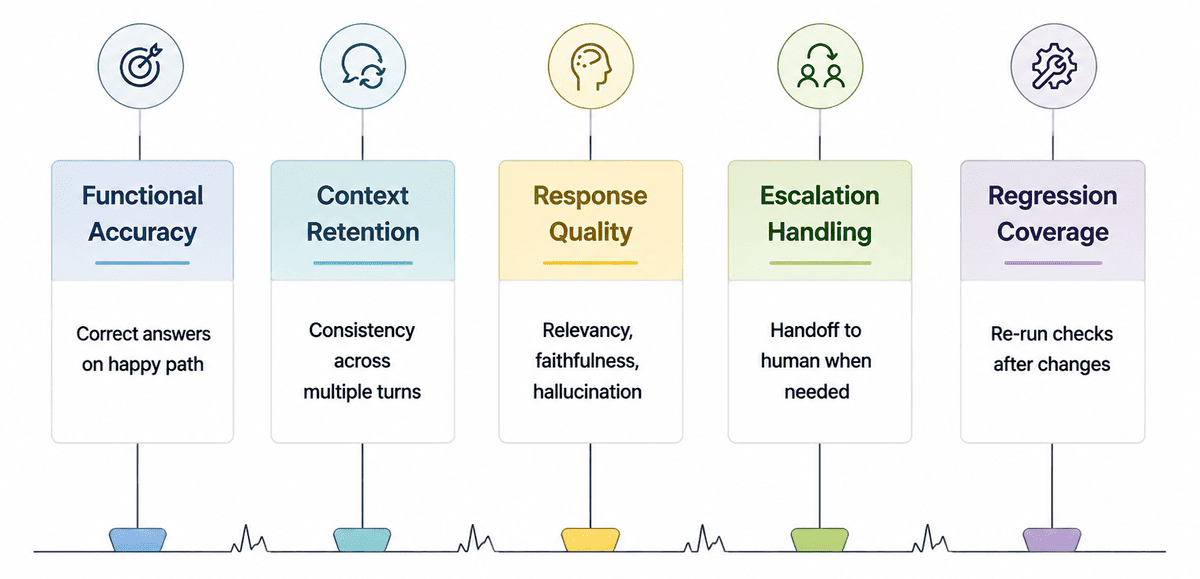
A useful chatbot testing framework needs to cover five kinds of scenarios; each exposes a different kind of failure.
Happy path
- Common intents, clean inputs, the questions that come up most often.
- This confirms that the basics work.
Edge cases
- Typos, slang, emojis, incomplete sentences, the way people actually type.
- A bot that only understands perfectly phrased questions will frustrate real users quickly.
Adversarial inputs
- Prompt injection attempts, off-topic redirection, attempts to get the bot to ignore its instructions.
- This category verifies that a bot cannot be talked out of its guardrails.
Multi-turn context retention
- Does the bot still remember what the customer said in turn one by the time you reach turn five?
- This is the kind of thing send-and-match testing structurally cannot check.
Escalation and fallback
- Does the bot recognize when it’s out of its depth and bring in a human? Or does it keep guessing?
- A bot that fails gracefully is less risky than one that fails confidently.
AI Chatbot Behavioral Testing: Moving From Assertions to Metrics
If send-and-match doesn’t work, don’t replace it with a better assertion. Opt for a different unit of measurement.
Behavioral testing runs as a layer on top of functional testing. You still need to confirm the bot works and also check that what it says is good.
- Single-turn metrics: answer relevancy (does the response address what was actually asked), faithfulness (is it factually grounded, not made up), hallucination detection, bias, and toxicity.
- Multi-turn metrics: role adherence (does the bot stay in character and within policy across a full conversation), knowledge retention (does it remember what the customer already said), and conversation completeness (did it resolve the query?)
Focus on thresholds, not black-and-white “pass” or “fail”. A faithfulness score of 0.85 tells you something specific. A binary pass or fail tells you nothing about how close the bot came to being wrong. Someone on your team has to decide what threshold is acceptable for your use case.
ACCELQ’s own LLM Testing framework runs exactly these metrics, both single-turn and conversational, as no-code test commands inside a standard automation pipeline. It’s a working example of what replacing send-and-match would look like in practice.
See how ACCELQ's LLM Testing framework applies these metrics, no code required.
Best Approach to Test AI Chatbots: Three Questions to Start With
If you’re wondering how to test AI chatbots without rebuilding your entire suite, start with these three questions that tell you how exposed you currently are.
- Are you testing single responses, or full conversations? If every test case is one exchange in isolation, you have no visibility into whether it loses context.
- Do you know what threshold is good enough for your use case? If the answer is “we haven’t defined one,” work on that first.
- Are you re-running these checks every time the model or prompt changes? LLM behavior drifts with every upstream update. A test suite that only runs once is already stale.
Enterprise Chatbot Testing Is Becoming a Governance Question
Again, you cannot assert your way to a good chatbot. You have to measure it.
Measuring introduces a threshold. A threshold needs an owner. When your chatbot’s faithfulness score is 0.85, someone has to decide that 0.85 is acceptable for a bot handling refund policy. The number would be different when measuring a bot recommending shoe sizes. Right now, in most organizations, that decision stays with whichever engineer set up the test.
This is risky.
Let’s say your vendor pushes a model update in March. Nobody re-runs the behavioral test suite because the update wasn’t flagged.
Your faithfulness score, which was 0.85 at launch, is now 0.7. The chatbot is still answering every question but is wrong more often.
The first person to notice is a customer, three months later, who got incorrect information about a return deadline.
At enterprise scale, a chatbot usually runs across four or five channels. It also runs on a model an outside vendor controls and handles conversations on regulated topics like healthcare guidance, financial disclosures, or legal disclaimers.
This adds questions: who approves the threshold before launch? Who’s notified when a score drops after a model update? Who signs off before the bot is allowed to keep running in production?
Assign those three approvals to named roles, whether that’s a compliance lead, a product owner, or whoever currently owns customer experience risk, before the next model update.
Talk to ACCELQ about testing your AI chatbot.
FAQ's
What is chatbot testing?
Chatbot testing validates the quality of a chatbot's functional behavior as well as the quality of its generated responses across single exchanges and full conversations.
How do you test AI chatbots?
You test AI chatbots by combining traditional functional and API testing with behavioral metrics like relevancy, faithfulness, and hallucination detection. AI-generated responses cannot be evaluated with exact-match assertions alone because multiple valid outputs may exist.
What is AI chatbot behavioral testing?
AI chatbot behavioral testing is the practice of scoring a chatbot's responses against multiple quality metrics rather than a single expected answer. This approach accounts for the range of valid responses that a large language model can produce.
What is the best approach to test a chatbot?
Start by testing full conversations rather than isolated responses. Define acceptable quality thresholds for your use case, and rerun behavioral checks whenever the underlying model or prompt changes.
What is enterprise chatbot testing?
At enterprise scale, chatbot testing adds governance layers. It considers who owns response quality thresholds, how those standards are enforced across teams, and how testing adapts to model updates across every channel where the chatbot is deployed.



Balbodh Jha
Associate Director Product Engineering
Balbodh is a passionate enthusiast of Test Automation, constantly seeking opportunities to tackle real-world challenges in this field. He possesses an insatiable curiosity for engaging in discussions on testing-related topics and crafting solutions to address them. He has a wealth of experience in establishing Test Centers of Excellence (TCoE) for a diverse range of clients he has collaborated with.


You Might Also Like:
 Cucumber in Test Automation: Implementation, Challenges, and Future Trends
Cucumber in Test Automation: Implementation, Challenges, and Future Trends
 Static Testing vs Dynamic Testing
Static Testing vs Dynamic Testing
 Manual Testers Matter: How They Drive Modern Automation