








Testing in MLOps: Keeping Machine Learning Honest

If you’ve ever deployed a machine learning model, you know it doesn’t end with “ship it.” Models age. Data changes. What looked great in the lab slowly goes off-track in production. That’s where testing in MLOps earns its keep. It’s not about perfection; it’s about making sure your models stay accurate, fair, and useful when real-world data starts hitting them.
Let’s walk through what testing actually means in MLOps, how it differs from regular QA, and how modern platforms like ACCELQ MLOps automation help teams handle it without losing their minds.
What MLOps Actually Is?
At its core, MLOps brings DevOps discipline to machine learning. It’s the glue between data science experiments and production systems.
Think of it as a loop, not a straight line. Data comes in, models are trained, deployed, monitored, and retrained. Every step touches code, data, and configuration, which means every step needs testing.
A healthy MLOps workflow includes:
- Continuous integration and deployment
- Automated validation for both data and models
- Version control for data, code, and pipelines
- Monitoring for drift and bias
- Clear rollback or retraining paths
When all that clicks, ML models behave like real, maintainable software, not fragile lab prototypes.
SUGGESTED READ - Quick Guide to Continuous Testing in DevOps
Continuous Testing in MLOps Pipelines
Here’s the thing: models break quietly. They won’t throw a 500 error; they’ll just start making bad predictions. That’s why continuous testing in MLOps exists, to catch subtle failures before they snowball.
A typical cycle looks something like this:
- Data checks before training: Make sure schema, ranges, and distributions are right.
- Model validation: Measure performance and check against your baseline.
- Pipeline testing: Deploy the model into staging and verify that the API, data sources, and triggers work.
- Post-deployment monitoring: Watch for accuracy drift and trigger retraining automatically.
The goal is to turn testing into a background habit, not a firefight after production goes sideways. With ACCELQ MLOps automation, teams can automate these validation loops and build confidence into every model update.
Explore how AI-driven automation is redefining how we design, execute, and maintain tests – bringing accuracy, adaptability, and speed to modern QA workflows.
👉 Read the full article
How to Test Machine Learning Models in MLOps?
Testing machine learning models isn’t a single task; it’s more like running a series of reality checks across data, code, and output.
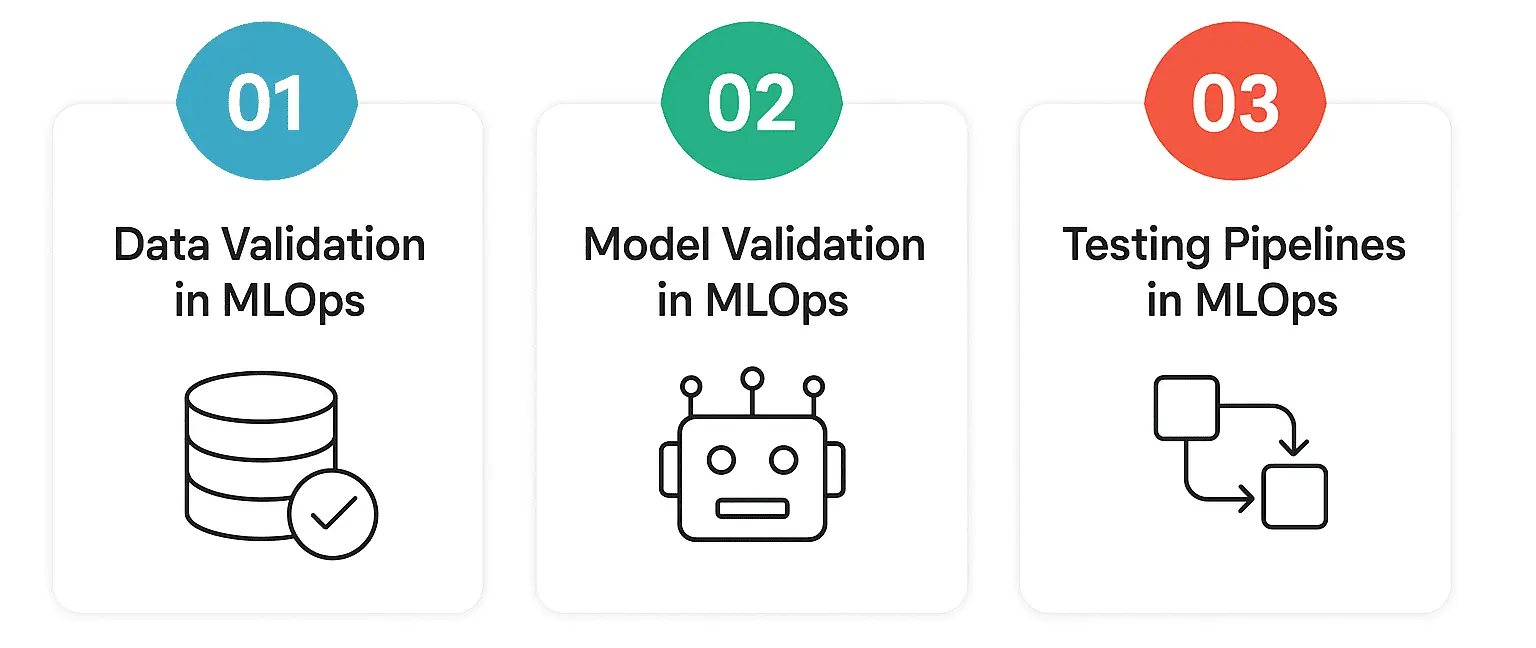
1. Data Validation in MLOps
Bad data ruins good models. Before training anything, you should validate what’s coming in.
Check for missing values, incorrect types, or sudden changes in distributions. If your feature “customer_age” suddenly has negative numbers, that’s your first red flag.
Automating data validation in MLOps helps catch these early. Tools can compare new data batches with old ones and flag unexpected patterns before training even starts.
2. Model Validation in MLOps
Once a model is trained, you need to make sure it actually performs the way you expect. This means:
- Comparing new performance metrics with a previous baseline.
- Ensuring precision and recall haven’t tanked.
- Watching for bias across gender, age, or region segments.
Sometimes a model looks “better” on paper but performs worse in production. Testing prevents those silent regressions.
3. Testing Pipelines in MLOps
A model is just one piece of the system. Pipelines connect everything; data ingestion, preprocessing, serving APIs, and monitoring.
Test those connections too. Run integration tests between pipeline components. Validate the API response time, the model outputs, and retraining triggers. The goal is to make sure every step works together when deployed at scale.
Why Test Automation Matters in MLOps?
Manual checks don’t cut it anymore. ML pipelines evolve too fast. You need test automation in MLOps that can keep up with frequent retraining and deployment cycles.
Good automation covers:
- Continuous validation on new datasets
- Regression checks when retraining models
- Real-time monitoring of drift
- Automated retraining triggers when performance drops
Platforms like ACCELQ MLOps automation make this practical. It connects CI/CD systems with ML workflows, lets you define validation logic without coding, and automatically tracks changes across data and model versions. The result is less firefighting and more predictable releases.
MLOps vs AIOps
Let’s clear up a common mix-up.
MLOps is about managing and testing machine learning models.
AIOps uses machine learning to manage IT operations.
Here’s a quick comparison:
| Category | MLOps | AIOps |
|---|---|---|
| Focus | Model lifecycle: training, validation, and deployment. | IT operations: monitoring, alerting, and remediation. |
| Goal | Keep models accurate, explainable, and continuously improving. | Keep systems healthy, efficient, and self-healing. |
| Users | Data scientists, ML engineers. | DevOps, IT operations teams. |
| Example Tools | ACCELQ, MLflow, Kubeflow. | Splunk, Moogsoft, Datadog. |
 Also Read:
 Challenges in Testing ML Models
Testing machine learning models comes with its own set of headaches. Unlike traditional code, model output depends on data quality and statistical quirks.
Here are a few real-world challenges:
| Challenge | Why It Matters |
|---|---|
| Data Drift | Gradually reduces model accuracy over time as data patterns evolve. |
| Bias and Fairness | Introduces skewed or unethical predictions that impact decision quality. |
| Version Control | Data, model, and code can easily fall out of sync, affecting reproducibility. |
| Explainability | Makes it difficult to understand why a prediction or outcome occurred. |
| Automation Gaps | Manual retraining and validation slow down model improvement cycles. |
Testing gives teams visibility back. The more you automate, the less time you spend guessing why a model went wrong.
Which tools are used for testing in MLOps?
There’s no shortage of tools claiming to simplify MLOps. A few actually do.
- ACCELQ MLOps Automation – Codeless test automation built for continuous model validation. Integrates directly with CI/CD and supports AI-driven drift detection.
- TensorFlow Extended (TFX) – Great for pipeline orchestration and data checks.
- MLflow – Handles experiment tracking and model versioning.
- Kubeflow – Runs full ML pipelines in production.
- Great Expectations – Focused on automated data validation.
These codeless test automation tools form the backbone of a solid MLOps testing framework that keeps data, code, and models in sync.
Final Thoughts
Machine learning isn’t magic; it’s just software that learns from data. That also means it can fail in sneaky ways. Testing in MLOps is what keeps it grounded. It’s not about slowing things down, it’s about catching issues before they catch you.
If your team’s struggling with flaky models, slow retraining, or inconsistent results, it’s probably time to look at automation. Tools like ACCELQ MLOps automation bring CI/CD-style testing into the ML world, allowing you to focus on improving models rather than supervising them.
Reliable ML isn’t an accident. It’s tested, tracked, and continuously improved.
Join the Future of Test Automation
Boost QA productivity with ACCELQ’s codeless platform
Watch Overview



Prashanth Punnam
Sr. Technical Content Writer
With over 8 years of experience transforming complex technical concepts into engaging and accessible content. Skilled in creating high-impact articles, user manuals, whitepapers, and case studies, he builds brand authority and captivates diverse audiences while ensuring technical accuracy and clarity.

You Might Also Like:
 Gen AI Use Cases: Practical Applications and Enterprise Framework
Gen AI Use Cases: Practical Applications and Enterprise Framework
 Why Everyone’s Talking About AI in QA
Why Everyone’s Talking About AI in QA
 Top AI Conferences In 2026