








Generative AI Testing: How AI Is Transforming Software Quality Assurance

Your team shipped a checkout bug last week that the regression suite should have caught. In the post-mortem, the VP of Engineering asked the question you didn’t have a clean answer for: developers are already using AI to write code twice as fast as before. Why isn’t QA using AI to keep up?
It’s a fair question, and it’s showing up in more post-mortems than most QA leads want to admit. AI-generated code ships faster than manual test-writing can cover it, which means the testing surface is growing while the time available to test it isn’t. Generative AI in software testing exists to close exactly that gap. Closing it well, though, requires knowing where generative AI actually helps, where it doesn’t, and how to verify its output before you let it anywhere near a release gate.
This guide covers what generative AI in software testing actually means, where it earns its place in an enterprise QA workflow, and (the part most guides skip) how to trust what it produces.
- What Is Generative AI in Software Testing?
- How Generative AI Is Changing Software Development
- Generative AI for Developers vs. Generative AI for QA
- Traditional Test Automation vs. Generative AI Testing
- Generative AI Use Cases in Software Testing
- Self-Healing Test Maintenance
- How to Use Generative AI in Software Testing: 5-Steps
- Verifying AI-Generated Tests Before You Trust Them in Production
- Challenges of Using Generative AI in Software Testing
- Choosing Generative AI Testing Tools: What to Look For
- Where ACCELQ Autopilot Fits
- The Bottom Line
- Generative AI in software testing creates new test assets (cases, scripts, synthetic data, failure summaries) instead of replaying what a human already wrote.
- Self-healing maintenance, not test generation, is the use case that actually moves the maintenance cost number most QA teams track daily.
- A verification gate with business-logic review, requirement traceability, and a defect-escape feedback loop is the difference between AI helping QA and quietly undermining it.
- The “hallucinated test” problem, where a generated test passes but checks nothing meaningful, is the single most consequential risk and the one most guides on this topic skip.
- Enterprise teams getting real value adopted in a specific sequence: define the failure, start with regression, set a review gate, track defect escapes, then expand. Not the reverse.
What Is Generative AI in Software Testing?
Generative AI in software testing refers to AI models, primarily large language models (LLMs), that create new testing assets: test cases, automation scripts, synthetic test data, and failure summaries, rather than only executing instructions a human already wrote.
That’s the distinction that matters. Traditional test automation runs a predefined script: the same steps, the same assertions, every time, until someone manually updates it. Generative AI for software testing instead takes requirements, user stories, existing test suites, or application behavior as input and produces new output from it. Give it a user story and it drafts test cases. Give it a broken locator and it can propose a fix. Give it a data schema and it can generate realistic, varied test data without touching production records.
The practical effect on a QA team is fewer hours spent on the repetitive front end of testing (writing the first draft of a test case, updating a script after a UI change) and more hours available for the work that still requires human judgment: deciding what’s actually worth testing, assessing risk, and catching the edge cases an AI model won’t think to generate on its own.
It’s worth being precise about what generative AI in software testing is not. It’s not the same as AI-assisted testing, where a model like GitHub Copilot helps a human write a script that human still owns and maintains. And it’s not the same as testing generative AI applications themselves: checking an LLM-powered product for hallucination or bias is a related but separate discipline. This guide is about using generative AI to test your application, not about validating an AI model.
How Generative AI Is Changing Software Development, Not Just Testing
Generative AI in software development has already reshaped how code gets written: Copilot-style tools, AI pair programmers, and code-generation agents mean a single developer can now produce a volume of code that used to take a small team. That shift is the real source of the pressure QA teams feel today.
Generative AI for Developers vs. Generative AI for QA
Here’s the gap most engineering orgs haven’t reconciled yet: generative AI for developers has matured faster than generative AI for QA has been adopted. Code ships faster. Test coverage doesn’t automatically scale to match it. The result is exactly the scenario that opened this guide: a defect escapes to production not because the QA team got careless, but because the volume of change outpaced the team’s manual capacity to cover it.
Closing that gap isn’t about matching every AI-generated line of code with an AI-generated test. It’s about using generative AI in software testing specifically where it removes the bottleneck: turning a requirement into a first-draft test case in minutes instead of hours, and keeping existing tests alive as the application underneath them keeps changing.
For a closer look at how these AI categories differ, see ACCELQ’s breakdown of agentic AI vs. generative AI.
Traditional Test Automation vs. Generative AI Testing
| Dimension | Traditional Test Automation | Generative AI Testing |
|---|---|---|
| Test creation | Manually scripted by an engineer | Generated from natural language, user stories, or code |
| Maintenance | Manual updates after every UI or API change | Self-healing: detects the change and adapts |
| Coverage | Limited to what the engineer thought to write | Can surface edge cases and negative paths a human might miss |
| Test data | Often production data, sanitized by hand | Synthetic data generated on demand, without exposing real records |
| Adaptability | Static until someone rewrites it | Evolves as the application evolves |
| Where it fails | Doesn’t scale with rapid release cycles | Can generate irrelevant or “hallucinated” tests without human review |
Neither column is strictly better. Generative AI testing removes the ceiling that manual scripting puts on coverage and maintenance speed, but it introduces a new failure mode traditional automation doesn’t have: a test that looks structurally correct but doesn’t actually reflect real user behavior. That risk is exactly why verification, covered further down, isn’t optional.
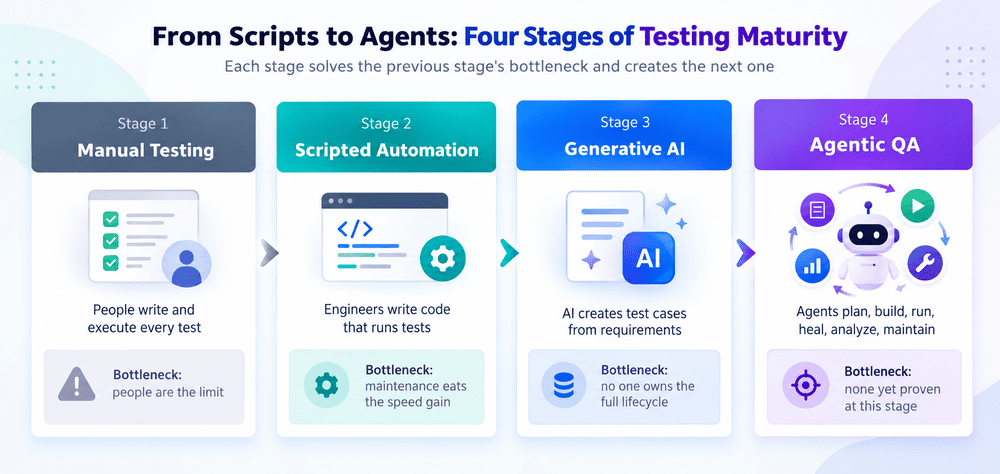
Each stage solves the previous stage’s bottleneck and creates the next one. Most enterprise teams are stuck between stages 2 and 3.
For a deeper look at how agentic automation differs from traditional scripted automation, see ACCELQ’s complete guide to agentic automation in testing.
Generative AI Use Cases in Software Testing
Gen AI use cases in software testing tend to cluster around four areas, and enterprise QA teams generally see the fastest return from the first two.
Test Case Generation from Requirements
Feed a generative AI testing tool a user story, a Jira ticket, or a Figma design, and it can draft a first set of functional, regression, and exploratory test cases in minutes. A QA engineer still reviews the output (checking for business-specific risk and edge cases the model wouldn’t know to include), but the blank-page problem that comes with writing every test case from scratch disappears.
SUGGESTED READ - Don’t use Manual Test cases for Automation
Synthetic Test Data Generation
Testing a healthcare claims workflow requires thousands of realistic patient records with varying conditions and demographics: data that’s either sensitive, unavailable, or too narrow in production to cover the scenarios that matter. Generative AI application testing can produce synthetic datasets that mimic real-world variation without exposing a single real record, which matters as much for HIPAA and GDPR compliance as it does for coverage.
Risk-Based Test Prioritization
By analyzing code changes, historical defect patterns, and past test failures, generative AI can flag which areas of an application are statistically more likely to break with a given release, the same logic behind risk-based testing with LLMs. That doesn’t replace a QA lead’s judgment about what’s business-critical, but it narrows a large regression suite down to what deserves attention first when a release window is tight.
Failure Analysis and Debugging Assistance
When a test fails, generative AI can summarize the likely cause from logs and stack traces faster than a human scanning the same output line by line, cutting the time between “test failed” and “here’s what actually broke.”
Self-Healing Test Maintenance: The Use Case That Actually Moves the Maintenance Number
If test case generation gets the attention, self-healing test maintenance is the use case that actually changes a QA team’s day-to-day workload, and it’s usually buried as a footnote in guides on this topic.
Here’s the scenario: a developer renames a button’s ID during a routine UI refactor. In a traditional automated suite, every test referencing that button fails, and someone has to manually track down and update each locator, often the single largest source of ongoing test debt in a mature regression suite. With AI-assisted self-healing, the system recognizes the element through visual and contextual cues, identifies the new locator, and updates the test automatically.
This is where generative AI in software testing shows up most directly in a metric a QA Lead already tracks: mean time to detect (MTTD) doesn’t move much from self-healing alone, but the hours a team spends on routine locator maintenance (the quiet tax on every regression suite) drops substantially. That’s time redirected toward the flaky-test root-cause work and exploratory testing that still needs a human.
How to Use Generative AI in Software Testing: A 5-Step Adoption Framework
Teams that get value from generative AI in software testing tend to follow a similar sequence. Teams that struggle usually skipped straight to step 3.
-
Define the failure you’re trying to prevent. Not “we want to use AI”: a specific problem, like the checkout-bug scenario above, or test debt that’s grown faster than the team can manage manually.
-
Start with regression, not exploratory testing. Regression suites are the highest-volume, most repetitive part of QA, and the part where AI-generated coverage and self-healing maintenance pay off fastest.
-
Set a verification gate before anything reaches production. Every AI-generated test gets human review before it’s added to the suite. This step is where most failed rollouts actually failed, not because the AI’s output was bad, but because nobody checked it. (More on what this should actually look like below.)
-
Track defect escape rate and MTTD, not just test count. A suite that generates twice as many tests but doesn’t reduce defects reaching production isn’t actually working. It’s just producing more test cases.
-
Expand from regression into synthetic data generation and risk-based prioritization once the verification habit is established and the team trusts the output.

Verifying AI-Generated Tests Before You Trust Them in Production
This is the step almost every resource on this topic mentions and none of them actually walk through, and it’s the difference between generative AI helping your QA process and quietly undermining it.
An AI-generated test can fail in a way a hand-written test rarely does: it can look completely correct (clean syntax, a plausible assertion, a reasonable-sounding scenario) while testing something that doesn’t reflect how a real user actually behaves. This is the “hallucinated test” problem, and it’s dangerous precisely because it doesn’t look broken. It passes. It just isn’t checking anything meaningful.
A working verification gate has three parts:
- Business-logic review: Before a generated test enters the suite, someone who knows the actual business rule (not just the UI flow) confirms the test reflects real intent. A test that verifies a checkout button is clickable isn’t the same as a test that verifies a discount code can’t be applied twice.
- Traceability back to a requirement: Every generated test should map to a specific requirement, user story, or known defect. If a QA lead can’t answer “why does this test exist,” it’s a candidate for removal, not inclusion.
- A defect-escape feedback loop: When something does slip through, trace it back: did the AI-generated suite miss it entirely, or did it flag a scenario nobody reviewed? That answer determines whether the fix is “generate more coverage” or “tighten the review gate.”
Teams that skip this and treat AI-generated tests as trustworthy by default tend to discover the gap the same way most teams discover any coverage gap: after a defect reaches production.
Challenges of Using Generative AI in Software Testing
The benefits get most of the attention, but a fair evaluation has to include what actually goes wrong.
- Hallucinated or irrelevant tests: Covered above: the most consequential challenge, and the one a verification gate exists to catch.
- Interpreting AI-generated failures: When a hand-written test fails, the engineer who wrote it usually has context for why. When an AI-generated test fails, that context doesn’t exist by default, and diagnosing the root cause can take longer than it would for a test the team wrote themselves.
- Governance in regulated environments. Financial services, healthcare, and other compliance-sensitive industries can’t treat AI-generated synthetic data or AI-driven test decisions as a black box. Audit trails, data-handling documentation, and clear accountability for what the AI generated and who approved it aren’t optional in these environments. They’re a prerequisite for adoption at all.
- Workflow and team adaptation. Introducing generative AI into an established QA process changes who does what. Testers move from writing every test by hand toward reviewing, prioritizing, and supervising AI output, a real shift in day-to-day work that needs deliberate training, not just a new tool rollout.
- Compute and data requirements. The more sophisticated generative AI testing tools (particularly those using GANs or large transformer models for synthetic data) require real infrastructure investment, which matters more for smaller teams than large enterprises.
Choosing Generative AI Testing Tools: What to Look For
The market for generative AI testing tools has grown crowded enough that the harder problem now is filtering, not finding. A few criteria matter more than the feature list:
- Does it integrate with your existing CI/CD pipeline, or does it require restructuring how your team already ships code?
- Does it support self-healing maintenance, or only initial test generation? The maintenance problem is usually the bigger cost over time.
- Can it generate synthetic test data with compliance controls built in, if you work in a regulated industry?
- Does it give you a review or approval step before generated tests enter your suite, or does it assume the output should be trusted by default?
For a full breakdown of specific platforms, see ACCELQ’s comparison of generative AI testing tools.
Where ACCELQ Autopilot Fits
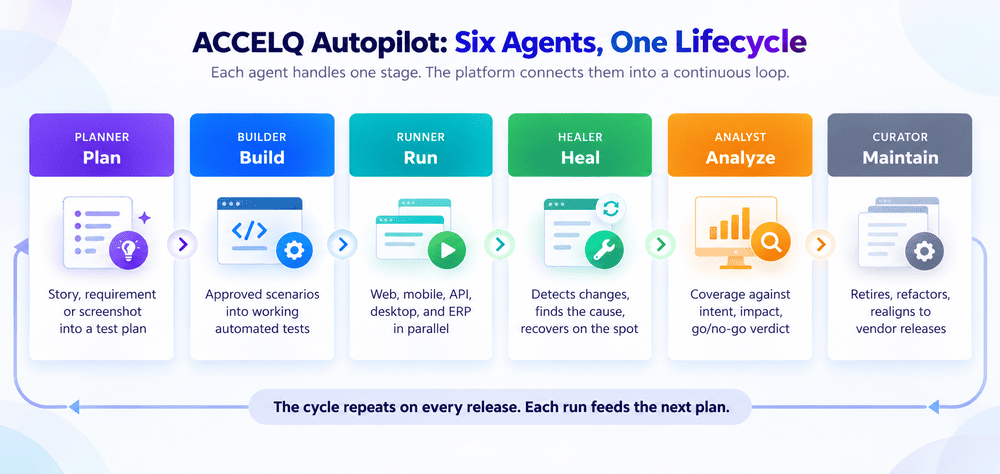
ACCELQ Autopilot is built around the adoption sequence above rather than test generation in isolation. Autonomous Discovery maps existing application workflows before generating anything, so test cases start from how the application actually behaves rather than a blind prompt. The Test Case Generator produces test combinations against real data relationships, and Autonomous Healing handles the locator-level maintenance described earlier, updating tests as the application changes rather than letting them break silently.
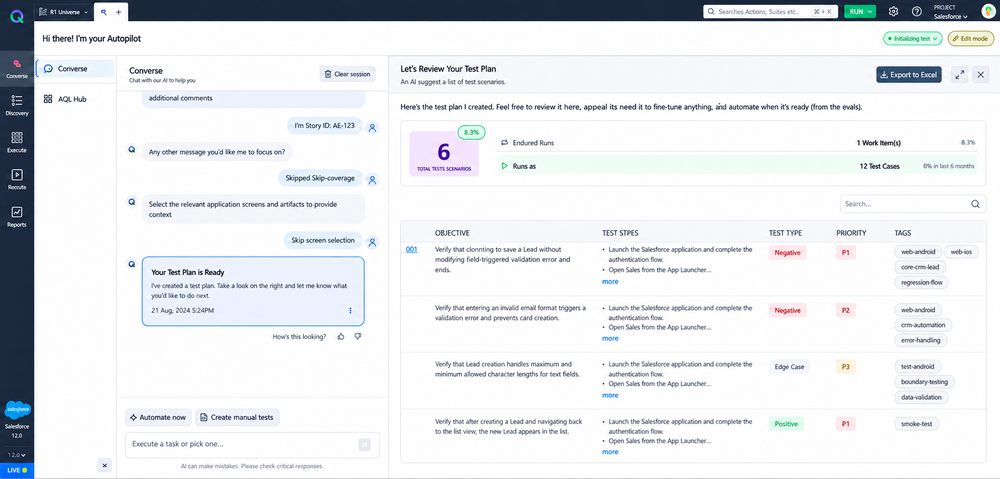
The distinction that matters for a QA Lead evaluating tools: Autopilot’s Logic Insights layer is built to support the verification step this guide argues is non-negotiable, surfacing what changed and why rather than presenting generated tests as a black box to be trusted on faith.
The Forrester Wave for Autonomous Testing Platforms (Q4 2025) scored ACCELQ’s current offering at 3.80, the highest of all 17 vendors evaluated, and named it a Leader. Gartner’s Magic Quadrant for AI-Augmented Software Testing Tools ranked ACCELQ first of ten vendors for the Agile Software Delivery use case.
A top American financial services company, in a published case study, reported test development and maintenance cost per test case falling to one-third after consolidating a patchwork of Selenium, UFT, and Java-based frameworks onto one platform. Multi-day manual regression cycles were reduced to a few hours, running as 378 CI/CD suites.
The Bottom Line
Generative AI in software testing isn’t optional for much longer, but it isn’t a plug-and-play fix either. It earns its place in an enterprise QA workflow the same way any new practice does: by proving it catches what it’s supposed to catch, with a verification step that keeps “the AI generated it” from being mistaken for “it’s correct.”
The teams getting real value aren’t the ones generating the most tests. They’re the ones who built a review gate before they scaled up generation, and can point to a defect-escape number that actually moved because of it.

FAQ's
What are the challenges of using generative AI in software testing?
The main challenges are hallucinated or irrelevant test generation, difficulty interpreting AI-generated failures without added context, governance requirements in regulated industries, and the workflow shift required as testers move from writing tests to reviewing and supervising AI output.
How is generative AI transforming software development processes?
Generative AI has accelerated code development through AI pair-programming and code-generation tools, which has widened the gap between how fast code ships and how fast it can be tested. In testing specifically, it's shifting QA from manual script-writing toward reviewing, verifying, and prioritizing AI-generated test coverage.
How do you verify AI-generated tests before trusting them in production?
Route every generated test through a review gate that checks business-logic accuracy, confirms traceability back to a specific requirement or defect, and feeds any escaped defects back into refining what gets reviewed, rather than adding AI-generated tests to a suite unreviewed.
Is generative AI testing the same as AI-assisted testing?
No. AI-assisted testing means a human still writes and owns the test, with AI help along the way, such as a Copilot-style tool suggesting code. Generative AI testing means the AI produces the test asset itself from a requirement or existing behavior, which a human then reviews rather than writing from scratch.
What's a good first use case for generative AI in QA testing?
Regression testing, specifically self-healing maintenance, is a strong first use case. It's the highest-volume, most repetitive part of many test suites, the failure mode of a broken locator after a UI change is well understood, and it's easier to verify AI output against than a completely novel exploratory test scenario.



Prashanth Punnam
Sr. Technical Content Writer
With over 8 years of experience transforming complex technical concepts into engaging and accessible content. Skilled in creating high-impact articles, user manuals, whitepapers, and case studies, he builds brand authority and captivates diverse audiences while ensuring technical accuracy and clarity.


You Might Also Like:
 AI Automation in Testing: The Future of Smarter, Scalable QA
AI Automation in Testing: The Future of Smarter, Scalable QA
 Agentic AI vs Generative AI: Understanding the Future of AI
Agentic AI vs Generative AI: Understanding the Future of AI
 ChatGPT for Mobile Testing – What It Actually Solves in 2026?