








Agentic AI Governance Framework for Testing: A QA Lead’s Guide

Quick Answer:
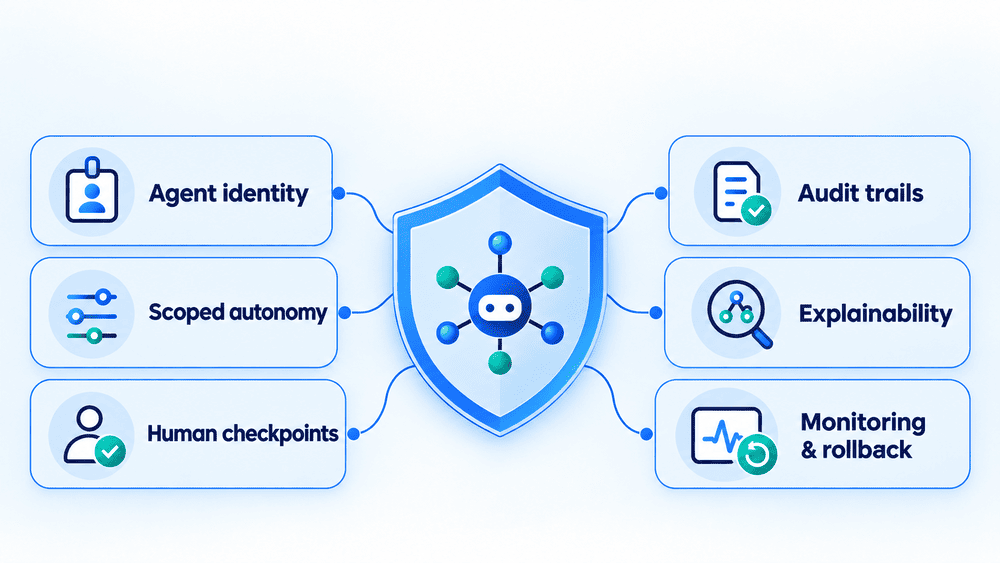
An agentic AI governance framework for testing is the set of policies, ownership rules, and technical controls that define how an autonomous test agent can operate. It lays out what the agent may do without approval, who is accountable when it acts, and how that action is logged for later review. It rests on six pillars: agent inventory and identity, scoped autonomy by risk tier, human checkpoints on consequential decisions, full traceability, explainability, and continuous monitoring with a rollback path. This isn’t general AI governance because the framework must also govern what an agent touches or changes in a live test environment along with the output it produces.
Every QA lead who has piloted an AI agent for testing has been asked this question: if the agent is writing and running these tests on its own, who’s checking its work?
Most teams don’t have a fast answer, which is why “agentic AI governance framework” has become one of the more searched phrases in QA circles this year.
- What Is Agentic AI Governance?
- Why Testing Needs Its Own Governance Layer
- The Standards Backdrop: What Changed in 2026
- The Core Pillars of an Agentic AI Governance Framework
- Best Practices for Governing AI-Generated Test Artifacts
- Building an AI Agent Governance Framework
- Agentic AI Framework Updates to Watch Going Into 2027
- What Governance Looks Like Inside a Platform
- A Starter Checklist for QA Leads
- FAQs
- Diagnose: QA teams are handing test creation, execution, and maintenance to AI agents more often than ever before. But they aren’t always asking who checked the code before it shipped.
- Fix: A working agentic AI governance framework depends on: agent inventory and identity, scoped autonomy, human checkpoints tied to risk, full traceability, and continuous monitoring. NIST, Singapore’s IMDA, and the EU AI Act have all published concrete guidance on this in 2026 alone.
- Third takeaway: Governance is often thought of as the tax you pay for using AI agents in testing. But it’s actually the thing that enables you to scale past a handful of pilots without losing the ability to explain, audit, or roll back decisions agents make.
What Is Agentic AI Governance?
Agentic AI governance is the set of policies, roles, and technical controls that decide what an autonomous AI agent is allowed to do, who is accountable when it acts, and how that action gets recorded so it can be reviewed later.
In testing, it covers what an agent can generate, execute, modify, or approve without a human in the loop, and what has to get a sign-off first.
A GenAI governance framework oversees an assistant that suggests something and waits. Governing an agent means governing something that decides, acts, and moves on to the next task on its own.
A test-writing copilot that a QA engineer accepts or rejects line by line carries a different risk profile than an agent that discovers a schema change, rewrites a regression suite, and pushes it into a pipeline. Most existing QA processes were built for the first kind of tool.
Why Testing Needs Its Own Governance Layer
Enterprise AI governance conversations right now are dominated by shadow AI, agent sprawl, and identity management at the infrastructure level. All of that applies to testing, but it comes with problems a generic enterprise framework won’t catch.
Test agents touch production-like data constantly, which means test data masking and environment isolation must exist inside the governance model. Test agents also make judgment calls that are easy to approve even if wrong. For example, a passing test suite looks like progress even when it’s testing the wrong thing.
That’s the practical case for mandatory review gates on generated tests. A suite can report full requirement coverage and still miss one business rule that determines whether the release was safe.
The Standards Backdrop: What Changed in 2026
If you’re building a governance framework this year, a few developments from 2026 will shape what auditors, regulators, and enterprise customers expect from you.
Singapore’s IMDA launched the world’s first Model AI Governance Framework built specifically for agentic AI. It’s voluntary and the first framework that treats “AI that acts” as a distinct governance problem from “AI that advises,”. It’s built around bounding risk upfront, keeping humans accountable, building in technical controls, and enabling end-user understanding.
NIST opened its AI Agent Standards Initiative in February 2026, run through its Center for AI Standards and Innovation. It sits alongside the existing NIST AI Risk Management Framework, and is specifically focused on agent identity, authentication, and authorization.
Analyst estimates on where this is headed are clear. Gartner has projected that task-specific AI agents will appear in roughly 40% of enterprise applications by the end of 2026. IDC has reported that enterprises are now putting close to 17% of total AI spend directly into agent security and governance.
This isn’t abstract policy reading for a QA lead. It’s the direction procurement, security, and compliance teams are taking, and testing is squarely inside.
The Core Pillars of an Agentic AI Governance Framework
Strip out the jargon, and most credible frameworks stand on the same pillars.
1. Agent Inventory and Identity
Every test agent needs a recorded identity: what it’s authorized to touch, who owns it, and which environment it operates in. This sounds basic until you consider how agents actually enter a QA org: through a platform update, a new integration, or an individual engineer’s experiment, often with nobody tracking it. Treat every agent the way you’d treat a new service account.
2. Scoped Autonomy, Not Blanket Autonomy
Not every agent needs the same amount of freedom. Establish autonomy tiers: an agent that only proposes test cases for human approval sits at a different tier than one that can push a regenerated regression suite into a CI/CD pipeline. Define what each tier is allowed to do without asking, and what requires human approval.
3. Human Checkpoints Tied to Risk
Blanket “human-in-the-loop” policies collapse because reviewing everything an agent does defeats the point of using them. QA teams tend to use a name-on-the-line rule: an engineer defines test intent, a lead approves generated tests before they merge, the original test owner still reviews anything an agent auto-heals, and someone signs off on release risk before a gate opens.
The specific roles can vary by org. The non-negotiable is that a name is attached to every consequential decision by an agent.
4. Traceability and Audit Trails
Every agent action needs to produce evidence along with the result. That means logging what the agent saw, what it decided, what it changed, and why. Instead of just saying, “the agent updated the regression suite,” you can explain to an auditor what it did, even if its six months later.
5. Explainability
If a test agent flags a defect, deprioritizes a scenario, or decides a change doesn’t need revalidation, someone needs to be able to ask why and get a real answer. This requires the agent’s reasoning to be visible in plain language to the reviewer.
6. Continuous Monitoring and Rollback Options
Agents drift. A test-generation agent that performed well against last quarter’s application won’t necessarily behave the same after three major releases. Governance frameworks need built-in ongoing monitoring for anomalous agent behavior. There should also be a straightforward way to pause or roll back an agent’s actions without pausing the whole pipeline around it.

Best Practices for Governing AI-Generated Test Artifacts
Governance frameworks tend to be written at the agent level. The artifacts those agents produce (test cases, scripts, regression suites, defect reports) need their own rules, because this is where most damage happens.
A 2026 study proposing a Governance-Aware Autonomous Testing Framework found that AI-generated test artifacts commonly suffer from hallucinated logic, compliance violations, security risks, and weak explainability when left unchecked.
Their framework layered governance validation, explainability analysis, and compliance monitoring into the testing pipeline and reported an 89.6% reduction in governance-related risk against a baseline. They saw meaningful gains in artifact reliability and compliance accuracy.
Based on that, here are a few practices worth building into your framework:
- Require a coverage map, not just a coverage number. An agent-generated suite can report 100% requirement coverage while missing one essential business rule. Tie every generated test back to the specific requirement or acceptance criterion it’s protecting. Flag anything that doesn’t map cleanly to one.
- Treat duplication as a signal. Agents optimizing for completeness will often generate near-identical scenarios across different user flows. A large suite doesn’t automatically cover everything important.
- Separate authorship from ownership. An agent can write a test. A human still owns whether that test stays in the suite, gets modified, or gets retired. Make that ownership explicit in your test management system.
- Apply the same rigor to auto-healing as you do to new test generation. A self-healing agent patching a broken locator can also be patching over a real regression. Route auto-healed tests through the same review gate as newly generated tests.
 Also Read: AI Agents in Testing
Building an AI Agent Governance Framework
The technical controls only work if someone owns them. Any workable organizational model for agentic testing governance needs three seats at the table:
- QA leadership owns risk-tiering of test agents, defines what needs review, and is accountable for what ships. This is a QA lead’s framework to build because nobody outside testing understands which test failures are noise and which ones are real signal.
- Platform or DevOps engineering owns identity, access control, audit logging, and where in the CI/CD pipeline a human checkpoint gets enforced.
- Security and compliance own the features that touch regulated data, third-party audit requirements, and anything that maps to a framework like NIST’s AI RMF or sector-specific rules.
Agentic AI Framework Updates to Watch Going Into 2027
A few threads are worth tracking, because they’ll likely shift what “good governance” means within the next year or two.
- NIST’s identity and authorization work is still running as an active NCCoE concept-paper project, with public comment on the identity and authorization paper having closed in April 2026. No finalized standard has been published yet.
- Singapore’s IMDA framework, in its May 2026 update (version 1.5) added over ten real-world examples from organizations including AWS, DBS, Google, and PwC. None of them are testing-specific yet.
- The EU AI Act’s high-risk classification is not “fully enforceable” the way it was expected to be by now. The Digital Omnibus on AI (Regulation (EU) 2026/1744), in force since 27 July 2026, pushed the Chapter III high-risk obligations from 2 August 2026 to 2 December 2027 for standalone Annex III systems and 2 August 2028 for Annex I product-embedded systems. Only the Article 50 transparency obligations are still on the original 2026 timeline.
What hasn’t changed is the underlying structure: the Act classifies by application context, not by how autonomously a system behaves. So, where an autonomous test agent lands still depends on what it’s testing.
Watch these as a signal of where the bar is moving. A framework you build now should be able to absorb whatever these initiatives finalize.
What Governance Looks Like Inside a Platform
The pillars discussed above don’t always require a specific AI agent governance platform to implement. They require discipline. But a platform built with governance as an architectural layer makes the discipline easier to sustain.
ACCELQ’s own agentic testing architecture maps cleanly onto the pillars above. It structures its agent system into four layers:
- a perception layer that pulls in real-time signals from logs, APIs, and application changes.
- a reasoning layer that decides what needs testing.
- an action layer that runs the adaptive tests.
- a governance layer responsible for traceability, compliance, and accountability in how the other three layers make decisions.
On top of that, ACCELQ defines four categories of guardrails, covering test data handling, execution safety, decision verification, and reporting transparency. Each is built to catch a different failure mode before it reaches a pipeline.
The platform’s agent framework is also named and scoped deliberately: a discovery agent maps the application, an automation-generation agent builds the tests, a change-analyzer agent handles self-healing, and an execution agent decides what runs and when.
That is exactly what autonomy tiering, described earlier in this piece, looks like when it’s built into a product.
Agentic QA is only as good as the guardrails around it. That’s the whole argument of this article in one sentence, and it’s true whether you use ACCELQ or not.
Also Read: Self-Healing Test Automation
A Starter Checklist for QA Leads
If you’re building this from scratch, start from these:
-
List every AI agent currently touching your test lifecycle, including the ones nobody officially approved.
-
Assign each one an autonomy tier and write down what it's allowed to do without asking.
-
Pick one checkpoint that always requires a name attached before it clears, and enforce it in your tooling.
-
Turn on logging for agent decisions before you turn on logging for agent output.
-
Revisit the whole framework quarterly.
FAQ's
What is Agentic AI governance?
Agentic AI governance is the set of policies, technical controls, and accountability structures that determine what an autonomous AI agent is permitted to do on its own, who is responsible when it acts, and how that action is logged and reviewed. In testing, it governs what agents can generate, execute, or modify without human sign-off, and what requires review.
What are the core pillars of an agentic AI governance framework?
Most credible frameworks stand on the same pillars: agent inventory and identity, scoped autonomy defined by risk tier, human checkpoints tied to important decisions, full traceability and audit logging, explainability of agent decisions, and continuous monitoring with the ability to pause or roll back an agent's actions.
How do companies actually govern agentic AI in practice?
In mature QA organizations, governance is a cross-functional responsibility. QA leadership defines risk tiers and review requirements. Platform or DevOps engineering builds the identity, access control, and audit logging that enforce those tiers. Security or compliance teams own alignment with broader standards like the NIST AI Risk Management Framework or sector-specific regulation.
What are best practices for governing AI-generated test artifacts?
Tie every AI-generated test back to a specific requirement so coverage numbers reflect real risk. Treat near-duplicate generated tests as a warning sign. Keep authorship and ownership separate; an agent can write a test, but a named person decides whether it stays in the suite. Apply the same review rigor to auto-healed tests that you apply to newly generated ones.
Are there any successful case studies of agentic AI governance?
Full, independently documented case studies specific to testing are still rare, since this is a young field where most available evidence is analyst survey data and framework proposals. Regulatory bodies like Singapore's IMDA are actively collecting these case studies now. What does exist is platform-level adoption data, including analyst recognition and reported customer benchmarks. It isn't a substitute for independent research, but it offers ideas on which direction governance is headed.
How is agentic AI governance different from general AI governance?
General AI governance frameworks are largely built around models that generate output for a human to review and approve. Agentic AI governance has to account for systems that decide and act on their own, often across several steps, before a human sees the result. For testing specifically, that means governing agent responses along with everything it can touch, change, or execute along the way.



Nishan Joseph
VP Sales Engineering
Nishan is a tech strategist with expertise in Test Automation and roles at giants like TCS, Microfocus, and Parasoft. At ACCELQ, he champions Strategic Alliances, cultivating global tech partnerships. Educated at Leeds University and Symbiosis Pune, he also possesses an engineering background from Bangalore.


You Might Also Like:
 Why AI Isn’t Replacing Testers? It’s Empowering Them
Why AI Isn’t Replacing Testers? It’s Empowering Them
 Role of AI and ML in Test Automation
Role of AI and ML in Test Automation
 Reimagine ServiceNow Testing with AI-Powered Codeless Automation