








API Contract Testing: Techniques, Tools, and Best Practices

A payment provider added one new field to its response payload during a routine Tuesday deploy. Nothing was removed, so nobody flagged it as breaking. Three services downstream, a reconciliation job started failing silently within two hours of the release, and nobody noticed until finance flagged a mismatch the next morning.
That is the exact failure mode API contract testing exists to catch: a change that passes every functional test and still breaks something, because nobody wrote down what the two sides had actually agreed to.
Quick Answer:
API contract testing verifies that the request and response format a consumer and a provider agreed on stays intact across changes, catching breaking changes such as removed fields, renamed keys, or altered data types before they reach production. It differs from functional or integration testing, which checks whether an API works, not whether it still honors the agreement other services depend on.
- What Is API Contract Testing?
- Why Is an API Contract Important for API Development?
- API Contract Testing Examples
- What Are the Main API Contract Testing Techniques?
- How Do You Write Contract Tests for APIs?
- API Contract Testing Tools
- What Are the Best Practices for API Contract Testing?
- Best Practices for Versioning in API Contract Testing
- What "Breaking" Means in API Contracts
- How Does API Contract Testing Fit Into Test Automation?
- The Bottom Line
API failures rarely happen because an API stops working. They happen when one service changes something that another service silently depends on. A renamed field, altered data type, or modified response structure can pass functional testing and still break downstream applications, causing failed transactions, data sync issues, or production incidents. API contract testing prevents this by turning assumptions between consumers and providers into automated agreements that are validated throughout the development lifecycle.
- Understand the Real API Dependency Risk: Functional testing checks whether an API works, while contract testing verifies that both sides continue following the agreed interface, including endpoints, request/response formats, headers, and status codes.
- Apply the Right Contract Testing Strategy: Schema validation protects API structures, consumer-driven contracts ensure providers meet consumer expectations, provider-driven contracts validate published API agreements, and mock servers enable testing before dependencies are available.
- Move Contract Checks Into CI/CD: Automated contract validation catches breaking changes early, reduces dependency on fragile end-to-end testing, and enables teams to release independently with confidence. ACCELQ brings contract, functional, and API automation together in one unified pipeline.
What Is API Contract Testing?
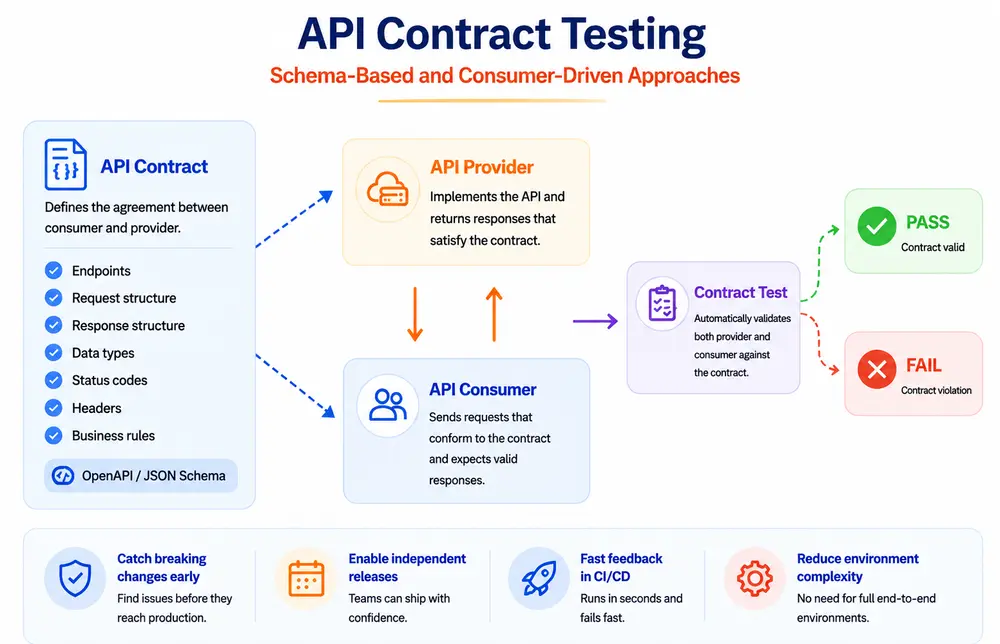
API contract testing verifies that two services, a consumer and a provider, continue to agree on how they communicate. The contract defines the expected endpoints, HTTP methods, request and response formats, data types, headers, and status codes, allowing teams to detect interface changes before they break dependent services.
Unlike functional testing, it does not primarily verify whether an API’s business logic works correctly. Instead, it ensures that the API continues to match the interface its consumers expect, even when the underlying implementation changes.
An API contract typically covers:
- Endpoints: The URLs available for interaction, such as /users or /orders.
- HTTP methods: The operations supported by an endpoint, such as GET, POST, PUT, or DELETE.
- Request and response formats: The expected structure and data types of API requests and responses, commonly JSON or XML.
- Headers: Metadata included in API requests or responses, such as Authorization and Content-Type.
- Status codes: Expected HTTP responses, such as 200 OK, 404 Not Found, or 500 Internal Server Error.
- Error responses: How the API communicates failures and validation errors.
This becomes especially important in microservices architectures, where multiple services depend on the same APIs. A seemingly small change, such as renaming or removing a response field, can break downstream consumers even when the provider’s own functional tests continue to pass.
Why Is an API Contract Important for API Development?
A contract turns an informal assumption (“the response will always include a status field”) into something a test suite can actually check, on every build, automatically.
Without a documented and enforced contract, teams rely on tribal knowledge, a shared Slack thread, or a hallway conversation to know what an API guarantees. That knowledge does not scale past a handful of services, and it does not survive team turnover, which is part of why common API testing mistakes so often trace back to an assumption nobody wrote down.
A contract matters for three concrete reasons:
- It catches breaking changes before they reach staging: A provider team can run consumer contracts against their own build, in their own pipeline, before a consumer ever sees the change.
- It decouples release schedules: Teams can ship independently instead of coordinating a synchronized deploy, because the contract, not a shared calendar, is what keeps both sides honest.
- It replaces expensive end-to-end tests with something faster: A full integration environment with every dependent service running is slow and flaky. A contract test runs in isolation, in seconds, with no shared environment required.
API Contract Testing Examples: How It Prevents Integration Failures
Example 1: Payment Gateway Integration – Preventing Checkout Failures
The Contract: An online shopping platform depends on a payment gateway API that returns a 200 OK response with a transaction_id, amount, and currency after a successful payment.
The Breaking Change: The payment provider updates its API response and renames transaction_id to txn_id.
Without Contract Testing: The checkout application cannot process the updated response format, causing payment failures and impacting customer purchases.
With Contract Testing: The contract test detects the response mismatch during CI/CD validation, blocks the breaking release, and allows teams to fix the issue before it reaches production.
Example 2: CRM API Integration – Protecting Customer Data Synchronization
The Contract: A CRM platform exposes an API that accepts a PUT /api/v1/clients/{client_id} request with client_name, client_email, and client_phone, then returns the updated customer record.
The Breaking Change: A schema update removes or renames one of the expected fields in the API request or response.
Without Contract Testing: Connected applications receive unexpected data structures, causing failed updates, inaccurate records, and customer support issues.
With Contract Testing: The contract validation catches the schema change in the development pipeline, ensuring both systems continue communicating correctly before deployment.
What Are the Main API Contract Testing Techniques?
| Technique | How It Works | Example |
|---|---|---|
| Schema validation | Checks that a request or response structure matches a predefined schema, typically an OpenAPI or JSON Schema definition. | A GET /users request must return a list where every object includes id and name. |
| Consumer-driven contract testing | The consumer defines its expectations as an executable contract, and the provider verifies it can satisfy that contract on every build. | A checkout service defines that the payment API must return an order_id and a status field; the payment team runs that contract against their own code before releasing. |
| Provider-driven contract testing | The provider publishes the contract, and consumers verify their integration against it. | A weather API specifies that GET /weather always returns temperature in Celsius; client teams test against that published contract. |
| Mock servers | Simulates the provider so a consumer team can test against a stand-in before the real service is ready or available. | A frontend team builds against a mocked payment gateway while the real integration is still in development. |
Consumer-driven contract testing was formalized by Martin Fowler’s original service-evolution pattern description and popularized in practice by tools like Pact, which remains one of the most widely adopted implementations for cross-language teams.
How Do You Write Contract Tests for APIs?
-
Map the consumer-provider pairs. List every service-to-service integration point before writing a single test; you cannot test a contract you have not identified.
-
Choose a contract format. Schema-first teams typically define contracts using the OpenAPI Specification; consumer-driven teams generate contract files directly from test runs using a tool like Pact.
-
Define the expected interaction. For each endpoint, specify the request shape, the response shape, required fields, data types, and status codes, not just a happy-path example.
-
Write the consumer test. The consumer test runs against a mock of the provider and, in consumer-driven tooling, generates a contract file as a byproduct of the test itself.
-
Verify on the provider side. The provider runs the published contract against its real implementation, confirming it still satisfies every consumer’s expectations.
-
Publish contracts to a shared broker. A central broker (such as the Pact Broker) gives both teams visibility into which contracts are active and which versions are compatible.
-
Wire verification into CI/CD. A broken contract should fail the build, the same way a failing unit test would, not surface as a warning someone reviews later.
API Contract Testing Tools
Contract-specific tools solve a narrower problem than general-purpose API testing tools, which is why most teams end up running both side by side.
| Tool | Best For |
|---|---|
| ACCELQ | Unifying contract, functional, and API test automation in one pipeline instead of maintaining separate tools for each. |
| Pact | Consumer-driven contract testing across multiple languages, with a broker for sharing and versioning contracts. |
| Postman/Newman | Schema and collection-based contract checks integrated into existing API testing workflows. |
| Swagger/OpenAPI validators | Schema-first contracts defined directly from an OpenAPI document. |
| WireMock | Simulating a provider’s responses so consumer teams can test without a live dependency. |
| Spring Cloud Contract | Consumer-driven contract testing native to JVM-based microservices. |
What Are the Best Practices for API Contract Testing?
- Give every contract a named owner. A contract with no clear owner on either side eventually goes stale, because nobody notices when it stops matching reality.
- Run contract tests on every pull request, not on a nightly schedule. A contract break caught the next morning has already been merged, and possibly deployed.
- Treat a failed contract test as a blocking failure, not a warning that gets acknowledged and ignored.
- Store contracts in version control alongside the code they describe, so a contract change is reviewed the same way a code change is.
- Test the agreed interface, not the implementation. A contract test should not care how a value is calculated, only that its shape and type match what was agreed.
SUGGESTED READ - API Testing Strategy: The Complete Guide for QA Teams
Best Practices for Versioning in API Contract Testing
Versioning is where most contract testing efforts quietly fall apart. A few practices keep it from becoming a liability:
- Use semantic versioning for the contract itself, not just the API. A backward-compatible addition (a new optional field) is a minor change; removing or renaming a field is a major, breaking change, even if the endpoint URL stays the same.
- Never remove a field a consumer still depends on without a deprecation window. Mark it deprecated, communicate a sunset date, and confirm through contract tests that no active consumer is still relying on it before removal.
- Version the contract, not just the code. Two consumers on different contract versions should be able to coexist during a migration instead of forcing a synchronized cutover.
- Automate the check for “is anyone still using this.” Contract verification results, not guesswork, should determine whether a field is safe to retire.
Why AI Agents Are Rewriting What “Breaking” Means in API Contracts
Contract testing was built on an assumption that is quietly becoming outdated: that a human developer reads the documentation, notices an ambiguous field, and asks a question before writing code against it. An AI agent calling your API through the Model Context Protocol does not ask that question. It reads your schema at runtime and decides, in a loop, which fields to rely on, with no developer in the middle to catch a misread assumption
That changes what “safe to change” means for a contract specifically. A field marked optional, one a human developer might reasonably ignore, can still be something an agent has started depending on to make a decision. A provider team assuming nobody uses an undocumented field discovers otherwise only when agent behavior breaks in production, not in a code review, because there was no code review to catch it.
This is the strongest argument for enforcing your contract in CI rather than treating it as descriptive documentation. A schema that is only reviewed by people can tolerate an ambiguous or undocumented field for years without incident. A schema that is read and acted on directly cannot, and a contract test is the only check standing in that gap.
How Does API Contract Testing Fit Into Test Automation and CI/CD?
Contract tests are deliberately lightweight compared to full integration tests, which is what makes them practical to run on every commit rather than on a nightly schedule.
- Faster feedback loops. A contract test runs in isolation against a mock, not a live dependency chain, so failures surface in seconds rather than after a full end-to-end suite finishes.
- Lower maintenance overhead. As long as the contract itself is valid, automated tests built against it are less likely to break from unrelated implementation changes.
- Shift-left by default. Contract verification happens before integration testing, catching mismatches at the earliest and cheapest point in the pipeline.
Platforms like ACCELQ’s Autopilot fold contract verification into the same pipeline as functional and API test automation, so a broken contract and a broken feature surface through the same release gate instead of two disconnected tools.
The Bottom Line
API contract testing turns an unwritten assumption between two services into something a build can actually enforce. That matters more, not less, as the traffic hitting your API increasingly comes from other software, whether that is a downstream microservice, a partner integration, or now an AI agent reading your schema and acting on it directly.
Teams that version their contracts deliberately, enforce them in CI rather than reviewing failures after the fact, and treat the schema as a contract rather than a suggestion catch these breaks before a customer, a partner, or an agent does. If your team is managing contract, functional, and API testing across separate tools, ACCELQ brings all three into one pipeline instead of three.
Your API contracts deserve a CI gate, not a Slack apology. Contact ACCELQ
FAQ's
What is API contract testing?
API contract testing verifies that the request and response formats two services agreed on remain consistent across changes. It catches breaking changes, such as removed fields or altered data types, before they reach production.
Why is an API contract important for API development?
An API contract replaces tribal knowledge with an automated, enforceable check. It helps teams catch breaking changes early, release services independently without synchronized deployments, and reduce the need for expensive full end-to-end test environments.
What is the difference between contract testing and integration testing?
Contract testing checks whether the interface between two services, including request and response structures, still matches what both sides agreed on. Integration testing checks whether the services work correctly together, including business logic and behavior beyond just the data format.
What are the best tools for API contract testing?
Pact is one of the most widely used tools for consumer-driven contract testing across multiple languages. Postman, Swagger/OpenAPI validators, WireMock, and Spring Cloud Contract cover different parts of the workflow, including schema validation and provider simulation.
How do you write contract tests for APIs?
Start by mapping every consumer-provider integration point. Choose a contract format such as OpenAPI or a Pact-generated contract file, define the expected request and response structure for each interaction, then verify the contract on both consumer and provider sides. Integrate verification into CI so failures block the build.
What are the best practices for versioning in API contract testing?
Use semantic versioning for contracts, avoid removing fields that consumers depend on without a deprecation window, allow multiple contract versions during migrations, and use verification results to confirm whether a field is safe to retire.




You Might Also Like:
 API Testing Strategy: Core Pillars, Steps, and Tools
API Testing Strategy: Core Pillars, Steps, and Tools
 Contract testing and its role in Microservices
Contract testing and its role in Microservices
 What are Mocking and Stubbing in API Testing? A Beginner’s Guide