








A Deep Dive into API Contract Testing

Whether you are building a web app, a mobile app, or working with microservices, chances are your software relies on multiple APIs. They allow systems to share data and work as one. But as teams grow and services multiply, the risks of something breaking increase.
A minute change in the structure of API’s, such as renaming a field or altering a response format, can cause failures. These failures are often discovered late in the testing cycle or after deployment, leading to broken integrations and frustrated users. That is where API contract testing comes in. It provides safety by ensuring that APIs behave exactly as expected and that changes do not break the agreement between teams.
- What is API Contract Testing?
- Why is API Contract Testing Important?
- How Does API Contract Testing Work?
- API Contract Testing Examples
- API Contract Testing Techniques
- Role of API Contract Testing in Test Automation
- Impact of API Contract Testing on Test Automation
- Contract Testing vs Integration Testing
- Best Practices for API Contract Testing
- Conclusion
What is API Contract Testing?
Contract testing is a specialized form of API testing. It focuses on verifying how well applications or services communicate with one another according to their defined contracts. Contract testing ensures that the requests sent and the responses received between these systems match the agreed-upon specifications. While testing contract does involve testing APIs, its primary focus is on the integration point and how the API interacts with other applications or services.
Why is API Contract Testing Important?
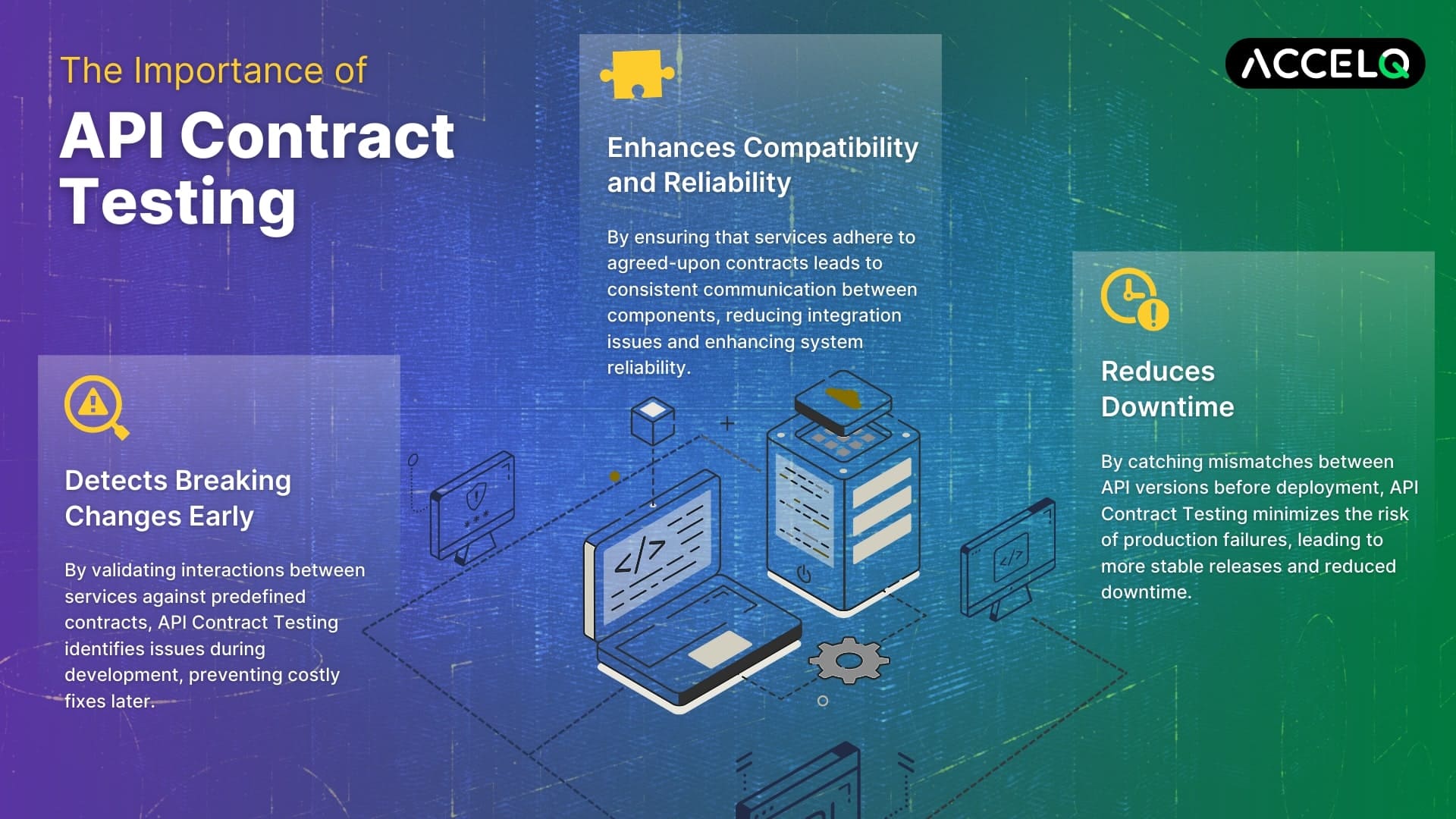
Detects breaking changes early
One of the main benefits of API contract testing is that it aids in discovering breaking changes early. It is majorly critical in fast-paced development environments where APIs change regularly.
For instance, suppose a development team changes the format of a response in one service. In that case, contract testing will immediately flag this, ensuring other services that depend on the API won’t suddenly break due to unexpected changes.
Drives collaboration
It improves collaboration among the development, QA, and operations teams. For example, contract testing ensures that API updates don’t disrupt the CI/CD pipeline in a DevOps setup. Validating service interactions in the beginning helps teams stay aligned, reducing the integration issues at later stages.
Reduces downtime
API contract testing can reduce downtime caused by mismatches between API versions, providing peace of mind that services can integrate without issues during production releases. Imagine a production failure caused by a mismatched API version during a release. Without API contract testing, such issues often go unnoticed until deployment, leading to significant downtime.

How Does API Contract Testing Work?
The process involves an API Provider (Producer), which is the team or service that develops and exposes the API. API Consumer, any client (frontend, service, or app) that uses the API.
The testing flow usually involves:
Step 1: Define the contract
This includes details like:
- Endpoints
- HTTP methods (GET, POST, etc).
- Input and output schemas.
- Expected status codes.
- Headers.
Frameworks such as OpenAPI, and Swagger are used to specify the contract.
Step 2: Validate provider implementation
When the provider implements the API, the implementation is validated against the specified contract. Deviation such as missing property, incorrect data type, incorrect status code makes the api contract test fail.
Step 3: Validate consumer expectations
In consumer-driven contract testing, the consumer specifies its expectations from the provider. They are translated into tests that the provider has to pass. This assures that the API is meeting actual usage requirements.
Step 4: Continuous integration
Contracts are validated in CI builds so that regressions can be found by testers as early as possible. This integrates contract testing as a natural part of DevOps pipelines.
API Contract Testing Examples
1. A contract between an online shopping platform (consumer) and a payment gateway service (provider). The API contract defines that the payment service will return a 200 OK response and payment details. By implementing contract testing, the shopping platform ensures that changes made by the payment provider do not break the integration. If a mismatch occurs, the test will flag the issue, allowing developers to address it before the system goes live.
2. A contract for updating client information between a B2B SaaS CRM platform (consumer) and its API (provider). According to the API contract, fields like client_name, client_email, and client_phone must be added in a PUT request to the endpoint /api/v1/clients/{client_id}. The API should reply with the updated client data and an exchange of 200 OK status.
API Contract Testing Techniques
| Technique | Description | Example |
|---|---|---|
| Schema Validation | Ensures the API request/response structure matches the predefined schema or contract. | GET /users returns a list of users with required fields such as id and name. |
| Consumer-Driven Contract Testing | Consumers define expectations, and providers ensure their API behavior conforms to those expectations. | A shopping app defines that a payment API must return order status with details after checkout. |
| Provider-Driven Contract Testing | Providers define the contract, and consumers adapt their implementation based on it. | A weather API provider specifies that GET /weather returns temperature in Celsius. |
| Mock Servers | Simulate the provider’s API, enabling consumers to test API interactions without depending on the real service. | A frontend team tests a checkout UI against a mock payment gateway to validate expected responses. |
| Bi-Directional Contract Testing | Compares provider and consumer contracts to verify compatibility and avoid integration issues. | Useful when integrating third-party APIs or API gateways to ensure both sides align on capabilities and expectations. |
Role of API Contract Testing in Test Automation
API contract testing helps streamline and enhance the accuracy of automated tests in the following ways:
- Defines expectations: Contract testing acts as a reference point for test automation frameworks by providing clear definitions of what an API is expected to do. It ensures that both API consumers (test cases) and API providers (code) work from the same contract.
- Detection of issues: Automated contract testing detects deviations in the API’s structure or behavior early in development. This approach reduces the risk of broken integrations or failures after testing phases, such as integration or end-to-end tests.
- Automate testing workflows: By integrating contract tests into CI/CD pipelines, teams can automate the validation of API changes whenever code is pushed. So, ensuring that breaking changes are detected automatically before they impact production.
Impact of API Contract Testing on Test Automation
API contract testing helps streamline and enhance the accuracy of automated tests in the following ways:
- Faster feedback: Contract tests are lightweight and typically faster to execute than functional or integration tests. Quicker feedback in the automated testing cycle allows developers to address issues immediately.
- Reduced maintenance: API contracts clearly define expectations, making automation tests easier to maintain. Automated tests are less likely to break with minor API changes as long as the contract remains valid.
- Enhanced coverage: Contract testing provides a foundational layer of validation, ensuring that all services adhere to the contract. It supports other automated tests, such as functional and performance tests, leading to comprehensive test coverage.
- Shift-left testing: API contract testing provides early-stage automated testing, commonly referred to as shift-left testing. Developers and testers can automate contract tests before integration testing, resulting in fewer late-stage issues and integration issues.
Contract Testing Vs Integration Testing
Contract testing focuses on checking that the contracts between an API provider and consumer are correctly implemented. Integration testing validates that modules function together as a system. Contract testing safeguards compatibility, while integration testing ensures functional harmony across systems. Together, both approaches provide complete coverage.
| Aspect | Contract Testing | Integration Testing |
|---|---|---|
| Purpose | Validate API contract adherence between consumer and provider. | Validate workflows and interactions between fully integrated services. |
| Scope | Focus on communication rules: schemas, fields, and expected responses. | Focus on end-to-end interactions across systems and modules. |
| Speed | Fast; runs pre-deployment using stubs or mocks. | Slower; executed post-deployment with real environments. |
| Dependencies | Does not require live services—runs independently. | Requires real services, databases, and infrastructure. |
| Failure Impact | Provides early warnings before actual integration. | Detects real runtime issues after services are connected. |
| Use Case | Validating schemas, endpoints, response formats, and provider expectations. | Testing business logic, workflows, and cross-service data flow. |
 Also Read: End-to-End Testing Vs Integration Testing
Best Practices for API Contract Testing
Effectively implementing API contract testing involves applying a set of best practices. These sets of practices ensure that different aspects of the testing process are efficient and reliable and support the overall goals of software development.
- Clear Contracts: Ensures an unambiguous understanding of API interactions.
- Version Control: Tracks changes and maintains compatibility.
- Automation: Enhances efficiency and integration in CI/CD pipelines.
- Regular Updates: Keeps contracts relevant and accurate.
- Team Collaboration: Promotes mutual understanding and reduces discrepancies.
- Tool Selection: Streamlines the contract testing process.
Conclusion
API contract testing is crucial for securing the stability and reliability of services interconnected with an application. Contract testing sets the standards for communication between service providers and consumers, but yes, that too is much needed and must be followed by team members to prevent failed integrations of pieces from getting together, which might be expensive in terms of downtime affecting user experience.
Adding API contract testing to the CI/CD pipeline means teams can catch problems earlier, giving them a cost-effective opportunity to fix mistakes before they disrupt production environments.
As software systems continue to become more complex, API contract testing is an essential method. ACCELQ, for example, centralizes its contract testing within an all-encompassing automated ecosystem complete with requisite coding structures. It allows your teams to work together and cuts down on wasted time. Developers and the QA teams can develop trustworthy, future-proof APIs by using best practices. To learn more about ACCELQ, click here.



Chaithanya M N
Content Writer
A curious individual who is eager to learn and loves to share her knowledge using simple conversational writing skills. While her calling is technology and reading up on marketing updates, she also finds time to pursue her interests in philosophy, dance and music.

You Might Also Like:
 Contract testing and its role in Microservices
Contract testing and its role in Microservices
 How to test gRPC API
How to test gRPC API
 Top API Testing Mistakes and How to Avoid Them